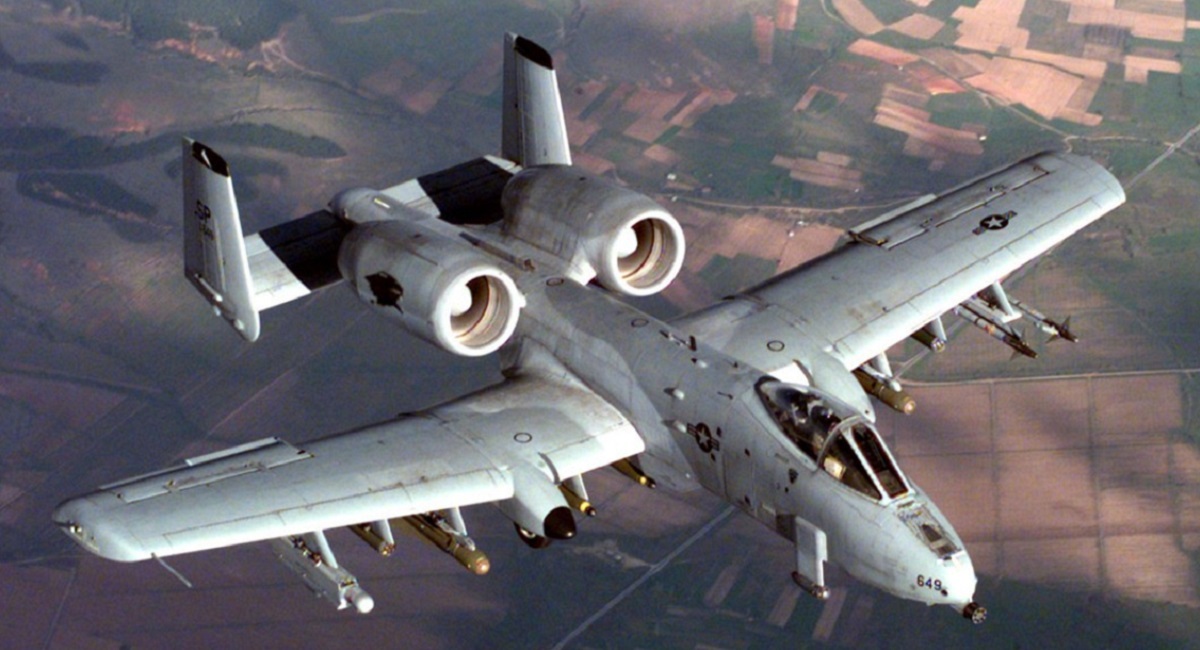
The A-10A Thunderbolt II entered serial production in 1975, and on September 30 of the following year, the first aircraft were officially accepted into service by the United States Air Force Tactical Command. Production rates were relatively high, peaking at 13 aircraft per month. By 1984, a total of 715 units had been built, including two prototypes and six pre-production aircraft. Notably, after production ended, the manufacturing tooling for the A-10A was not scrapped. Instead, it was transferred to the Davis-Monthan Air Force Base in Arizona for storage, in case production needed to be resumed under mobilization conditions.
Read also:
- First American Attack Aircrafts: Development Path, Part 1
- First American Attack Aircrafts, Part 2: Alternative Projects of the Early 1920s
- American Attack Aircraft, Part 3: The First Production Variants
- First American Attack Aircraft, Part 4: On the Eve of the 1930s
- First American Attack Aircraft, Part 5: Production A-12 “Shrike”
- American Attack Aircraft, Part 6: Experiments of the 1930s
- American Attack Aircraft, Part 7: John Northrop’s “Gamma”
- American Attack Aircraft, Part 8: Contribution of Gerard Valtí
- American Attack Aircraft, Part 9: Northrop A-17
- American Attack Aircraft, Part 10: Douglas Export Models
- American Attack Aircraft, Part 11: Near-Bomber Designs of the Second World War
- American Attack Aircraft, Part 12: Lessons from the Luftwaffe
- American Attack Aircraft, Part 13: New Generation, the Precursors to the A-10A
TABLE OF CONTENT:
Variants
The single-seat A-10A Thunderbolt II became the only production variant of the aircraft. Contrary to common U.S. practice, which often included two-seat training or combat variants for single-seat fighters, no dual-seat version was initially produced for the A-10.
A two-seat trainer variant, the A-10B Thunderbolt II, was ordered by the U.S. Air Force in 1981, but funding was subsequently canceled by Congress, and the aircraft never entered production. As a result, initial pilot training relied on a two-aircraft approach: a trainee in one A-10 and an instructor in a second aircraft, supervising the trainee’s actions.

A two-seat version of the Thunderbolt II was eventually developed, but it was not intended as a trainer. The A-10 Night Adverse Weather (N/AW) was designed as an all-weather combat variant, with the second cockpit occupied by a weapons systems officer responsible for electronic countermeasures (ECM), navigation, and target acquisition.
The demonstrator for this variant was converted from the first pre-production A-10A. However, the N/AW version failed to attract interest from either the U.S. Air Force or foreign buyers, and the prototype was ultimately retired to a museum.
Upgrades
During its service, the A-10A Thunderbolt II underwent limited modifications. In the 1980s, its electronic countermeasures (ECM) equipment was updated twice, incorporating more advanced individual aircraft protection systems.
U.S. Air Force leadership initially viewed the A-10 as a highly specialized aircraft, with plans to replace it in attack units with a ground-attack variant of the F-16, designated the A-16. In anticipation of this, approximately 250 Thunderbolt II aircraft were transferred between 1989 and 1991 from attack squadrons to forward air control squadrons, replacing turboprop OV-10A aircraft.
This adaptation, designated the OA-10A, differed from the base model only by the addition of specialized marker pods for designating ground targets. However, two factors extended the operational life of the A-10: its successful performance during the Gulf War and the cancellation of the A-16 program due to post–Cold War defense budget reductions. As a result, the Thunderbolt II remained in service as a dedicated attack aircraft.
Modernization to A-10C
Between 2005 and June 2011, the entire fleet of 356 existing A-10A/OA-10 aircraft was upgraded under the Precision Engagement program. Aircraft receiving the upgrade were redesignated as A-10C Thunderbolt II.
The A-10C gained all-weather combat capability, an improved fire-control system, enhanced electronic countermeasures, and the ability to employ precision-guided munitions using targeting pods such as the AN/AAQ-28(V)4 LITENING AT or Sniper XR. Communication systems were upgraded to include Link 16 data exchange and satellite links.
The cockpit was fully modernized, now featuring two multifunction displays and a HOTAS (hands-on throttle-and-stick) control layout. The control stick was adapted from the F-16, while the engine throttle lever was derived from the F-15.
Service in the U.S. Air Force
Although designed as an attack aircraft, the A-10A Thunderbolt II was initially assigned to tactical fighter units. This created an unusual situation: the U.S. Air Force possessed dedicated attack aircraft, but no separate branch of attack aviation.
The first operational units equipped with the A-10A were training wings. These included the 355th Tactical Fighter Wing (TFW) at Davis-Monthan Air Force Base, responsible for pilot training, and a single squadron of the 57th TFW at Nellis AFB, Nevada, tasked with developing combat employment tactics. Combat wings subsequently received the aircraft, with two three-squadron wings based in the continental U.S.: the 354th TFW at Myrtle Beach, South Carolina, and the 23rd TFW at England AFB, Louisiana. The latter was part of the rapid deployment forces, primarily supporting the 18th Airborne Corps.
In spring 1978, A-10A re-equipment began for U.S. Air Force units in Europe, specifically the 81st TFW. In peacetime, six squadrons of this wing (108 A-10A aircraft in total) were stationed at Bentwaters and Woodbridge air bases in the United Kingdom. In the event of conflict with the Soviet Union, they were planned to relocate to six forward airfields in West Germany.
Additional squadrons were deployed in Alaska (the 18th Squadron of the 343rd Composite Wing, receiving A-10As in 1981) and the Republic of Korea (the 25th Squadron of the 51st TFW, re-equipped in 1982). Several Air National Guard squadrons were also equipped with Thunderbolts.
Read also:
- Pilatus Turboprop Aircraft: An Overview of PC-9
- All About Lightweight Patrol and Counter-Drone Aircraft “Draco”: Reincarnation of Iconic “Vilga”
Combat Employment
During Operation Desert Storm in January–February 1991, 144 A-10A Thunderbolt II participated, drawn from a total of 572 aircraft available in active and reserve units at the time. In the early days of the conflict, A-10As operated in large formations under the protection of fighter aircraft and electronic warfare planes, striking Iraqi radar sites and surface-to-air missile (SAM) positions. Later, one of their primary missions became targeting mobile Scud ballistic missile launchers.
By late January, A-10As were shifted to attacks against Iraqi ground forces in occupied Kuwait. The density of short-range air defense systems, notably the ZSU-23-4 “Shilka,” limited the use of the Thunderbolt II’s primary weapon, the GAU-8/A cannon. Instead, AGM-65 Maverick missiles were widely employed, allowing strikes from outside the range of Shilka defenses. Of the 5,296 Mavericks fired during the operation, 5,013 were launched by A-10As. Approximately one-third of combat sorties were conducted at night. Because the aircraft lacked night vision equipment at the time, Maverick missile seekers were used to locate targets, with the imagery displayed on cockpit monitors.
Overall, during Desert Storm, A-10As flew roughly 8,000 combat sorties, destroying 987 tanks, 501 armored vehicles, over 1,100 artillery pieces, 11 mobile Scud launchers, and numerous other targets, including two helicopters shot down by the aircraft’s onboard guns. U.S. losses amounted to five A-10As shot down by enemy air defenses. Another 73 aircraft sustained various levels of damage, with three so severely damaged that they were written off.
Later Combat Operations
In 1999, 43 A-10A Thunderbolt II participated in Operation Allied Force against Yugoslavia. The aircraft operated from Italian bases at Aviano and Trapani. In addition to battlefield strike missions, a key role for the Thunderbolt II during this campaign was support for search-and-rescue operations.
In April 2003, during Operation Iraqi Freedom, 60 A-10As from three squadrons – two active-duty and one Air National Guard – were deployed. The aircraft initially operated from Ali Al Salem Air Base in Kuwait, with part of the force later relocated to Talil Air Base in Iraq. During this operation, the A-10s employed LANTIRN targeting pods for the first time, enabling the use of laser-guided bombs.
Alongside conventional strike missions, the aircraft flew 32 leaflet-dispensing sorties. One A-10A was lost, shot down over Baghdad International Airport. In the fall of 2007, the upgraded A-10C Thunderbolt II made its combat debut in Iraq.
The Thunderbolt II also participated in operations in Afghanistan, primarily operating from Kandahar Air Base. Across the Second Iraq War and operations in Afghanistan, A-10s accounted for roughly 32% of all combat sorties conducted.
In spring 2011, six A-10C Thunderbolt II participated in combat operations against Libya. Since October 2014, A-10s have been employed in strikes against positions held by the Islamic State in Syria and Iraq.
Current Status
As of 2023, the U.S. Air Force operated 135 A-10C Thunderbolt II, with 85 assigned to the Air National Guard and 61 to the Air Force Reserve. These aircraft were flown by five active-duty squadrons (excluding test units): the 74th and 75th of the 23rd Wing at Moody AFB, Georgia; the 354th and 357th (training-combat) of the 355th Wing at Davis-Monthan AFB, Arizona; and the 25th of the 51st Wing at Osan Air Base, Republic of Korea. The Air National Guard operated four A-10C squadrons, and the Air Force Reserve had three.
By mid-2025, two active-duty squadrons (354th and 25th) were deactivated, and the National Guard retained only two squadrons: the 107th in Michigan and the 190th in Idaho. While discussions about retiring the A-10C have occurred repeatedly, operational experience in Middle Eastern conflicts has demonstrated the continued utility of the aircraft. Current USAF plans call for their retirement between 2028 and 2029. In late February 2026, it was reported that the Ogden Air Logistics Complex was preparing to conduct the final maintenance on the A-10 fleet before their removal from Hill Air Force Base.
The Thunderbolt II was never exported due to its highly specialized role. U.S. allies generally preferred multi-role fighters over dedicated close air support aircraft. In the early 1990s, the transfer of 50 surplus A-10As to Turkey was considered but never implemented.
Following the large-scale Russian invasion of Ukraine in 2022, some observers suggested supplying A-10s to Ukraine under Lend-Lease. In an interview in December 2022, Ukrainian Defense Minister Oleksii Reznikov stated that he had requested 100 surplus A-10s from U.S. Secretary of Defense Lloyd Austin at the end of March, emphasizing their value against Russian armored columns. Austin reportedly responded that the plan was “impossible” and that the “outdated and slow” A-10 would be “an easy target” for Russian air defenses. However, given the rapid development of unmanned warfare in the Russia–Ukraine conflict, the A-10’s potential role in drone defense could have extended its operational relevance.
Read also: