After the Second World War, the evolution of attack aviation in the U.S. Air Force was effectively interrupted, and attack aircraft as a distinct branch were formally eliminated. The close air support mission had already been largely assumed by fighter-bombers during World War II, and during the Korean War (1950–1953) this category transitioned from piston-engine aircraft to jet-powered platforms. The situation changed with U.S. involvement in Indochina. It became clear that jet fighter-bombers – by then predominantly supersonic – were poorly suited for counterinsurgency operations. At that time, the U.S. Air Force had no more appropriate aircraft available for this role.

Read also:
- First American Attack Aircrafts: Development Path, Part 1
- First American Attack Aircrafts, Part 2: Alternative Projects of the Early 1920s
- American Attack Aircraft, Part 3: The First Production Variants
- First American Attack Aircraft, Part 4: On the Eve of the 1930s
- First American Attack Aircraft, Part 5: Production A-12 “Shrike”
- American Attack Aircraft, Part 6: Experiments of the 1930s
- American Attack Aircraft, Part 7: John Northrop’s “Gamma”
- American Attack Aircraft, Part 8: Contribution of Gerard Valtí
- American Attack Aircraft, Part 9: Northrop A-17
- American Attack Aircraft, Part 10: Douglas Export Models
- American Attack Aircraft, Part 11: Near-Bomber Designs of the Second World War
- American Attack Aircraft, Part 12: Lessons from the Luftwaffe
TABLE OF CONTENT:
For Asymmetric Warfare
In the 1960s, Indochina became a testing ground for improvisation within the U.S. Air Force. The search for rapid and preferably cost-effective solutions to the challenges of counterinsurgency warfare led to the reintroduction of aircraft designated with the letter “A” into the inventory. Previously, the modernization and return to service of the B-26K bombers – reclassified as A-26K – illustrated this approach. The U.S. Navy also transferred the piston-engine attack aircraft Douglas A-1 Skyraider to the Air Force; these single-engine aircraft dated back to the Korean War.
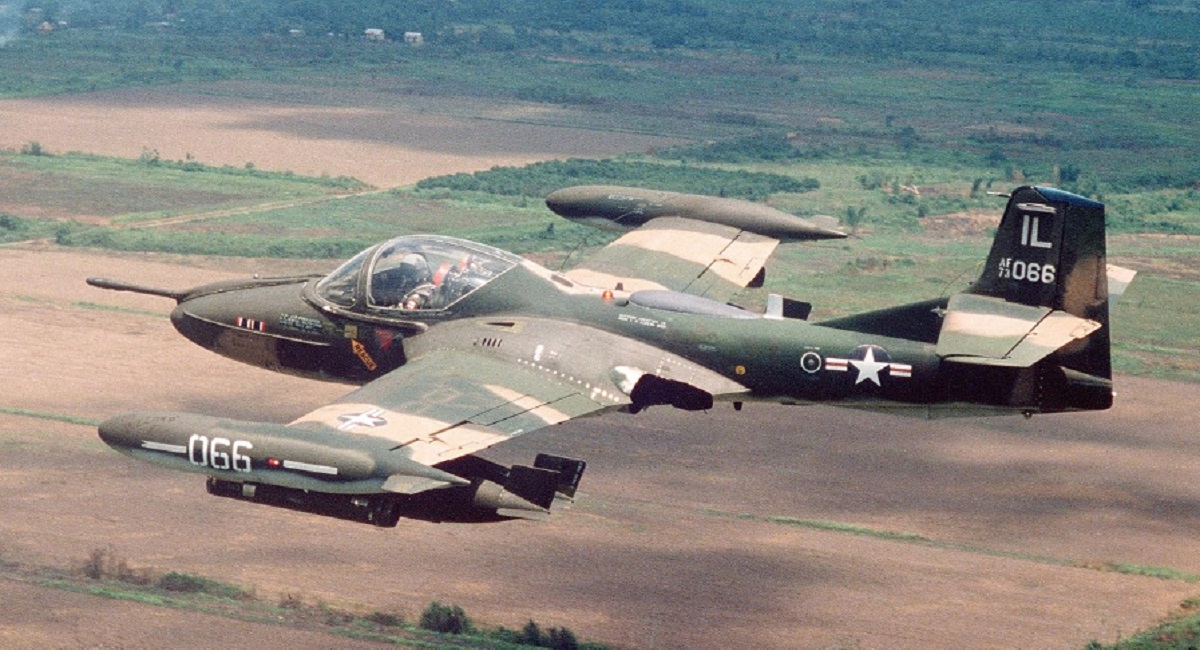
In 1963, Cessna developed the light attack aircraft Cessna A-37B Dragonfly based on the twin-engine jet trainer T-37 Tweet. Produced in nearly 600 examples, it served in the air forces of 14 countries. In 1968, the heavier LTV A-7D Corsair II made its first flight. It was developed by Ling-Temco-Vought from the carrier-based A-7C Corsair II, which itself had evolved from the F-8 Crusader fighter.In addition, numerous gunships were created from transport aircraft platforms, including the AC-47 Spooky, AC-119 Shadow, AC-130 Hercules, AU-23 Peacemaker, and AU-24 Stallion. Each of these merits separate discussion.
However, the focus here is on a different program – one that led to the creation of the first attack aircraft designed from the ground up since the Second World War, rather than adapted from an aircraft of another class.
An Attack Aircraft for the Army
In the first half of the 1960s, the U.S. Air Force addressed the issue of close air support primarily in the context of counterinsurgency operations in Southeast Asia. For the European theater, existing and prospective supersonic fighter-bombers were considered sufficient.
The U.S. Army disagreed. Its planners reasonably assumed that, in the event of a NATO–Warsaw Pact conflict in Europe, fixed airbases would become priority targets and could be disabled early in the campaign. From the Army’s perspective, a dedicated attack aircraft with good short takeoff and landing performance, capable of operating from austere or improvised airstrips, was required. In 1960–1961, the Army conducted comparative trials of several existing light jet aircraft to evaluate their suitability for the attack role.
Alongside American aircraft – including the Cessna T-37 trainer, the carrier-based Douglas A4D-2N, and the Northrop N-156F (the prototype of what would become the F-5A light fighter) – the Italian Fiat G.91R was also tested. However, the Army’s efforts to acquire its own fixed-wing combat aircraft were blocked by the Air Force. After several years of interservice negotiations, a compromise was reached in 1966, known as the Johnson–McConnell Agreement (named after the respective Chiefs of Staff of the Army and the Air Force at the time). Under its terms, the Army was prohibited from operating armed fixed-wing aircraft, while the Air Force agreed not to operate armed helicopters.
Since the Army continued to insist on the need for a dedicated attack aircraft for the European theater, the Air Force ultimately had little choice but to initiate an appropriate development program.
The A-X Program
On September 8, 1966, U.S. Air Force Chief of Staff General John P. McConnell directed that a specialized close air support aircraft be designed, developed, and adopted. On December 22 of the same year, a formal directive was issued in which the designation A-X (Attack Experimental) appeared for the first time, and a dedicated program office was established. On March 6, 1967, the Air Force sent a request for information regarding the A-X program to 21 aircraft manufacturers. This marked only the first step in a lengthy selection process.
The proposals submitted included both single- and twin-engine designs, powered by turboprop or turbofan engines. After reviewing the initial responses, the Air Force issued a revised and more detailed request for proposals in May 1970. The aircraft was to be optimized to counter large-scale Soviet armored offensives. A 30 mm rotary cannon was defined as the key weapon system; in practical terms, the aircraft was to be built around this gun.
The request specified core performance parameters: a maximum speed of 740 km/h, a takeoff distance of 1,200 m, an external payload of 7,300 kg, and a combat radius of 460 km. Cost was also a defining requirement – $1.4 million per aircraft (approximately $10.8 million in 2025 prices), substantially lower than the cost of contemporary combat aircraft.
During the same period, a separate request for proposals was issued for the A-X 30 mm cannon, with requirements including a high rate of fire (4,000 rounds per minute) and high muzzle velocity. In August 1970, six companies submitted aircraft proposals; in December, Northrop Corporation and Fairchild Republic were selected to build prototypes, designated YA-9A and YA-10A respectively. General Electric and Philco-Ford were chosen to develop and test prototypes of the GAU-8 cannon.
Read also:
- Pilatus Turboprop Aircraft: An Overview of PC-9
- All About Lightweight Patrol and Counter-Drone Aircraft “Draco”: Reincarnation of Iconic “Vilga”
Prototypes
The YA-9A was a high-wing monoplane constructed entirely of aluminum alloys, incorporating honeycomb structures and chemically milled skin panels. As required by the specification, it was powered by two turbofan engines mounted in nacelles beneath the wing roots. Northrop Corporation selected the Lycoming YF102 engine, rated at 32 kN of thrust, instead of the more powerful General Electric TF34 (41.3 kN) used on the A-10, although the airframe design allowed for either engine to be installed.
The YF102 was a new development derived from the T55 turboshaft engine produced by Avco Lycoming and used on the Boeing CH-47 Chinook helicopter. It was chosen primarily for cost considerations.
The YA-10A, by contrast, featured a low-mounted wing, with its engines housed in nacelles positioned on either side of the rear fuselage.
The large-area vertical stabilizer of the YA-9A was designed to enhance directional stability at low altitudes. The aircraft was equipped with split ailerons that could also function as air brakes. When deployed asymmetrically in combination with the rudder, these air brakes generated lateral control forces, allowing the aircraft to shift sideways without banking. This feature facilitated more precise aiming during strafing runs. The YA-10A, in contrast, employed a twin-tail configuration, which partially shielded the engine nacelles from ground fire.
On both aircraft, the cockpit was positioned as far forward as possible to improve visibility. It was enclosed within an armored “bathtub” – made of aluminum in the prototypes, but of titanium in production A-10 aircraft (assembled from plates 13 to 38 mm thick). The wing fuel tanks were self-sealing and filled with foam to reduce the risk of fire or significant fuel loss.
Both the YA-9A and YA-10A featured dual-redundant hydraulic flight control systems, supplemented by an emergency mechanical backup to prevent a single hit from resulting in total loss of control. These measures were expected to reduce combat losses by nearly 90 percent in conflicts similar to Vietnam. On the YA-10, all three landing gear struts retracted forward in the direction of flight. This design ensured that, even in the event of hydraulic failure, the gear could extend under its own weight and aerodynamic airflow.
The primary armament of both aircraft was a 30 mm seven-barrel rotary cannon mounted in the lower fuselage, with the barrels protruding beneath the nose. Because the gun was aligned with the aircraft’s centerline, the nose landing gear was offset by one foot (0.30 m) – to the left on the YA-9A and to the right on the YA-10A. Since the GAU-8 Avenger was not yet ready, both YA-9A prototypes (as well as the two YA-10A prototypes) were initially equipped with the smaller 20 mm M61 Vulcan.
Under the wings, ten hardpoints were installed (eleven on the YA-10A), allowing the aircraft to carry up to 7,300 kg of ordnance, including bombs and air-to-ground guided missiles.
The first YA-10A prototype took to the air on May 10, 1972, and twenty days later its competitor, the YA-9A, began flight testing. On January 18 of the following year, the Fairchild Republic design was declared the winner. Despite having somewhat inferior flight performance compared to its rival and more complex ground servicing requirements, the YA-10A proved to be a superior weapons platform and – most importantly – offered significantly greater survivability over the battlefield.
In June 1973, General Electric was selected to manufacture the GAU-8 Avenger. In 1974, the YA-10A underwent additional comparative trials against the LTV A-7D Corsair II to demonstrate the necessity of developing a new dedicated close air support aircraft. Ultimately, the aircraft was accepted into service under the designation Fairchild Republic A-10 Thunderbolt II. We will discuss the production history, modernization, and operational service of this attack aircraft next time.
Read also: