As I mentioned in one of the earlier articles, the engineers at Northrop, drawing on their experience with the “militarization” of the civilian Gamma, developed the Gamma 2F modification. In this version, only faint traces of resemblance remained to the early mail planes of the series.
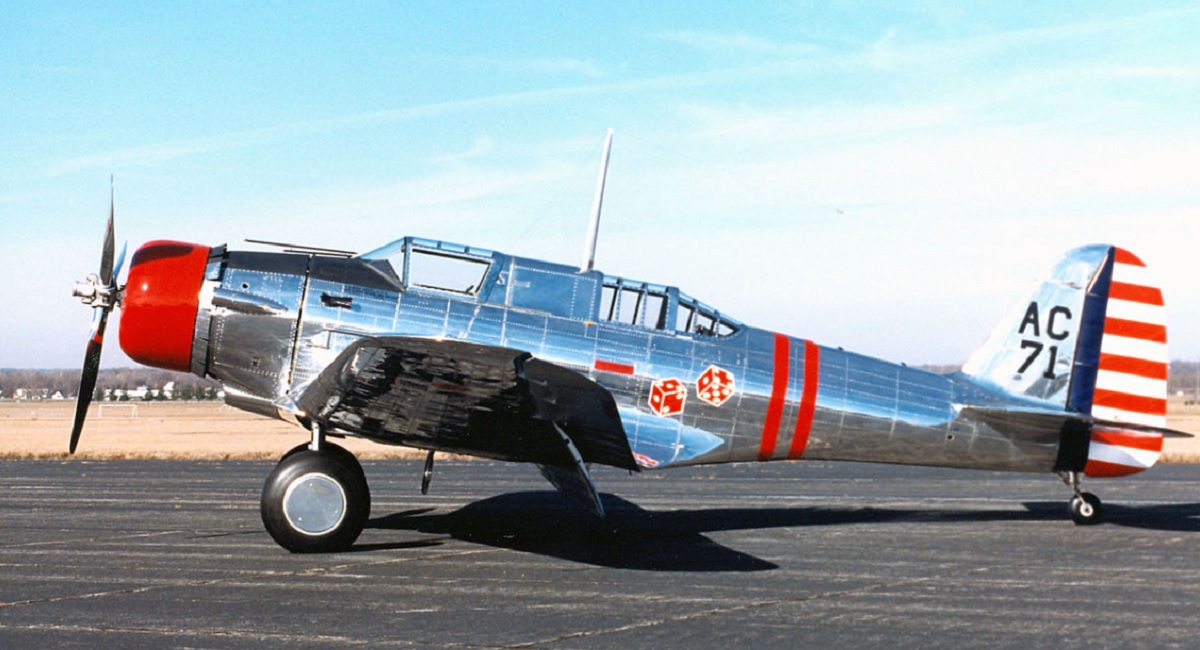
First and foremost, the aerodynamics were significantly refined: the fuselage received more streamlined contours, the cockpit canopy was lowered and lengthened (with the radio operator/gunner’s position shifted further aft), and the tail assembly was redesigned.
A logical step in this modernization was the move toward retractable landing gear – yet for some reason, the designers settled for a halfway solution: the main wheels did not retract into the wings but into bulky fairings known as “pants.”
The aircraft was also fitted with a new powerplant – a 14-cylinder, air-cooled Pratt & Whitney R-1535-11 engine producing 750 hp, driving a three-blade propeller. This twin-row radial engine, better known as the Twin Wasp Junior, had a notably smaller diameter compared to the powerplants used in earlier Gamma aircraft.
Read also:
- First American Attack Aircrafts: Development Path, Part 1
- First American Attack Aircrafts, Part 2: Alternative Projects of the Early 1920s
- American Attack Aircraft, Part 3: The First Production Variants
- First American Attack Aircraft, Part 4: On the Eve of the 1930s
- First American Attack Aircraft, Part 5: Production A-12 “Shrike”
- American Attack Aircraft, Part 6: Experiments of the 1930s
- American Attack Aircraft, Part 7: John Northrop’s “Gamma”
- American Attack Aircraft, Part 8: Contribution of Gerard Valtí
TABLE OF CONTENT:
From prototype to production aircraft
The Gamma 2F prototype (serial number 44) was built at Northrop’s own expense in 1934. The exact date of its first flight remains unknown. On October 6, the aircraft was handed over to the military for testing. The results were generally satisfactory, but the prospective customer was dissatisfied with the unconventional landing gear design. The aircraft was returned to the manufacturer for modification.
It was then fitted with a conventional fixed landing gear featuring wheels enclosed in teardrop-shaped fairings. The sides of these fairings were left open, which made it easier to remove dirt accumulated during operations from unpaved airfields. The cockpit canopy was also redesigned, incorporating an unglazed section between two sliding glazed panels. In this configuration, the aircraft was accepted for service under the designation A-17.
On December 24, 1934, just before Christmas, Northrop received a significant order for 110 A-17 aircraft, at the time the largest attack aircraft contract in U.S. aviation history. The aircraft were assigned serial numbers 35-51 through 35-160, with the prototype Gamma 2F itself accepted by the military on July 27, 1935, as the first unit of the series. Producing such a large batch was a serious challenge for the company’s limited manufacturing capacity. Due to the need to prepare the production facilities, the first production A-17 was not delivered until December 23, 1935. Deliveries of all aircraft were completed by January 1937.

The powerplant of the production A-17s matched that of the prototype, as did the armament, which was typical for American attack aircraft of the late 1920s–1930s. Armament comprised five 7.62 mm machine guns: four mounted in the wings and one on an upper movable (dorsal) mounting. The normal bomb load was either twenty 30-pound (600 lb; 272.16 kg) bombs carried in the bomb bay, or four 100-pound (400 lb; 181.44 kg) bombs on external racks. In an overloaded configuration the aircraft could carry up to 1,200 lb (544.31 kg) of bombs. Production aircraft differed from the Gamma 2F prototype by the addition of airbrakes: three perforated panels installed under the center section between the ailerons. This arrangement enabled the A-17 to perform dive-bombing runs.
Improvement
The powerplant of the production A-17s matched that of the prototype, as did the armament, which was typical for American attack aircraft of the late 1920s–1930s. Armament comprised five 7.62 mm machine guns: four mounted in the wings and one on an upper movable (dorsal) mounting.
The normal bomb load was either twenty 30-pound (600 lb; 272.16 kg) bombs carried in the bomb bay, or four 100-pound (400 lb; 181.44 kg) bombs on external racks. In an overloaded configuration the aircraft could carry up to 1,200 lb (544.31 kg) of bombs.
Production aircraft differed from the Gamma 2F prototype by the addition of airbrakes: three perforated panels installed under the center section between the ailerons. This arrangement enabled the A-17 to perform dive-bombing runs.
In 1936, the Army placed an order for one hundred A-17A aircraft (serial numbers 36-162 to 36-261). The first unit underwent testing on July 16 of that year and was delivered to the customer less than a month later, on August 12. However, operational testing revealed issues with the landing gear retraction and extension mechanism, which required time to resolve. As a result, the remaining production A-17A aircraft were accepted by the military between April and December 1937. In the second half of 1938, an additional batch of twenty-nine aircraft (serial numbers 38-327 to 38-355) was ordered. These were delivered between June and September 1938.
Another variant worth noting was the A-17AS – a three-seat, unarmed courier aircraft designed for transporting high-ranking officers. Two examples were built (military serial numbers 36-349 and 36-350, manufacturer serial numbers 289 and 290). The first aircraft was fitted with a nine-cylinder, direct-drive Pratt & Whitney R-1340-41 engine rated at 600 horsepower and equipped with a three-blade propeller. The second used an R-1340-45 engine of the same power output but with a reduction gear and a two-blade propeller. Both aircraft were delivered within the same week – on July 17 and July 21, 1936.
Aircraft 36-349 was assigned to Major General Oscar Westover, commander of the Air Corps, while 36-350 went to Brigadier General Henry Arnold. The first aircraft crashed near Burbank on September 21, 1938, killing General Westover, the pilot, and the radio operator. Following the accident, General Arnold became the new commander of the Air Corps. Historical records do not indicate whether he continued to use his own A-17AS.
Read also:
- Everything About the Bell AH-1Z Viper and UH-1Y Venom Helicopters: History, Specifications, and Prospects in Ukraine
- General Atomics Unveils Render of MQ-20 Avenger Drone Equipped with Laser Weapon
On duty
A-17s began arriving at operational units in February 1936. They equipped two attack groups: the 3rd (Barksdale Field, Louisiana; the 8th, 17th and 90th squadrons) and the 17th (March Field, California; the 34th, 37th and 95th squadrons). About a year later these units were initially supplemented with, and then replaced by, the faster A-17A.
In 1938 the attack aircraft took part in large Army maneuvers, after which the A-17A were described in official remarks as “the most effective aircraft for attacking ground targets ever developed.” Behind that claim, however, lay a less positive reality: both the A-17 and even the A-17A were considerably slower than contemporary fighters; their strike effectiveness was limited by the inability to carry sufficiently large bombs; and the lack of armor made them highly vulnerable over the battlefield.
From 1939 onward, A-17 and A-17A aircraft were progressively reassigned to training units and secondary duties. In 1939 the 17th Group was reorganized as a bombardment unit and reequipped with twin-engined Douglas B-18 Bolo aircraft. The following year the 3rd Group underwent the same conversion; due to a shortage of newer types, it was also supplemented with several older Martin B-12s.
The A-17, rather than the more modern A-17A, remained in operational units the longest in the Panama Canal Zone. In the fall of 1937, they replaced Boeing P-12 biplanes in the 74th Pursuit Squadron, which was redesignated as an attack squadron. Part of the unit was based at Albrook Field as part of the 16th Pursuit Group, and in February 1940 it was reassigned to the 6th Bombardment Group.
In March, the 74th Squadron was reequipped with twin-engine B-18 aircraft, and the A-17s were placed in storage. They were returned to service in January 1941 to equip the newly formed 59th Bombardment Squadron at Rio Hato. The squadron was intended to receive A-20 aircraft, but due to a shortage of new planes, the A-17s were temporarily assigned. Within the 59th Squadron, these attack aircraft were used for coastal patrol duties until early 1942.
After withdrawal from U.S. military service
In 1940 a buyer was found for A-17s that the U.S. military no longer required – France. A French procurement commission was authorized to select the required number of attack aircraft, and the process proceeded accordingly. By 20 June 1940, 93 A-17A aircraft destined for France had been assembled at the El Segundo factory in California (the U.S. Army still retained 95 A-17s and 24 A-17As).
The aircraft were scheduled for overhaul and installation of an export version of the engine, the R-1535-S2A5-GS, rated at 825 horsepower. However, by that time France had capitulated; the completed aircraft were transferred to British control and designated Nomad.
Sixty-one aircraft were accepted by the RAF; they were allocated British serials AS440–AS462, AS958–AS976 and AW420–AW438. However, British aircrews shared the assessment of their American counterparts that the A-17A was unsuitable for combat employment.
As a result, only four Nomads were retained in the United Kingdom; the other 57 were shipped to South Africa for use as training aircraft. The remaining 32 aircraft originally intended for France were transferred to Canada in August 1940, where they received serials 3490–3521 and served as target tugs with the 4th, 6th and 9th Bombing and Gunnery Schools.
In the United States, the last A-17 and A-17A aircraft remained in service until 1944, primarily in liaison roles.
Two aircraft (A-17 35-122 and A-17A 36-184) were transferred to the National Advisory Committee for Aeronautics (NACA) for aerodynamic experiments. The first was used to test a laminar-flow wing: a new wing skin was added directly over the old one, but only along half the span of each wing panel. This modification nearly doubled the chord length between the fuselage and the ailerons. Small engines with two-blade propellers were mounted on the leading edge of each wing to study airflow characteristics.
However, the results from this “flying laboratory” were unsatisfactory, and NACA subsequently shifted laminar-flow experiments to wind tunnel testing, which allowed for significantly more precise data.
The second aircraft was used at the beginning of 1939 to test different engine cowlings. Initially, it was fitted with a solid cowling featuring a large spinner, giving the attack aircraft the appearance of a liquid-cooled engine type. Cooling air was supplied through two inlets at the wing roots. However, ground tests revealed significant engine overheating, and the aircraft was not flown in this configuration.
The cowling was later modified with a central opening and removal of the side inlets. In this configuration, ground tests were more successful: the engine could run at full throttle for 15 minutes without signs of overheating. However, flight tests produced disappointing results – contrary to expectations, the aircraft’s speed with the new cowling was slightly lower than that of a standard A-17A.
By the late 1930s, the U.S. Army’s interest in traditional single-engine attack aircraft had largely disappeared. Twin-engine bombers became the focus, valued not only for striking targets deep in enemy territory but also for providing direct support to ground forces. Nonetheless, the A-17 design still retained export potential, which was later realized by another manufacturer – Douglas. That story will be covered in the next account.
Read also: