In the first half of the 1930s, the U.S. aviation industry was introducing new civilian aircraft one after another. These models incorporated the most advanced solutions of the time in aerodynamics, aircraft construction, powerplants, and onboard systems. As a result, mail and passenger planes often outperformed military aircraft – not only bombers and reconnaissance planes but also fighters – particularly in terms of speed. At first glance, speed might not seem critical for an attack aircraft. However, it is worth noting that as early as the 1920s, the U.S. military had abandoned the idea of armored attack planes. In this context, high speed became important, as it reduced the time spent under anti-aircraft fire. It is therefore unsurprising that new attack aircraft were developed in the mid and late 1930s.
Read also:
- First American Attack Aircrafts: Development Path, Part 1
- First American Attack Aircrafts, Part 2: Alternative Projects of the Early 1920s
- American Attack Aircraft, Part 3: The First Production Variants
- First American Attack Aircraft, Part 4: On the Eve of the 1930s
- First American Attack Aircraft, Part 5: Production A-12 “Shrike”
- American Attack Aircraft, Part 6: Experiments of the 1930s
TABLE OF CONTENT:
Northrop Gamma 2
In January 1932 John K. Northrop, with financial backing from Donald Douglas, founded the Northrop Corporation. The firm’s objective was to leverage Northrop’s experience in designing all‑metal aircraft. Following the naming practice of his earlier designs, Northrop assigned Greek letters to new projects. This produced the Gamma mailplane and the Delta passenger type – single‑engine monoplanes with low‑mounted wings and fixed undercarriages whose main struts were enclosed in streamlined “pants.” Owing to its smaller dimensions, the Gamma was the more suitable candidate for conversion to a military variant.

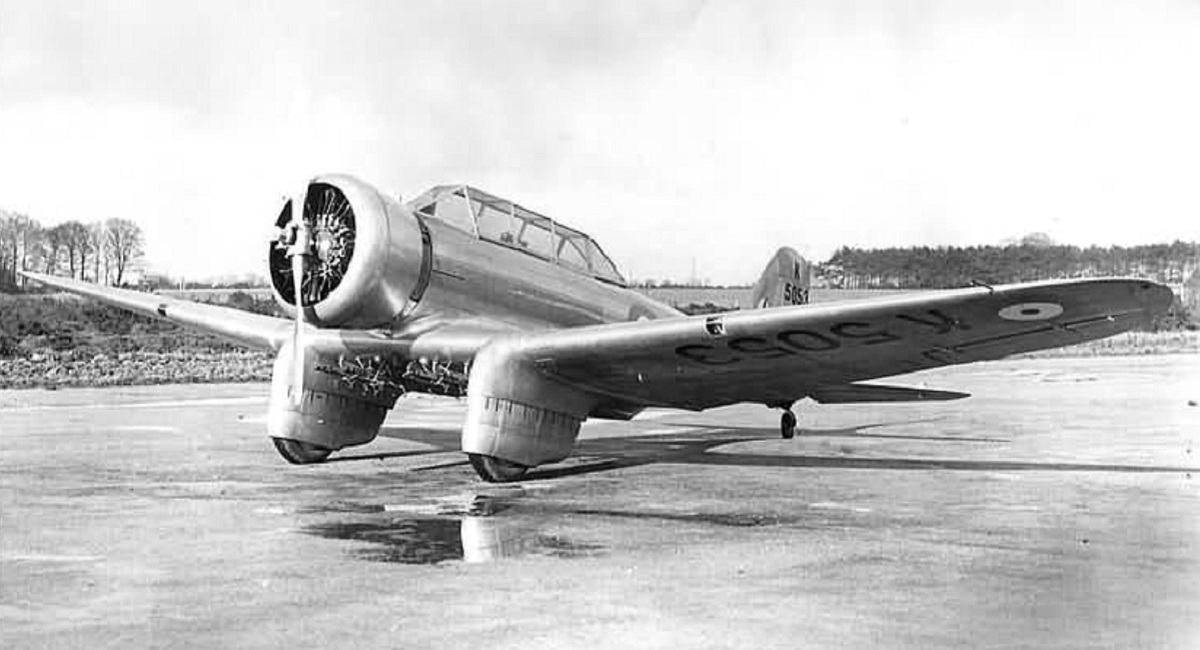
The first two examples (Gamma 2A and 2B) were completed in August 1932. A distinctive feature of the civil Gamma was the pilot’s cockpit, set well aft; between it and the engine were the cargo hold and fuel tanks. That layout was unsuitable for a combat type because of the limited pilot view, so on the military prototype Gamma 2C (s/n 5) the cockpit was moved forward and made two‑seat – the pilot’s position now sat slightly ahead of the wing leading edge.
Because the cockpit occupied the former cargo space, bomb load had to be carried on six external hardpoints under the center section; the total could reach about 500 kg (some sources give a lower figure of 600 lb, ≈272 kg). Defensive armament comprised five 7.62 mm Browning machine guns: four mounted in the wings outside the propeller arc and one on a movable turret for the observer. For firing, the observer rotated with his seat, slid back part of the canopy, and swung his gun from its stowed position into action.
The Gamma 2C was fitted with a Wright SR‑1820‑F2 nine‑cylinder radial engine rated at about 735 hp driving a two‑blade propeller. The military version’s tail, empennage, wing and undercarriage were otherwise unchanged from the civil variants.
Read also:
- Weapons of Ukraine’s Victory: Modern Long-Range ERAM Missiles
- Thrust Reversal: How and When an Aircraft Uses Engine Braking
Prototypes YA-13 and XA-16
The Gamma 2C was initially developed as a company‑funded private initiative. The aircraft, completed by May 1933, was first registered as a civil experimental type under NX12291. In July, it was delivered to Wright Field for testing. The plane achieved a top speed of 329 km/h, although this was without armament or bomb load. In terms of speed, range, and maneuverability, Northrop’s design outperformed the newly adopted Curtiss A‑12 Shrike attack aircraft.
However, the aircraft’s operational performance did not meet military expectations. In February 1934, the Gamma 2C was returned to the company for modifications. The most noticeable external change was a redesigned vertical stabilizer, now triangular instead of trapezoidal. It was only on June 28, 1934, that the Air Corps purchased the aircraft, assigning it the designation YA‑13 and military serial number 34‑27. At that time, there were no plans for production.
In January 1935, the aircraft returned to the factory for an engine upgrade, receiving a 14‑cylinder, two‑row Pratt & Whitney R‑1830‑7. Compared to the earlier Cyclone engine, it had a smaller frontal area and higher power output (950 hp). The two‑blade propeller was replaced with a three‑blade unit. After these modifications, the aircraft was redesignated XA‑16.
However, follow‑up testing proved unsatisfactory: the engine proved too powerful, requiring an increase in tail surface area to compensate. Further development of the XA‑16 was abandoned in favor of the more promising Gamma 2F project. The sole XA‑16 was later used as a flying laboratory to test the R‑1830‑9 engine (same power as the R‑1830‑7) and eventually served at the aircraft mechanics school at Roosevelt Field, Long Island.
Export version – Gamma 2E
Chinese military requirements proved considerably less exacting than those of their American counterparts. They purchased a relatively large batch, for the time, of the Gamma 2E light bombers, an improved variant of the Gamma 2C.
The Chinese aircraft were fitted with a ventral “bath” located aft of the wing that provided the observer – who also served as bombardier and rear gunner – with good downward visibility; in flight the bath retracted partly into the fuselage. Power came from a Wright SR‑1820‑F3 radial rated at about 710 hp driving a two‑blade propeller. Defensive armament matched that of the Gamma 2C, while bomb load was substantially increased, reaching up to 1,600 lb (≈726 kg).
China ordered 24 Gamma 2E aircraft (s/n 14–17, 30–37, 45, 46). Due to differences in equipment fit, the batch is usually divided into three subvariants: the standard Gamma 2E (two aircraft), Gamma 2EC (seven), and Gamma 2ED (15). Deliveries took place between February and September 1934.
In addition, Northrop produced 25 sets of components (s/n 48–72) for the Gamma 2E, which were later assembled in China at CAMCO’s (Central Aircraft Manufacturing Company) plant in Loiwing. Of the 49 Chinese Gamma 2E aircraft, several were lost in training accidents. By early 1937, the remaining aircraft were concentrated in two bomber groups: the 1st Group (1st and 2nd squadrons) and the 2nd Group (9th, 11th, and 14th squadrons; the 9th and 14th also operated Fiat BR.3 and Douglas O‑2MC aircraft alongside the Gammas). By mid‑August 1937, when the Second Sino-Japanese War began, the 1st Group had already been disbanded, and all Northrop bombers were consolidated in the 2nd Group, whose three squadrons then totaled 37 Gamma 2E aircraft.
By order of August 13, 1937, the 2nd Group was redeployed from Xinyang to Guande and Changxing. On the morning of August 14, heavy air battles broke out near Shanghai, with Northrop bombers taking part. At 08:00, two formations of nine aircraft each attacked Japanese ships at the mouth of the Yangtze. Due to heavy cloud cover, the strike was largely ineffective: one squadron dropped its bombs on a spinning mill, while the other did engage the ships but managed only to damage one. Over the course of the day, the 2nd Group carried out several more sorties, losing two Gammas.
Information on the later combat use of these aircraft is fragmentary, but it is clear that their operational career was brief under conditions of Japanese air superiority. On September 21, 1937, for example, the 9th Squadron took off from Guangzhou to attack Japanese ships in the South China Sea. Carrier-based fighters inflicted heavy losses on the formation. The exact number of Northrops destroyed is unknown, but that same day the 9th Squadron was ordered to transfer its surviving Gammas to the 14th Squadron, while its personnel were reassigned for retraining on Soviet aircraft.
The 14th Squadron continued operating for a few more months. On October 24, a Gamma ferried to Nanjing after repairs was destroyed by Japanese fighters. On November 11, three Northrops attempted to attack the carrier Kaga, but two were shot down by defending fighters. By December 1937, the last of the Chinese Gammas had been lost.
The Gamma 2E design also drew interest abroad. Although no large-scale orders followed, several aircraft were purchased for evaluation. One example, in the Gamma 2ED-C configuration, was acquired by the Royal Air Force and used at the test center at Martlesham Heath. In 1933, the Imperial Japanese Navy purchased two more aircraft, which were designated BXN in Japan.
Read also:
By progressively adapting a civil airframe to military requirements, engineers had to depart increasingly from the original design. It turned out that a competent combat aircraft cannot be created simply by arming a passenger plane, no matter how good it was for its time. The inevitable evolution led to substantial structural changes and essentially produced a new aircraft that retained little of its civilian “parent.”
A similar path was taken in the 1930s by Kharkiv designer Yosyp Neman: he first adapted his HAI-1 passenger monoplane for military use (designated HAI-1VV) and then developed a purpose-built military type – the reconnaissance/light bomber HAI-5 (R-10). In the United States, the Gamma airframe served as the basis for the A-17 attack aircraft. More on that in the next installment.
Read also: