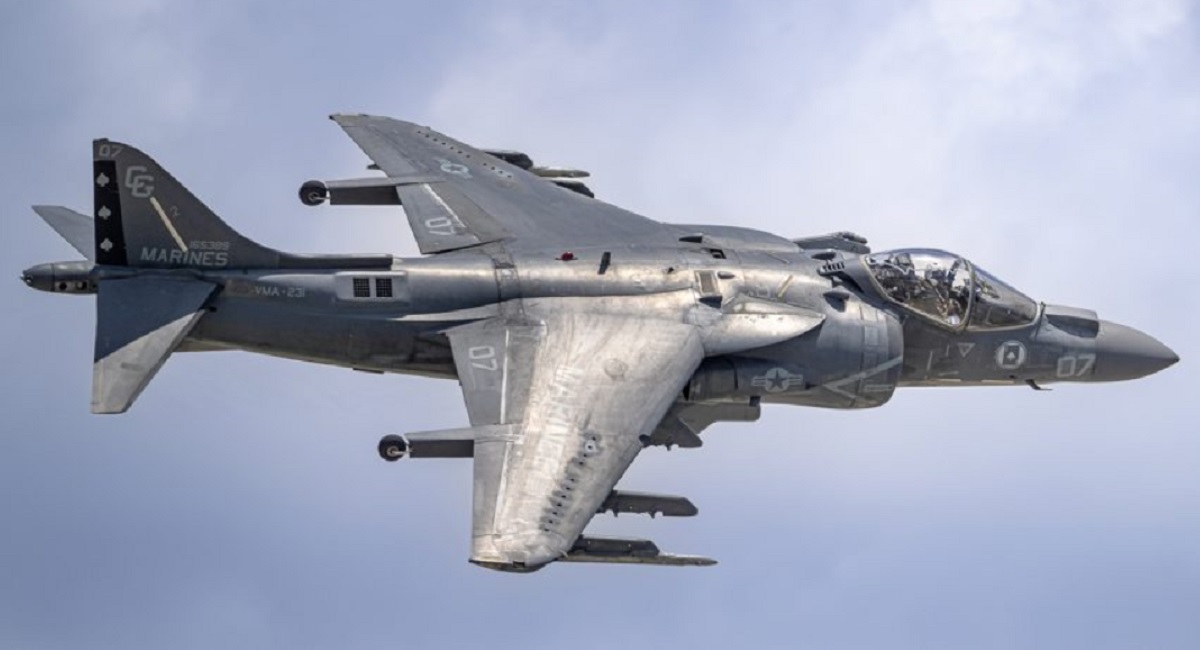
On June 3, 2026, a notable event took place at Marine Corps Air Station Cherry Point, as the United States Marine Corps officially retired its last AV-8B Harrier II attack aircraft from active service. This provides an opportunity to revisit the history of the AV-8B Harrier II program.
TABLE OF CONTENT:
A British-American Project
In 1972, the American company McDonnell Douglas – later acquired by Boeing – and the British company Hawker Siddeley, which later became part of British Aerospace, began joint development of the Harrier II short takeoff and vertical landing aircraft.
The aircraft was conceived as a major modernization of the original Harrier, the world’s first serially produced aircraft of this type. The project ultimately resulted in two variants that shared the same airframe and powerplant design but differed in onboard systems and weapon configurations: the American AV-8B and the British Harrier GR.5/7/9. The British aircraft were retired from service in 2010, while the American variants remained operational until recently, when they were fully replaced by the F-35B Lightning II fighter aircraft.
The initial concept for the new aircraft, designated AV-8X and later redesignated AV-16A in 1974, envisioned a platform significantly larger than the original AV-8A Harrier. The project included a more powerful Pegasus 15 engine and upgraded avionics capable of supporting all-weather operations. However, due to excessive projected costs, the concept was abandoned in favor of the less ambitious AV-8+ program launched in 1975. The AV-8+ retained the fuselage and Pegasus 11 engine from the AV-8A, but received a newly designed wing with greater span, increased area, and a thicker airfoil profile, which made it possible to increase internal fuel capacity. The onboard systems were also modernized.
Two YAV-8B prototypes were converted from production AV-8A aircraft and entered flight testing on November 9, 1978, and February 19, 1979, respectively. Although the second prototype crashed on November 15, 1979 – with the pilot successfully ejecting – the tests were considered successful. Between 1981 and 1983, the company produced four pre-production AV-8B attack aircraft. These aircraft were equipped with more powerful Pegasus 11-21 Mk.105 (F402-RR-404) engines with a thrust rating of 9,975 kgf. Deliveries of serial production aircraft to the United States Marine Corps began in January 1984.
Design
The AV-8B was built using a conventional aerodynamic layout with a high-mounted swept wing. The aircraft features a bicycle-type landing gear configuration with additional outrigger supports mounted under the wings. Its engine is equipped with four rotating nozzles positioned along the sides of the fuselage, allowing the thrust vector to be redirected. This makes vertical or short takeoff and landing operations possible, enabling the aircraft to operate from small площадки and from ships that are not equipped with catapults.
During serial production, the original F402-RR-404 engine was replaced with the improved F402-RR-404A variant featuring a digital control system. The aircraft’s fixed armament – a more accurate term in the case of the AV-8B than “internally mounted” – consists of a 25 mm five-barrel GAU-12/U Equalizer cannon. The gun is housed in a pod under the left side of the fuselage, while the ammunition container with 300 rounds is mounted on the right side.
External weapons are carried on six underwing hardpoints. The payload includes unguided bombs and cluster munitions, rocket pods, laser-guided bombs, and AGM-65 Maverick air-to-surface missiles. For self-defense, the aircraft can carry two AIM-9 Sidewinder AIM-9L/M Sidewinder air-to-air missiles. The total external payload can reach 4,200 kg.
Read also:
- Last of Mohicans: A-4 Skyhawk Attack Aircraft in Argentina and Brazil
- The Aircraft That Never Were: Convair Kingfish
Variants
The first 162 production AV-8B aircraft – along with 12 units delivered to the Spanish Navy – built before 1987 were equipped with avionics suitable only for operations in favorable weather conditions. The core of the targeting and navigation system was the AN/ASB-19 ARBS television-based target detection and tracking system combined with a laser rangefinder. The same system was also installed on the A-4M Skyhawk attack aircraft. Weapons control was managed by the AN/AYK-14 mission computer. The electronic warfare suite included the AN/ALR-67 radar warning receiver and two AN/ALE-39 countermeasure dispensers. The aircraft could also carry an external pod equipped with the AN/ALQ-126 active jamming system.
A two-seat trainer and combat-capable variant, designated TAV-8B, was developed from the AV-8B. It featured a fuselage extended by 1.2 meters with a tandem cockpit arrangement and a vertical stabilizer increased in height by 0.43 meters. The first TAV-8B entered flight testing on October 21, 1986. Unlike the single-seat version, the TAV-8B was initially equipped with the more powerful F402-RR-406A engine, which was later also installed on late-production AV-8B aircraft. By the early 1990s, 24 TAV-8Bs had been produced, including 22 for the United States Marine Corps and two for the Italian Navy. During later modernization programs, the aircraft received F402-RR-408 engines.

In the mid-1990s, the Harrier II underwent modernization aimed at improving its night combat capabilities. This resulted in the AV-8B(NA) variant, which received the AN/AAR-51 NavFLIR infrared navigation system in addition to the existing ARBS targeting system. The cockpit lighting was also adapted for compatibility with night vision goggles. The first AV-8B(NA), converted from a production AV-8B aircraft, completed its maiden flight on June 26, 1987. By 1992, 66 serial AV-8B(NA) aircraft had been produced. Early production examples were equipped with F402-RR-406A engines, while later aircraft received the more powerful F402-RR-408 engine with a thrust rating of 10,620 kgf.
The next stage in the aircraft’s evolution was the AV-8B+, equipped with the AN/APG-65 AN/APG-65(V)2 multirole radar – a modified version of the radar used on the F/A-18 Hornet with a smaller antenna adapted to the narrower nose section of the Harrier II. Installation of the radar increased the fuselage length and altered the shape of the aircraft’s nose, which received a radar-transparent radome. The ARBS system was removed, with its functions largely replaced by the radar, while the NavFLIR system was retained.
The AV-8B+ prototype, converted from a production AV-8B(NA), entered testing on September 22, 1992. Serial production began in March 1993. By 1995, a total of 51 aircraft had been built, including 27 for the United States Marine Corps, 16 for the Italian Navy, and eight for the Spanish Navy.
Between 1996 and 2003, a modernization program was carried out for AV-8B aircraft, covering 74 aircraft operated by the United States Marine Corps and five belonging to the Spanish Navy. These aircraft received the AN/APG-65 radar and F402-RR-408 engines, while the weapons package was expanded to include JDAM precision-guided bombs. In addition, the aircraft were adapted to carry AN/AAQ-28 LITENING targeting pods. This upgraded configuration became known as the AV-8B+(R).
A further modernization effort introduced from 2016 enabled the Harrier II to employ AIM-9X Sidewinder short-range and AIM-120 AMRAAM medium-range air-to-air missiles, as well as AGM-154 Joint Standoff Weapon AGM-154C JSOW guided munitions. The aircraft also gained the ability to use the AN/ALQ-231 Intrepid Tiger II electronic warfare system carried in an external pod.
Read also:
- An old warrior ready for battle: Everything you need to know about Pakistan’s ‘Mirage’ jets
- The story of Rosie the Rocketeer: Little airplane with ‘bazooka’
Service with the Marines
The re-equipment of the United States Marine Corps aviation units with Harrier II aircraft began with the VMAT-203 training squadron based at Marine Corps Air Station Cherry Point. In 1985, the first operational attack squadron to receive the AV-8B was VMA-331, also stationed at Cherry Point. The aircraft was later introduced into VMA-223, VMA-231, and VMA-542 at Cherry Point, as well as VMA-211, VMA-214, VMA-311, and VMA-513 based in Yuma, Arizona.
The AV-8B made its combat debut during Operations Operation Desert Shield and Operation Desert Storm in 1990–1991. A total of 86 aircraft of this type were deployed to the Persian Gulf region. Squadrons VMA-231, VMA-311, and VMA-542, each operating 20 aircraft, flew missions from land bases, while VMA-331 with 20 aircraft and a six-aircraft detachment from VMA-513 operated from the amphibious assault ships USS Tarawa and USS Nassau. Harrier II aircraft carried out more than 3,300 combat sorties and dropped approximately 2,700 tons of ordnance on enemy targets. Total losses amounted to five aircraft.
Between March and June 1999, 12 AV-8B+ aircraft operating from the amphibious assault ships USS Nassau and USS Kearsarge took part in NATO bombing of Yugoslavia. One Harrier II was lost during the operation, although the loss was not combat-related.
From November 2001, Harrier II aircraft participated in operations in Afghanistan, initially flying from naval vessels and later, beginning in December 2001, from Kandahar Airfield. The aircraft suffered their largest single-day losses on September 14, 2012, when Taliban militants attacked Camp Bastion, destroying six AV-8B aircraft from squadron VMA-211 and damaging several others. Beginning in 2003, Harrier II aircraft also took part in operations in Iraq. During March and April 2011, AV-8Bs deployed aboard USS Kearsarge participated in military operations against Libya.
From June 2014 onward, Harrier II units were involved in Operation Inherent Resolve against Islamist militants in Iraq and Syria, operating from air bases in Bahrain and Qatar as well as from amphibious assault ships. Between August and December 2016, a detachment from VMA-542 operating from the deck of USS Wasp participated in Operation Odyssey Lightning against Islamist forces in northern Libya.
At the beginning of 2017, the United States Marine Corps aviation arm operated more than 100 AV-8B Harrier II aircraft, including roughly fifteen TAV-8B trainers. These were distributed across the VMAT-203 training squadron at Marine Corps Air Station Cherry Point and five operational squadrons: VMA-223, VMA-231, and VMA-542 at Cherry Point, as well as VMA-214 and VMA-311 in Yuma, Arizona. By 2023, only two squadrons remained active – VMA-223 and VMA-231. Although the Harrier II fleet was steadily approaching retirement, the aircraft continued to participate in intensive operational deployments.
An interesting fact: Harrier II pilot Captain Earl Ehrhart V of VMA-231 became the first officially recognized U.S. military aviation ace since the Vietnam War era. In 2023, his unit operated from the amphibious assault ship USS Bataan (LHD-5). The Bataan Amphibious Ready Group was deployed in the Mediterranean but was redirected to the Red Sea following the Hamas attack on Israel on October 7, 2023. It was in this theater that Captain Ehrhart reportedly achieved ace status, claiming seven downed drones operated by Houthi forces from December 2023 onward.
In 2025, VMA-231 was re-equipped with the F-35B Lightning II. Meanwhile, VMA-223 returned in May 2026 from its final combat deployment aboard the amphibious assault ship USS Iwo Jima (LHD-7).
Service with allies
The Spanish Navy received 12 EAV-8B aircraft in 1987–1988, followed by eight EAV-8B+ aircraft in 1996. In addition, one used TAV-8B was acquired in October 2000. In Spain, the Harrier II aircraft were designated VA-2 “Matador II” and entered service with 9 Squadron based at Naval Station Rota. In 2003, five EAV-8B aircraft were upgraded to the EAV-8B+ standard, while between 2011 and 2012 the remaining four in service were modernized under the SNUG (Spanish Navy Upgrade) program. This upgrade implemented improvements similar to the EAV-8B+ configuration, but without installing an onboard radar system.
The Spanish “Matador II” aircraft were intended for operations from the light aircraft carrier Príncipe de Asturias, and after its decommissioning in 2013, from the amphibious assault ship Juan Carlos I. Their only combat experience was participation in NATO operations in Bosnia and Herzegovina. Currently, around 10–12 Matador II aircraft remain in operational readiness. They are likely to be replaced by the F-35B Lightning II, although no formal decision has yet been made. In practice, Spain’s Harrier II fleet is expected to remain the longest in service among all operators of the type.
The Italian Navy received 16 AV-8B+ aircraft and two TAV-8B trainers. Five of these aircraft (three single-seat and both two-seat variants) were delivered from the United States in 1994, while the remaining aircraft were assembled in Italy under license in 1995–1996. The aircraft were assigned to the embarked air group Gruppo Aerei Imbarcati (GRUPAER) based at Grosseto Air Base. The first carrier to operate the Harrier II in Italian service was the light aircraft carrier Giuseppe Garibaldi, later sold to Indonesia. In 2009, the Italian Navy commissioned the new aircraft carrier Cavour, and in 2025 the amphibious assault ship Trieste, both of which are capable of operating aircraft.
The combat debut of Italian Harrier II aircraft took place in February 1995, when three jets from the aircraft carrier Giuseppe Garibaldi provided air cover for the evacuation of United Nations forces from Somalia. In May–June 1999, Italian AV-8B+ aircraft flew 30 combat sorties during NATO operations against Yugoslavia. From December 2001 to March 2002, they conducted 288 sorties against targets in Afghanistan. In both cases, the aircraft operated from the deck of the Giuseppe Garibaldi.
The most recent combat deployment was Operation Operation Unified Protector in Libya in 2011. Between March and October of that year, eight AV-8B+ aircraft accumulated 1,221 flight hours and delivered 160 precision-guided bombs against designated targets. As of now, the Italian Navy’s GRUPAER unit still operates 14 AV-8B+ aircraft and two TAV-8B trainers. Their retirement was originally planned for the end of 2024, but Italian Harrier II aircraft remain in service.
Read also: