The PC-7 aircraft, whose long history I discussed recently, proved to be a commercially successful project. However, in 1980 it faced a serious competitor: the Brazilian EMB-312 Tucano, a heavier and more powerful aircraft. As a result, in 1982 the Swiss manufacturer began designing its own trainer aircraft with improved flight and tactical performance characteristics.
TABLE OF CONTENT:
The History of the “Nine”
The aircraft designated PC-9 was presented as an improved version of the PC-7, although in reality the two aircraft share only about 10% of their components. The PC-9 is larger in size and powered by a more powerful PT6A-62 engine rated at 950 hp. Ejection seats became standard equipment rather than an option, as on the PC-7, and the landing gear retraction system was changed from electric to hydraulic. Of the six underwing hardpoints, the two inner stations are “wet,” allowing the carriage of 145- or 248-liter external fuel tanks.
The first PC-9 prototype made its maiden flight on May 7, 1984, followed by a second aircraft entering flight testing on July 20 of the same year. This accelerated schedule had a clear reason: Pilatus was participating in a British competition to select a new training aircraft to replace the Jet Provost. These efforts ultimately proved unsuccessful, as the Brazilian Tucano was declared the winner in 1985. Despite this setback, the PC-9 became a commercially viable program, with approximately 240 aircraft sold.
Read also:
- Everything About Three Generations of PC-7: Predecessor of Pilatus Turboprop Aircraft Family
- Light Fighters: Useful Option or an Unnecessary Substitute?
Export Success
As with the PC-7, the vast majority of PC-9s were intended for export. The Swiss Air Force received only 12 aircraft starting in 1987. In Switzerland, the PC-9s are not primarily used for pilot training; instead, they are employed for target towing, carrying two RM-24 tow devices under the wings. They are also used to deploy active electronic countermeasures during air defense exercises, in which case the aircraft carry underwing ECM pods such as the EriJammer A100.

PC-9s are also used as target tugs in Germany. In 1990, a private company, Condor Flugdienst, purchased ten aircraft to operate under contracts with the German military. These German aircraft were delivered in the PC-9B variant, which features increased fuel capacity, allowing flights of up to 3 hours and 20 minutes. Another private company, Kinetic, acquired a total of 12 used PC-9s – including nine in early 2023 – which are employed by its German division to train pilots, forward air controllers, and to practice close air support operations.
Among the earliest PC-9 customers was Myanmar, whose air force already operated PC-7s. From April 1986, ten PC-9s were delivered to the country; currently, no more than four remain in service. Deliveries to Saudi Arabia began in December 1986, with a total of 50 aircraft purchased. In this case, the planes were first sent to the UK, where British Aerospace performed final modifications before transferring them to the customer. In Saudi Arabia, the PC-9s served as trainers with the 9th, 22nd, and 42nd squadrons but were eventually replaced by the PC-21. The last PC-9s were retired in June 2025.
Australia purchased a substantial batch of trainer aircraft under the designation PC-9/A. Of the 67 aircraft, two were delivered fully assembled from Switzerland, 17 were supplied as kits, and the remaining 48 were produced under license by the Australian company Hawker de Havilland. Deliveries took place between 1987 and 1992, and the last PC-9/A aircraft were retired in 2019, replaced by the PC-21.
In 1987, Iraq acquired 20 PC-9s. One of these aircraft was lost in combat on March 22, 1991, when a pair of US F-15Cs patrolling the airspace over Kurdistan intercepted two Iraqi planes – a Su-22 and a PC-9. The Su-22 was shot down, and the PC-9 pilot ejected rather than attempting to evade. The unmanned aircraft crashed to the ground within two minutes.
In 1991, deliveries of the PC-9 began to Thailand. The Royal Thai Air Force received 26 aircraft, which were replaced by American AT-6TNs by early 2024. In 1995, three PC-9s were delivered to Slovenia – these aircraft had been used by the US Army for testing since 1991 and were later returned to the manufacturer. In 1996, three more aircraft were supplied to Croatia. Additionally, two PC-9s were delivered to Cyprus in 1989, and one aircraft was sent to Chad.
Second Generation
The next development of the PC-9 was the PC-9M, featuring modernized onboard avionics: a “glass cockpit” with multifunction displays and an optional head-up display, GPS navigation, and other enhancements. Slovenia was the first customer, receiving nine aircraft in 1998, which were named Hudornik (“Swallow”). These aircraft were equipped with a target-navigation system supplied by the Israeli company RadaM. The Slovenian PC-9Ms are operated by the 152nd Squadron. Of the previously acquired PC-9s, one was lost in a crash in 2004, and two were sold to civilian owners in 2015.
Between 1996 and 1997, Croatia received 17 PC-9M aircraft and later upgraded three of its original PC-9s to the same standard. In 2017, these upgraded aircraft, along with three additional PC-9Ms, were sold off, while the remaining aircraft continue to serve with the 392nd Squadron.
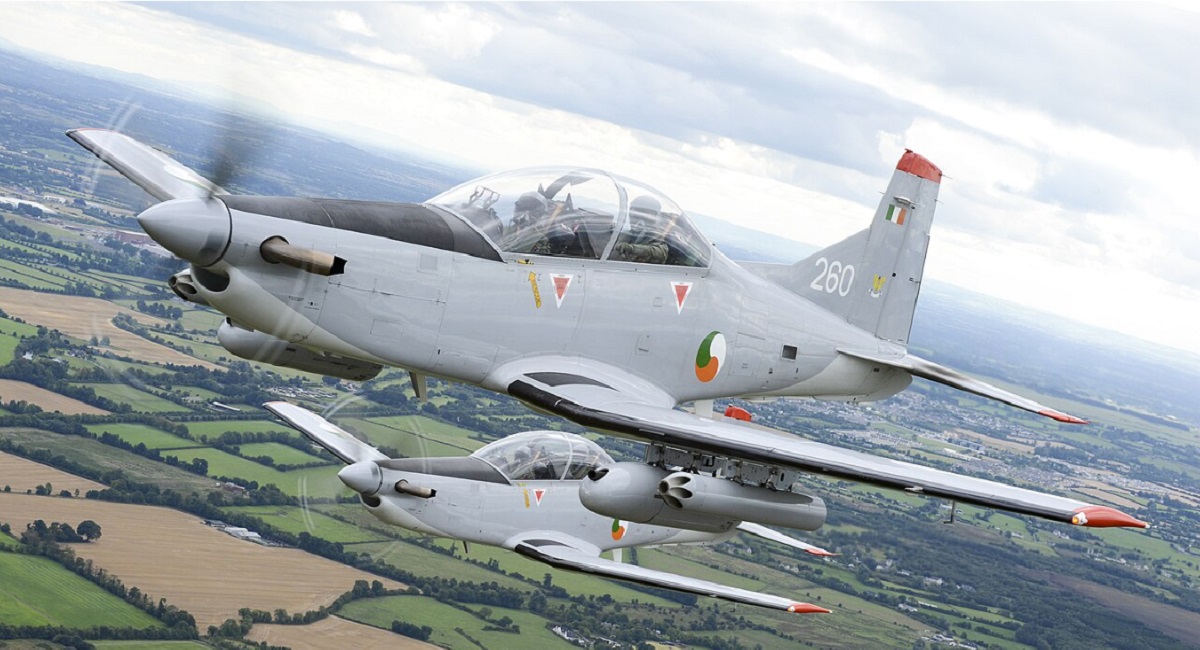
Between 1999 and 2004, Oman received 12 PC-9M aircraft. In 2004, the type was also adopted by Bulgaria (six aircraft) and Ireland (eight aircraft). While the Bulgarian aircraft are used exclusively for training, the Irish PC-9Ms carry armament, including gun pods and rocket launchers. Additionally, Mexico acquired two PC-9Ms; the country had previously ordered ten PC-9s in 1994, but the Swiss government blocked the delivery over concerns that the aircraft might be used in counterinsurgency operations.
Another notable variant is the “Americanized” Beech Pilatus PC-9 Mk.2, which won the competition for a new trainer for the United States Armed Forces. Production of the original Swiss PC-9 ended over twenty years ago, while the American T-6/AT-6 variant continues to be built today, with Pilatus receiving royalties for each aircraft. Its history, however, is a topic for a separate discussion.
Read also: