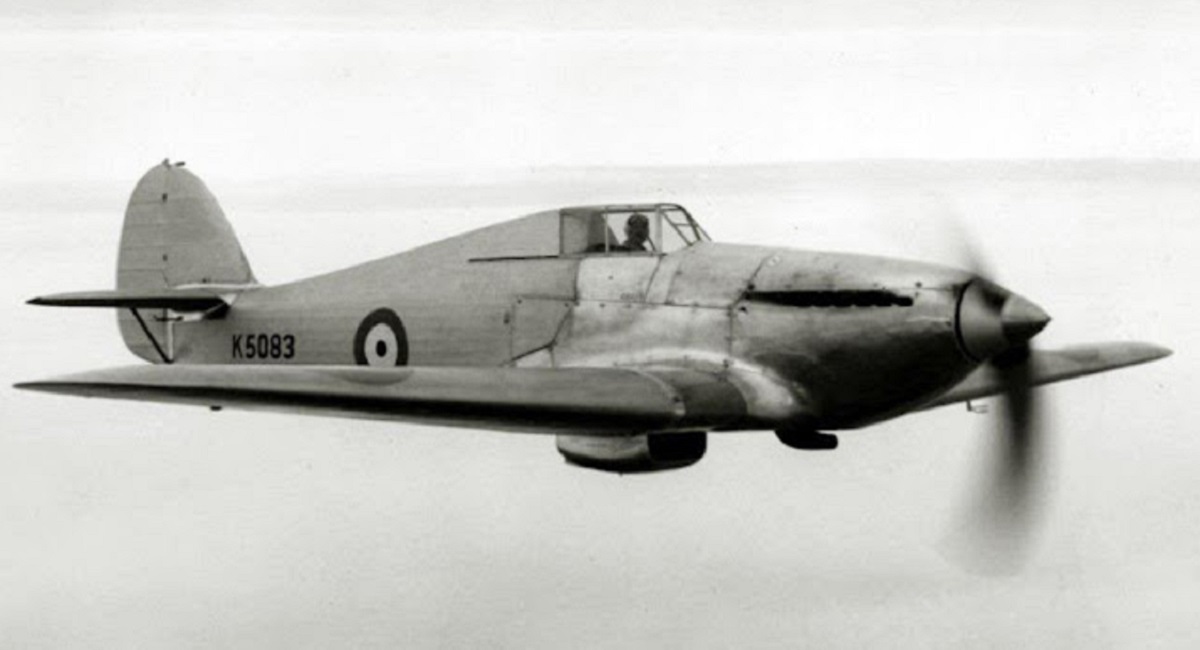
Today marks 90 years since Flight Lieutenant George Bulman conducted the first flight of the Hurricane prototype at Brooklands. The aircraft became the first in a new generation of British monoplane fighters that would carry much of the operational burden in the Western theatre during the Second World War. It was also the only British fighter to remain in frontline service for the entire duration of the conflict – from the opening day to its final stages.
Read also:
- First American Attack Aircrafts: Development Path, Part 1
- First American Attack Aircrafts, Part 2: Alternative Projects of the Early 1920s
- American Attack Aircraft, Part 3: The First Production Variants
- First American Attack Aircraft, Part 4: On the Eve of the 1930s
- First American Attack Aircraft, Part 5: Production A-12 “Shrike”
- American Attack Aircraft, Part 6: Experiments of the 1930s
- American Attack Aircraft, Part 7: John Northrop’s “Gamma”
- American Attack Aircraft, Part 8: Contribution of Gerard Valtí
- American Attack Aircraft, Part 9: Northrop A-17
TABLE OF CONTENT:
Evolution
The aircraft was developed at Hawker under the direction of Sydney Camm. Design work began in 1933, and the project went through several iterations before the first flight. The initial concept was a relatively simple conversion of the Fury biplane into a monoplane – informally referred to as the “Fury Monoplane.” Over time, the design shifted to incorporate more advanced elements, most notably the Rolls-Royce Merlin engine, retractable landing gear, and an expanded armament of eight machine guns. The final configuration was shaped by Specification F.36/34, which defined the aircraft as a “single-seat, high-speed monoplane fighter.”
The Hurricane featured a mixed-construction fuselage built around a steel tube framework with plywood formers and stringers, aluminum skinning at the front, and fabric covering toward the tail. The wing was initially wooden, but from spring 1940 onward all production Hurricanes were equipped with all-metal wings.
The prototype did not reach the projected top speed of 560 km/h, achieving 507 km/h instead. Even so, it became the first British aircraft to exceed 300 mph (483 km/h). Its handling and maneuverability were assessed as generally good. On 3 June 1936, the Air Ministry placed an order for the first production batch of 600 Hurricanes. Total British production reached 12,875 units, and with additional manufacturing in Canada, Belgium, and Yugoslavia, the overall number exceeded 14,500 aircraft.

Variants
The first production Hurricanes, the Mk.I, were powered by Merlin II or III engines (1,030 hp) and armed with eight 7.7 mm Browning Mk.I machine guns. Deliveries began in December 1937. A total of 3,774 Mk.I aircraft were produced in the United Kingdom. Additional production included 166 units in Canada, 20 in Yugoslavia (out of an original order of 60, completed before the German occupation), and roughly a dozen in Belgium.
The Hurricane Mk.IIA, introduced in June 1940, featured the more powerful Merlin XX engine (1,460 hp). A total of 451 Mk.IIA aircraft were built, after which production shifted to the Mk.IIB variant in November 1940, which had reinforced armament with twelve 7.7 mm machine guns. From mid-1941, these aircraft were also fitted with bomb racks capable of carrying two 250 lb (113 kg) bombs. Overall, 2,948 Mk.II Hurricanes were produced.
Variants (neutral technical style)
The next step in increasing the Hurricane’s firepower was the Mk.IIc. Its wings replaced the numerous machine guns with four 20 mm Hispano cannons (British Hispano Mk.II). Limited production of the Mk.IIc began in February 1941, with full-scale production starting in May. A total of 4,711 aircraft were built, making this the most numerous Hurricane variant.
From the second half of 1941 the Hurricane’s role progressively shifted from a pure fighter toward a tactical close-support aircraft – a functional analogue to ground-attack types. The need to counter German and Italian tanks in the deserts of Libya produced the Mk.IId, armed with two 40 mm automatic cannons (12–15 rounds per barrel) and two 7.7 mm machine guns. Some 296 Mk.IId aircraft were built in the spring of 1942.
The Hurricane Mk.IV was a more general-purpose ground-attack version with increased armor and a strengthened wing primarily intended for external stores (bombs, rockets, or 40 mm gun pods). These aircraft used low-altitude-tuned Merlin 24 or Merlin 27 engines (1,260 hp). Production ran from April 1943 to July 1944, with 774 machines completed.
The Hurricane Mk.III, which was to be powered by the American-built Packard Merlin 24 engine, was never produced, and the ground-attack Mk.V with a Merlin 32 engine was built in only two examples.
In Canada, the Hurricane line continued with the Mk.X (268 units), Mk.XII (50 units), and Mk.XIII (967 units) variants. These were derivatives of the Mk.I, fitted with American Packard Merlin engines, Canadian avionics, and armament of eight or twelve 7.7 mm machine guns.
The Royal Navy’s Fleet Air Arm operated carrier-adapted Sea Hurricanes, including Mk.I, Mk.IIB/C, and Mk.XII models. Additionally, approximately 200 Hurricanes of the Mk.I and Mk.II series were converted for reconnaissance roles, designated as PR Mk.II, TacR Mk.II, and FR Mk.II.
Operational Service
By the outbreak of the Second World War, the Royal Air Force had received 497 Hurricanes. These aircraft were operated by 18 squadrons, with an additional three in the process of re-equipment. In September 1939, four squadrons were deployed to France as part of the British Expeditionary Force. By 10 May 1940, at the start of the German Blitzkrieg in the West, six Hurricane squadrons were in France, increasing to 13 by the end of the campaign. The fighters supported the attempted advance of the British Expeditionary Forces into Belgium and subsequently covered their retreat to the English Channel. RAF losses in France amounted to 261 Hurricanes, roughly two-thirds of which were damaged or abandoned during the withdrawal.
The Hurricane’s most prominent role came during the Battle of Britain, where it served as the RAF’s primary fighter. By early July 1940, 28 squadrons were equipped with Hurricanes. Although the aircraft was generally inferior to the German Bf 109E in performance, RAF tactics paired Hurricanes with Spitfires: Hurricanes engaged enemy bombers while Spitfires confronted the escorting Messerschmitts. By the end of September, 35 squadrons operated Hurricanes. The type accounted for a significant proportion of enemy losses, with Hurricane pilots responsible for 57% of aircraft shot down during the battle. From spring 1941, Hurricanes were actively involved in raids against enemy coastal targets, a role they continued to perform until 1944.
From July 1940, Hurricanes were based in Malta, and from September they operated in Egypt. In February 1941, they were deployed to Greece. In May, they participated in the defense of Crete and in suppressing Rashid Ali’s revolt in Iraq, followed by operations to expel Vichy French forces from Lebanon and Syria. Between late August and October 1941, the 151st Wing, comprising two Hurricane squadrons, provided air defense for Murmansk.
Hurricanes took part in the North African campaign up to the surrender of remaining Axis forces in Tunisia in May 1943. In January 1942, they were introduced to the Far East, seeing action in Singapore and Sumatra. Hurricanes were widely used in India and Burma; by August 1942, 11 squadrons were equipped with the type in this theater, increasing to 16 by June 1943. In Burma, Hurricanes continued operations until the end of the war, serving in fighter-bomber and ground-attack roles.
Naval and Allied Service
From mid-1941, Sea Hurricanes were used by naval aviation to provide cover for convoys launched from catapult-equipped merchant ships. Between March and the autumn of 1942, carrier-based Sea Hurricanes operated from HMS Eagle and HMS Indomitable, covering convoys to Malta. They saw wider deployment from escort carriers assigned to convoy protection. In November 1942, Sea Hurricane Mk.IIC aircraft from HMS Avenger, Biter, and Dasher participated in covering the Allied landings in Algeria. The longest-serving Sea Hurricanes operated from HMS Stalker until April 1944.
In addition to British squadrons, Hurricanes were extensively used by Canadian and Indian units, and to a lesser extent by Australian, New Zealand, and South African forces. For a limited period, Free French and Dutch East Indies air units also operated the type.
Hurricanes also saw service with foreign operators. Belgian aircraft were engaged against the Nazis in May 1940, and Yugoslav Hurricanes saw action in April 1941. Aircraft delivered to Romania in the summer of 1939 participated in operations against the Soviet Union, and Finnish Hurricanes, supplied by Britain in March 1940, were also used against Soviet forces. In contrast, service in Turkey, Portugal (where they remained in use until 1951), Ireland, and Iran was non-combat.
Read also:
- All about the “passenger attack” Cessna AC-208 Combat Caravan: an air‑defense variant?
- K-MAX Logistics Drone: An American Case Study
Ukrainian episode
The Soviet Union became the largest operator of Hurricanes after the United Kingdom. Between 1941 and 1944, it received 3,082 aircraft, primarily Mk.II models, along with 30 Mk.IVs and Canadian Mk.X and Mk.XII variants. The first units to see combat on these aircraft in November–December 1941 were the 72nd and 78th regiments of the Northern Fleet Air Force, and the 152nd and 760th regiments on the Leningrad Front.
Many Soviet-operated machine-gun-equipped Hurricanes were modified to enhance their armament. Typical conversions included the installation of four 12.7 mm UBK machine guns, four 20 mm ShVAK cannons, or a combination of two UBK and two ShVAK weapons.
The primary area of deployment for Soviet Hurricanes was the Northern sector, but from 1942 they were also present on other fronts. For example, the 235th Air Division, fully equipped with Hurricanes across four regiments, operated near Stalingrad. From the second half of 1942, most Hurricanes were reassigned to air defense regiments; by 1 June 1944, these units operated 711 aircraft. At the front lines, however, their numbers declined rapidly: from 202 Hurricanes on 1 July 1942 to just 130 by November of the same year.
On 2 July 2023, reports emerged that the remains of eight Hurricane fighters had been discovered in a forest in the Kyiv region during sappers’ work. Several decades earlier, the aircraft had apparently been deliberately buried in a ravine after having their armament, radios, and other equipment removed.
The planes likely belonged to one of the air defense regiments stationed in Brovary. They were reportedly “buried” to avoid costs under the Lend-Lease agreement, which required no payments from the USSR for lost equipment. The find is considered highly significant for Ukrainian aviation archaeology, as Ukrainian museums do not have any aircraft older than the 1950s. Restoration of even a single Hurricane – or more – would be valuable for historical preservation. However, more than two years after the excavation, no updates on the fate of the aircraft have been published.
The Hurricane did not have outstanding performance compared to its main opponent, the Bf 109E/F, lagging in speed, climb rate, and maneuverability. However, it had certain advantages: robust armament (particularly on cannon-equipped variants), structural strength, and ease of maintenance. These qualities allowed the Hurricane to remain in service throughout the Second World War, evolving from a pure fighter into a fighter-bomber and ground-attack aircraft, although by the end of the war it was mostly used on secondary fronts and in support units.
Read also: