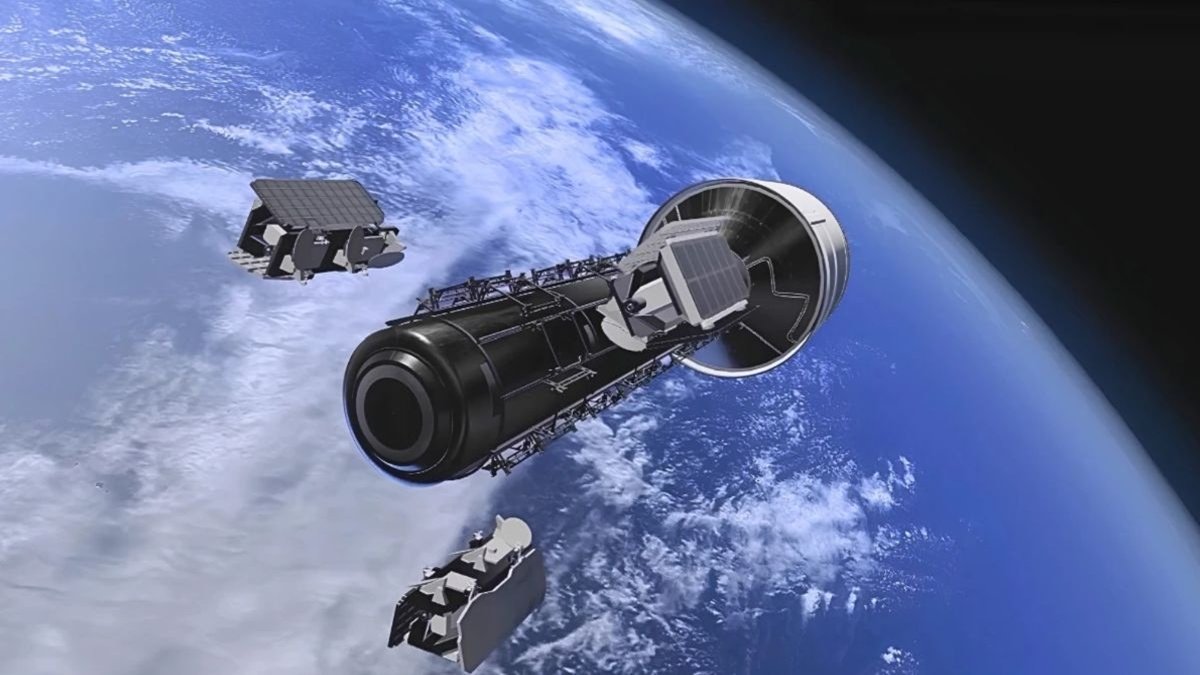
The European Ariane 6 rocket has set a new record by deploying 36 Amazon Leo satellites into orbit – more than ever before on a single mission. At first glance, this may look like a purely technical achievement. However, it reflects something broader: Europe’s return as an independent actor in the space race, intensifying competition between Amazon and Starlink, and the growing question of whether the Old Continent can catch up with American giants – or at least avoid falling further behind.
Read also: Weapons of Ukraine’s Victory: “Vyrivniuvach” Guided Glide Bomb
TABLE OF CONTENT:
The long-awaited return of Europe
On June 17, 2026, a rocket lifted off from the Kourou spaceport in French Guiana carrying far more than just 36 satellites. It carried the hope of an entire continent – hope that Europe has not only returned to the space arena, but is also ready to take part in it seriously.

In its Ariane 64 configuration – equipped with four upgraded P160C solid rocket boosters – Ariane 6 placed a record payload of Amazon Leo satellites into low Earth orbit. The mission carried 36 satellites instead of the 32 launched during the two previous missions in February and April. Those four additional satellites are more than just a statistical improvement. They carry symbolic weight. They suggest that Ariane 6 is no longer a costly promise confined to presentation slides at ESA headquarters, but a fully operational and commercially viable launch system for space missions.
To understand why this launch truly matters, it is necessary to step back and view the broader context – technological, commercial, and geopolitical.
Read also: Interview with Bell Textron: Investing in the future in Ukraine
Years of delays: how Europe ended up on the sidelines
Just ten years ago, Arianespace was the undisputed leader in commercial launches. Ariane 5 – powerful, reliable, and expensive – was delivering the world’s largest telecommunications satellites to geostationary orbit. At the same time, Russia was supplying Soyuz rockets for medium-class payloads, while Vega handled light launch missions. It was a balanced, if somewhat conservative, portfolio.
However, the market began to change rapidly. SpaceX did what most had considered impossible: it started recovering first-stage boosters, reduced launch costs, and – most importantly – raised flight cadence to a level Arianespace could only aspire to. Then came the era of mega-constellations – large-scale deployments of hundreds and thousands of small satellites in low Earth orbit. The traditional market of individual, high-value geostationary satellites began to lose its dominance.
Meanwhile, Ariane 6 continued to slip. First by a year. Then again. And again. A program designed to replace Ariane 5 and preserve Europe’s competitiveness in the launch market gradually became a chronic symbol of continental inertia – bureaucratic coordination across dozens of public and private stakeholders, and an inability to respond quickly to a rapidly shifting market.
At the same time, the situation deteriorated further. Vega C suffered an accident and was taken out of service for requalification. Following Russia’s invasion of Ukraine in 2022, Arianespace lost access to Soyuz rockets launched from Kourou, which had covered an entire segment of the market. Suddenly, Europe – a continent that had prided itself on independent access to space – found itself in a position where it effectively had no fully operational domestic launch capability. Even some ESA missions had to be launched on SpaceX’s Falcon 9. A painful and unprecedented precedent.
Read also: Middle Strike: How Ukraine Is Building a New Class of Medium-Range Strike Systems
What is P160C and why it matters
The technical core of the record-breaking launch is the new solid-fuel P160C side boosters. This is the next generation following the P120C, and the difference between them is significant: each P160C carries approximately 14 tonnes more propellant, which provides higher thrust during the initial, most energy-intensive phase of flight – when the rocket must overcome gravity and build up velocity.
The key advantage of this approach is modularity. The core structure of the Ariane 6 remains unchanged: upgrading the boosters allows for increased payload capacity without requiring a major redesign of the entire launch vehicle. For programs that need gradual capability scaling, this is a pragmatic and technically sound approach.
It is precisely due to the P160C that Ariane 6 was able to carry 36 Amazon Leo satellites – four more than ever before. From a commercial standpoint, this is significant: customers can deploy more satellites per launch, logistics are simplified, and the cost per satellite delivered to orbit is reduced.
However, it is important to be clear: even with the P160C, Ariane 6 does not match Falcon 9 in cost per kilogram of payload. The reason is straightforward and structural – reusability. SpaceX recovers and reuses the first stages of its rockets, allowing a significant portion of hardware costs to be amortized across multiple flights. Ariane 6, by contrast, is expendable: each launch requires a new vehicle. Over the long term, this represents a structural disadvantage that is difficult to offset through incremental improvements to the boosters alone.
Read also: The Ukrainian “Tryzub” Laser System: From Testing Grounds to the Front Line
Amazon Leo: the bet on orbital internet
Amazon Leo – the new name for what was previously known as Project Kuiper – is an ambitious bet by Amazon on the satellite broadband internet market. The goal is to deploy more than 3,200 satellites in low Earth orbit capable of providing high-speed internet access in regions where terrestrial infrastructure is unavailable. Rural areas, maritime operations, aviation, conflict zones, and island nations represent a genuinely global potential user base.
However, Amazon Leo is not only a technological initiative. It is also a direct response to SpaceX’s Starlink system. Elon Musk holds a substantial advantage in this domain: thousands of already operational satellites, a mature network infrastructure, and established commercial contracts, including with various governments and military users. Starlink has already demonstrated its strategic relevance, including during the war in Ukraine.
Amazon is entering this market with a delay, but with resources that are difficult to overstate. The company has signed agreements with multiple launch service providers – United Launch Alliance, SpaceX, Blue Origin, and Arianespace. This is a typical risk diversification strategy: avoiding dependence on a single supplier, maintaining competition among providers, and ensuring continuity of deployment even if one partner experiences disruptions. For Arianespace, the contract with Amazon is not only about 18 launches and significant revenue. It is also a validation of its status as a reliable market participant in an environment where reputation matters no less than technical capability.
Read also: Weapons of Ukraine’s Victory: The Hornet UAV, Also Known as “Martian-2”
The geopolitical dimension: why independent access to orbit is not just about rockets
What is happening with Ariane 6 is not solely a commercial issue. It is a matter of strategic sovereignty. In an era where low Earth orbit is becoming critical infrastructure – for communications, navigation, Earth observation, and early warning – states without independent access to orbit become structurally dependent on those that have it. This is a form of dependency that cannot be quickly eliminated: building a launch industry takes decades.
For Europe, this issue became more acute after 2022 than ever before. The gap was effectively filled by SpaceX, and filled well – but it meant that European Space Agency had to rely on an American private company even for its own scientific missions. For an organization that positions itself as a symbol of independent European space capability, this was an uncomfortable position.
Each successful launch of Ariane 6 is interpreted in two registers simultaneously: commercial and geopolitical. A reliable Ariane 6 flying on a regular cadence is not only a source of revenue for ArianeGroup and Arianespace. It is also a guarantee that Europe is not dependent on external goodwill when it needs to place into orbit a reconnaissance satellite, a space telescope, or a spacecraft for Solar System exploration.
Read also: Weapons of Ukraine’s Victory: FP-1 – A Drone Capable of Reaching Moscow
Tempo as a determining factor: what Ariane 6 still lacks
Despite clear progress, there is a fundamental issue that remains unresolved: launch cadence. Falcon 9 performs dozens of launches per year. In 2023 and 2024, SpaceX exceeded 90 missions annually. Ariane 6 has not yet reached even a small fraction of that figure.
Launch frequency is critical for several reasons. First, it directly affects unit cost: the more rockets produced and flown, the lower the cost per launch. Second, large constellation customers – such as Amazon – depend on a regular and predictable launch schedule. Delays slow down constellation deployment, which in turn delays revenue generation.
Third – and arguably most important – in the race of megaconstellations, time is a resource no less critical than technology. Starlink is already operational. Amazon’s Leo constellation is still in the deployment phase. Every month of delay is a month in which the competitor strengthens its position in the market.
Arianespace states ambitions to increase its launch rate, but the structural gap to SpaceX cannot be closed through technical improvements alone. Real competitiveness requires either radically lower costs (difficult to achieve with an expendable launch system), significantly higher launch cadence (which demands major investment in production capacity), or a clearly defined niche where Ariane 6 does not compete directly with Falcon 9 but instead occupies its own distinct role.
Launch market in 2026: a new architecture
The global launch services market today looks fundamentally different from what it was five or ten years ago. SpaceX dominates both in launch volume and price competitiveness. However, a monopoly – even an informal one – is undesirable for everyone: customers, governments, and even SpaceX itself, from the perspective of long-term market development.
Amazon, by working with multiple providers, is deliberately maintaining a diversified launch supply chain. This is a rational strategy: if an issue arises with Falcon 9 – and such events are always possible, as demonstrated by past grounding periods following anomalies – the availability of Ariane 6 as an alternative allows constellation deployment to continue without interruption.
From this perspective, successful launches of Ariane 6 for Amazon are not merely revenue for Arianespace. They represent support for a healthier competitive ecosystem in orbit. The more reliable providers exist, the lower the risk that access to space could one day become a monopoly controlled by a single company or a single state.
Read also: Weapons of Ukraine’s Victory: The “Shvidun” Interceptor Drone
What comes next: development scenarios
There are several possible trajectories for Ariane 6 in the coming years. The first scenario is gradual stabilization. Ariane 6 increases its launch cadence to around 6–8 missions per year, fulfills its contract with Amazon, attracts additional constellation operators, and establishes itself as a reliable, if expensive, launch system. This is a realistic and acceptable outcome, though not a particularly transformative one.
The second scenario is a technological leap. In parallel with Ariane 6, Europe is developing more ambitious systems, including Themis – a demonstrator for reusable first-stage technologies developed by ArianeGroup. If these efforts succeed and a future system such as an Ariane 7 class vehicle introduces first-stage reusability, Europe could achieve a significantly more competitive cost structure. However, this is at least a decade-long horizon.
The third scenario is stagnation and marginalization. If Ariane 6 fails to substantially increase its launch rate, if prices remain uncompetitive, and if new customers increasingly prefer Falcon 9 or China’s Long March family, Ariane 6 risks becoming a niche system used primarily for institutional missions – European Space Agency and national government payloads. It would formally remain operational, but lose commercial relevance.
Read also: Everything About Ukrainian Interceptor Drone JEDI Shahed Hunter
Record as a starting point, not a finish line
The record-breaking launch of 36 Amazon Leo satellites is a significant achievement that should be acknowledged without undue restraint. For a program long associated with delays and setbacks, it sends a strong signal: Ariane 6 is flying, it is capable of executing complex commercial missions, and it can expand its operational envelope.
However, it would be a mistake to interpret this launch as the end point of Europe’s return to space competitiveness. It is only the beginning – and arguably, the most difficult phase lies ahead. Sustaining cadence, maintaining reliability, attracting new customers, and defining a viable niche in a market shaped by SpaceX dominance are the real challenges facing Arianespace in the coming years.
At the same time, it is important to recognize that Ariane 6 has reached this point at all. After several difficult years for the European space industry – the loss of Soyuz access, the Vega C failures, and prolonged delays to Ariane 6’s debut – seeing it fly consistently and set records is more than an operational milestone. It is evidence that Europe has retained both the will and the capability to remain an independent actor in a domain where the stakes continue to rise.
The race to orbit is only beginning. And now, it once again has three serious players.
Read also: