While writing an article on the Northrop Gamma attack aircraft, I kept getting a sense of déjà vu: the idea of converting a civil light transport into an attack platform is still alive. A current and relevant example – particularly for Ukraine’s fight against hostile drones – is the AC‑208 Combat Caravan from Cessna.
TABLE OF CONTENT:
Base for the attack variant
The light single‑engined transport Cessna 208 Caravan first flew in December 1982; it was certified two years later and entered civilian service. A stretched version, the Cessna 208B Grand Caravan, followed, with a fuselage extended by 1.2 m and a more powerful engine. The type can carry 9–14 passengers, and cargo‑oriented variants exist – Cargomaster and Super Cargomaster, based on the 208 and 208B respectively. Aerodynamically it is a high‑wing monoplane with a straight wing and conventional empennage. The undercarriage is fixed, tricycle type. Power comes from a Pratt & Whitney Canada PT6A turboprop in various marks (the Grand Caravan commonly uses the PT6A‑114 rated at 675 shp). The design achieved wide use globally – more than three thousand Cessna 208 airframes have been produced – and the largest civilian operator is the FedEx courier service, which acquired around 300 aircraft in Cargomaster and Super Cargomaster configurations.
The Caravan and Grand Caravan’s reliable performance and low cost have made them popular in the air forces of several countries, particularly those with limited defense budgets. Grand Caravans serve as liaison aircraft across all three branches of the Colombian armed forces, as well as in the air forces of Brazil, South Africa, Chile’s army aviation, and several other nations. As of 2024, a total of 123 Cessna 208 aircraft were reported in military service worldwide.
Read also:
- First American Attack Aircrafts: Development Path, Part 1
- First American Attack Aircrafts, Part 2: Alternative Projects of the Early 1920s
- American Attack Aircraft, Part 3: The First Production Variants
- First American Attack Aircraft, Part 4: On the Eve of the 1930s
- First American Attack Aircraft, Part 5: Production A-12 “Shrike”
- American Attack Aircraft, Part 6: Experiments of the 1930s
- American Attack Aircraft, Part 7: John Northrop’s “Gamma”
Reconnaissance role
For nearly two decades, efforts to adapt the Cessna 208 for combat tasks in low-intensity conflicts have been ongoing and, by most accounts, reasonably successful. The Colombian Air Force was first to implement this approach: in 2007–2008 it received five Cessna 208B-ISR reconnaissance aircraft. These aircraft are fitted with a sensor suite comparable to systems used on the RQ-1 Predator UAV. The core of that suite is a Wescam MX-15D electro-optical turret mounted in a swivelling fairing beneath the fuselage. It provides day and thermal imaging for detecting ground targets, together with a laser rangefinder for distance measurement.
Reconnaissance Grand Caravans have proven to be an effective and low-cost alternative to unmanned systems for operations over areas with limited air-defense coverage. In addition to Colombia, such aircraft have been supplied to Jordan, Niger, Yemen, Guatemala, the Philippines, and several other countries.

Attack variant
As the Predator evolved from a pure reconnaissance platform into a multi-role ISR/strike asset, the Cessna 208 has undergone a similar transition to a combat variant. Equipping the transport with strike weapons to engage detected targets was a logical step. Rather than relying on improvised unguided ordnance, the conversion fitted the type with precision weapons – variants of the AGM-114 Hellfire missile: the AGM-114M with a laser homing seeker and the AGM-114K with a microwave-band radar seeker. The modification was developed under contract to the US government by Alliant Techsystems (ATK).
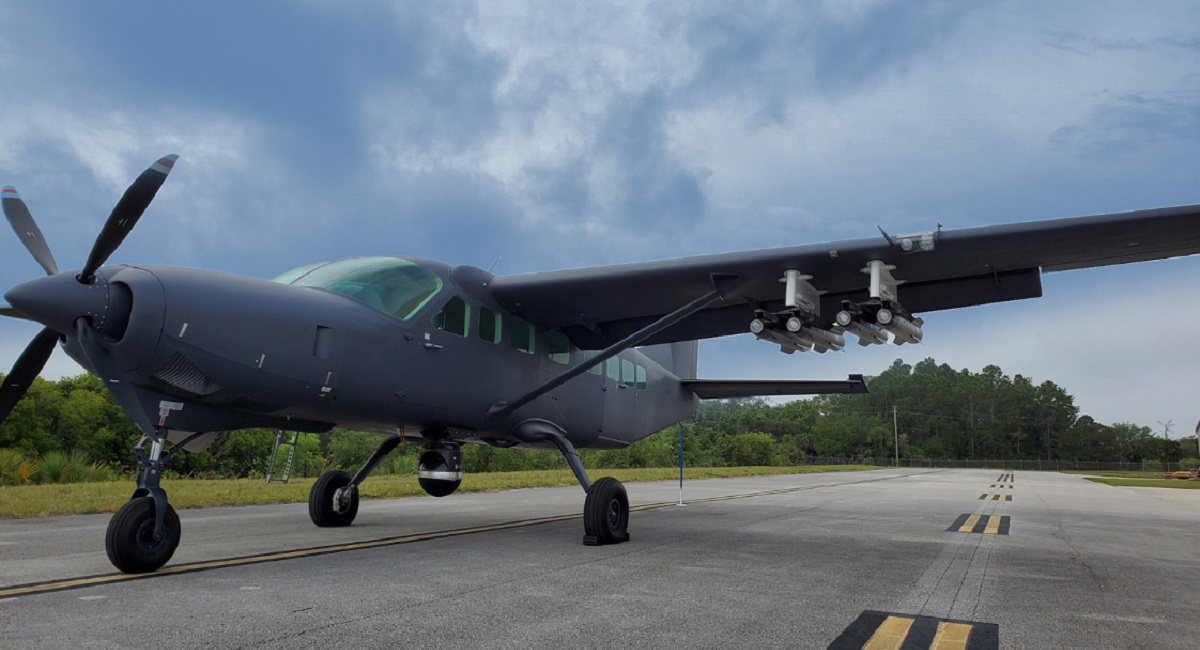
The attack variant was designated the AC-208B Combat Caravan. Compared with the reconnaissance version, it carries a substantially expanded suite of onboard avionics. In addition to the MX-15D electro-optical system, it is fitted with the STAR mission-management system and defensive avionics comparable to those found on conventional combat aircraft: an AN/AAR-60 missile-warning system and AN/ALE-47 countermeasure dispensers for launching chaff and flares. These additions materially improve survivability when operating over areas controlled by irregular armed groups, where man-portable air-defence systems of various types are commonly encountered.
The AC-208B’s armament is modest: four guided Hellfire missiles carried in pairs on two underwing pylons. That weapons fit and the aircraft’s sensor suite define its employment profile – armed reconnaissance: locate and identify targets (primarily small, mobile contacts such as vehicles) and engage them selectively. It is intended for targeted, point strikes rather than area bombing. The AC-208B has a three-person crew (two pilots and an operator), and its cockpit is protected with Kevlar armour.
The first customer for the Combat Caravan was Iraq. In this case (as with later exports), the order was placed by the U.S. government, and the aircraft were subsequently transferred as part of military aid. Between 2007 and 2009, Iraq received 11 aircraft – five C-208B transports, three RC-208B reconnaissance versions, and three AC-208B strike variants. The reconnaissance and attack aircraft were assigned to the 3rd Reconnaissance Squadron based in Kirkuk.
The AC-208B became the first armed aircraft in the newly reconstituted Iraqi Air Force. Their combat debut took place in January 2014, during operations against Islamist extremists in Anbar Province. The aircraft went on to play an active role in the subsequent campaigns against the militants. The statistics are telling: between mid-2014 and the end of 2017, the three AC-208Bs flew 3,459 sorties – nearly matching the 3,562 sorties conducted by 21 Su-25 attack jets.
Losses were inevitable: on March 16, 2016, one AC-208B crashed near Kirkuk. The cause remains disputed – official reports cited a technical malfunction, while militants claimed they had downed it using a 57 mm anti-aircraft gun. In October 2016, the U.S. announced plans to deliver two additional AC-208Bs to Iraq, though no confirmation of this transfer has surfaced.
Between 2010 and 2016, the Lebanese Air Force received three AC-208B aircraft. However, the largest operator of the type became Afghanistan. Starting in 2018, the country took delivery of at least 12 aircraft – and by August 2021, following the Taliban’s seizure of power, that same number reportedly fled to neighboring Tajikistan. The subsequent fate of these aircraft – which technically remained U.S. government property – remains unknown.
A drone hunter?
This raises the question: could the AC-208B serve as a drone hunter for us? The aircraft’s onboard sensors – in particular the MX-15D – are well suited to detecting small aerial targets. Its armament is less ideal: Hellfire missiles can theoretically engage airborne targets but are not optimized for that role, and, to my knowledge, other weapon types have not been integrated on the AC-208B.
Still, with minimal modification it would likely be possible to replace the paired Hellfire launchers with a seven-round rack for APKWS II rockets. That would increase the onboard munition count by a factor of 3.5 – from four to 14 rockets – and correspondingly improve the aircraft’s effectiveness against massed air attacks. The AC-208B’s speed profile is modest, but Shahed-type loitering munitions have been shot down by much slower helicopters, so speed alone is not necessarily disqualifying. Given this, it may be worth investigating the whereabouts of the Afghan AC-208Bs and whether any could be transferred to us.
In this context, it’s worth mentioning the newest armed variant of the Cessna 208B – the MC-208B Guardian. Developed by MAG Aerospace, it was proposed for the U.S. Special Operations Command, but ultimately lost the competition to the OA-1K.
The MC-208B differs notably by an increase in underwing hardpoints – from two to four – and a broader weapons palette that explicitly includes APKWS II rockets.
Read also: