As mentioned in the previous part, in 1925 the leadership of the U.S. Army Air Service concluded that large, armored aircraft were unsuitable for direct support of ground forces. What was needed were much lighter, faster, and more maneuverable attack aircraft. Rather than designing these from scratch, existing reconnaissance planes could be converted. Obvious candidates for such a conversion were the Curtiss O-1 Falcon and Douglas O-2, adopted by the Army Air Service as replacements for the DH-4B and DH-4M. Both were very similar two-seat, single-engine biplanes of mixed construction, featuring metal-framed fuselages and wooden wings. The near-simultaneous adoption of two aircraft with similar roles and characteristics reflected the requirements set by the military.
To cover their bases, the U.S. Army held a competition for two reconnaissance variants: one using the older but proven Liberty engine, and the other fitted with the new Packard 1A-1500. In the end, the Douglas prototype performed better with the Liberty engine, while the Curtiss excelled with the Packard. As a result, both companies received orders, and their reconnaissance aircraft became the foundation for long-running attack aircraft lines produced into the mid-1930s. However, production O-1s were equipped with Curtiss D-12 (V-1150) engines instead of the Packard units.
Read also:
- First American Attack Aircrafts: Development Path, Part 1
- First American Attack Aircrafts, Part 2: Alternative Projects of the Early 1920s
TABLE OF CONTENT:
ХА-2 and ХА-3
In 1926, the U.S. Army Air Corps (renamed that year from the Army Air Service) approached Douglas and Curtiss to develop attack aircraft based on their reconnaissance planes. These aircraft were designated XA-2 and XA-3. Why start with “2”? The designation XA-1 had already been assigned to a Cox-Klemin ambulance aircraft. Under the old system, the letter “A” stood for Ambulance; in the new system, it indicated Attack.
The requirements called for minimal changes to the base aircraft: reinforcing the forward-firing machine guns and adding mounts for small bombs. Armor protection was not included, as adding it would have significantly increased the aircraft’s weight and, in turn, reduced its flight performance.

When comparing the attack prototypes from the two companies, it’s worth noting that the XA-2 differed much more from the base O-2 than the XA-3 did from the O-1. Douglas engineers considered the liquid-cooled engine, due to its vulnerability, poorly suited for an attack aircraft. They replaced the standard Liberty engine with a 420 hp Allison VG-1410, essentially a Liberty unit modified for air cooling. The armament was also significantly upgraded. Instead of the O-2’s standard two 7.62 mm machine guns (one synchronized, one in the turret), the XA-2 carried eight: six Brownings (two synchronized, two in the upper wing, and two in the lower wing) and two Lewis guns in the turret. Under the wings, four hardpoints could carry 100 pounds (45.4 kg) of bombs – some sources cite up to 200 pounds (90.8 kg).
The XA-2 prototype was ordered in March 1926. It was not built from scratch but converted from the 46th serial O-2 (military number 25-380).
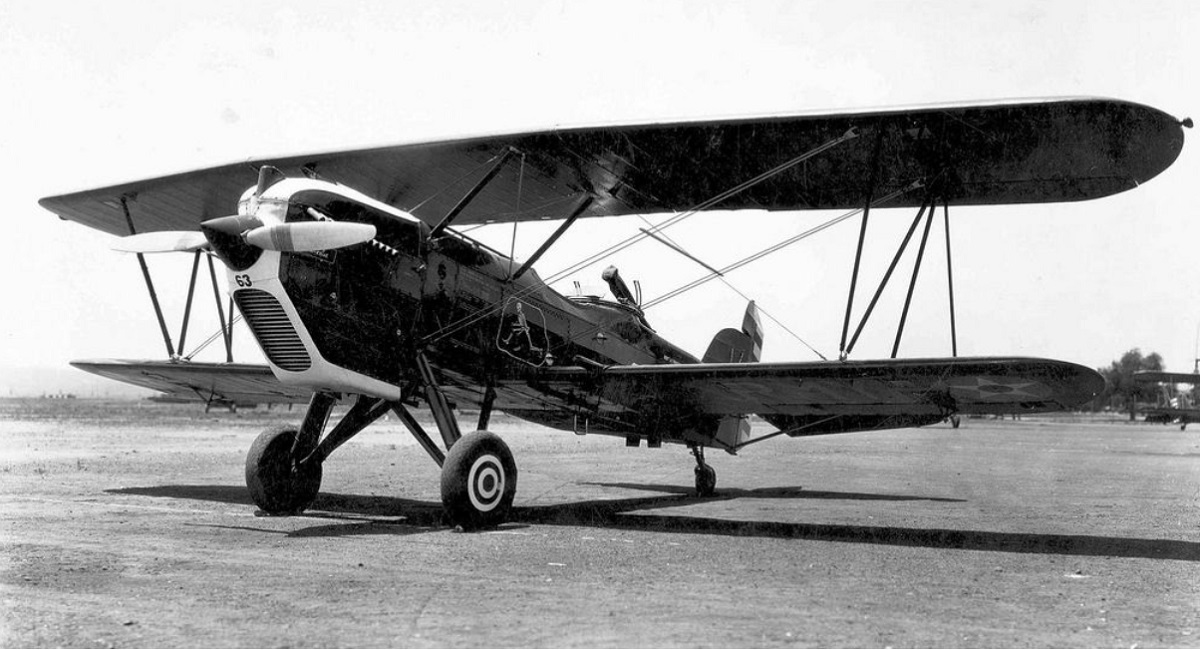
Rex Beisel, the designer of the “Curtiss-style” O-1, took the opposite approach, aiming to make minimal changes. The O-1B reconnaissance model served as the base, differing from the early production Falcons only in minor upgrades, such as the addition of wheel brakes and the option to mount an auxiliary fuel tank under the fuselage. The Curtiss V-1150-3 (D-12D) engine remained unchanged, and the offensive armament was only slightly enhanced: the XA-3 was equipped with two 7.62 mm Browning machine guns mounted in the lower wing, outside the propeller disc, eliminating the need for synchronizers. Bomb load capacity could reach 200 pounds, while defensive armament consisted of two Lewis guns on a turret for the observer.
The XA-3 prototype was ordered on August 2, 1926. It was modified from the first production O-1B (serial 27-243) and sent for testing on October 31, 1927. Due to the distinctive shape of its propeller cowling, pilots nicknamed the aircraft the “Eversharp Pencil.”
The competition results were disappointing for Douglas: engine cooling issues rendered their prototype unsuitable for combat use. Ultimately, Curtiss secured three contracts for production of the A-3 attack aircraft (company designation: Model 44). The first contract involved converting 20 existing O-1Bs, including the XA-3 and XA-4 prototypes (serials 27-243 to 27-262). The other two contracts called for 20 (serials 27-298 to 27-317) and 26 new aircraft (serials 28-83 to 28-118), respectively. In total, 66 A-3 aircraft were ordered, six of which were later converted into A-3A trainers with dual controls.
The second series of Curtiss attack aircraft was based on the O-1E reconnaissance model, which featured improved aerodynamics, a modified tail, and pneumatic landing gear shock absorbers. The V-1150-5 (D-12E) engine retained the same power output but offered better overall performance. This updated attack aircraft, designated A-3B (Model 37H), received enhanced armament, including two additional synchronized machine guns, bringing the total to six. During the 1930 fiscal year, 78 A-3Bs were ordered (serials 30-1 to 30-28 and 30-231 to 30-280), with deliveries completed by the end of 1930.
ХА-4
The drawbacks of liquid-cooled engines were clear: even minor damage could cause coolant leaks and engine overheating. Air-cooled engines offered significantly better durability. Early attempts to use them in attack aircraft were unsuccessful – the V-shaped VG-1410 engine failed to adequately cool the rear cylinders. Radial engines proved more promising.
One such engine was tested on the second A-3 (serial 27-244), which was designated XA-4 and fitted with a 410 hp Pratt & Whitney R-1340-1 Wasp. Although its performance was similar to the A-3 and its weight was even reduced, it was not adopted for operational use. However, it became the basis for the F8C carrier-based fighter. The XA-4 continued to be used for various tests until 1932.
Two more variants, the XA-5 and XA-6, remained on paper. The XA-5 was an attack version of the XO-16 reconnaissance aircraft, another member of the Falcon family. It existed as a single prototype and was distinguished by its powerplant – a 12-cylinder liquid-cooled Curtiss V-1570 Conqueror engine producing 600 hp. The XA-6 was derived from the XO-18 and also remained a prototype. It was equipped with a Curtiss H-1640 Chieftain, an experimental 12-cylinder, two-row, air-cooled radial engine.
The delivery of around 150 new attack aircraft allowed three squadrons of the 3rd Attack Group to be re-equipped between 1928 and 1930. A fourth squadron, which had been disbanded in 1924, was reactivated in 1930 in Hawaii, becoming the first attack squadron stationed outside the continental United States. In 1929, units of the group were involved in patrolling the border with Mexico.
In 1932, the A-3 began to be replaced by more modern aircraft. Retired Falcons were transferred to training units, with most being withdrawn from service by 1936. The last A-3B (serial 30-13) was retired in October 1937, having logged 2,850 flight hours.
The A-3 became the first widely used attack aircraft in the U.S. Army Air Corps. Its introduction allowed pilots and units to develop tactics for employing attack aircraft effectively. By the early 1930s, however, the A-3 was already considered outdated. The process of selecting a new attack aircraft began, with Curtiss once again emerging as the winner. But that story comes next.
Read also: