The GA-1 and GA-2 aircraft, discussed in the first part of this series, were not the only early American attempts at developing ground-attack planes. In 1921, the Engineering Division team led by Isaac Laddon (the designers of the GA-1 and GA-2) created a lighter attack aircraft, the PG-1. The designation stood for Pursuit Ground – roughly translated as “ground fighter” or, in contemporary English terms, something like a “trench fighter.” A contract to build three prototypes (military serial numbers 64244–64246) was awarded to Aeromarine in May 1921.

Read also: The First American Attack Aircrafts: Development Path, Part 1
TABLE OF CONTENT:
PG-1
The PG-1 was a single-engine, single-seat biplane with the upper wing slightly larger in span and surface area than the lower one. To improve visibility, the upper wing was mounted level with the top of the fuselage. Even so, the pilot’s forward view was poor, as the radiator had to be placed above the engine directly in front of the cockpit. The upper and lower wings were connected with V-shaped struts.
As intended for its role, the PG-1 featured armor protection: a box of 6.35 mm plates shielded both the engine and the pilot. Its armament consisted of a 37 mm Baldwin cannon firing through the engine shaft, along with a synchronized 12.7 mm machine gun. No bomb load was included in the design.
The PG-1 was initially designed to use an 8-cylinder Wright K-2 engine (an evolution of the Wright-Hispano H) rated at 300 hp. However, the engine development lagged behind the aircraft design, so the first PG-1 prototype, which went for testing on August 22, 1922, was fitted with a Wright-Hispano H engine. The second prototype received a 12-cylinder V-type Packard 1A-1116 engine (346 hp), but it crashed on its first flight. The third PG-1 was initially tested with a Packard 1A-1237 before finally receiving the intended Wright K-2 engine.
Test results were disappointing: the aircraft had low performance, poor cockpit visibility, and significant vibration issues. As a result, it was not adopted for service. The two surviving prototypes were used for weapons testing for a short period afterward.
IL-1
The PG-1 was initially designed to use an 8-cylinder Wright K-2 engine (an evolution of the Wright-Hispano H) rated at 300 hp. However, the engine development lagged behind the aircraft design, so the first PG-1 prototype, which went for testing on August 22, 1922, was fitted with a Wright-Hispano H engine. The second prototype received a 12-cylinder V-type Packard 1A-1116 engine (346 hp), but it crashed on its first flight. The third PG-1 was initially tested with a Packard 1A-1237 before finally receiving the intended Wright K-2 engine.
Test results were disappointing: the aircraft had low performance, poor cockpit visibility, and significant vibration issues. As a result, it was not adopted for service. The two surviving prototypes were used for weapons testing for a short period afterward.
On January 26, 1920, Orenco (Ordnance Engineering Corporation) received a contract to build two IL-1 prototypes (military serial numbers 63273 and 63274). According to the company’s press release, in 1920 it was producing two types of aircraft: the “armoured fighter” model E and the “infantry liaison” model E2. This has led to some uncertainty about whether both IL-1 prototypes were identical – one may have been model E and the other E2. Testing of the IL-1, which began on March 21, 1921, proved disappointing. The aircraft was considered too heavy, and its flight performance was poor.
JL-12
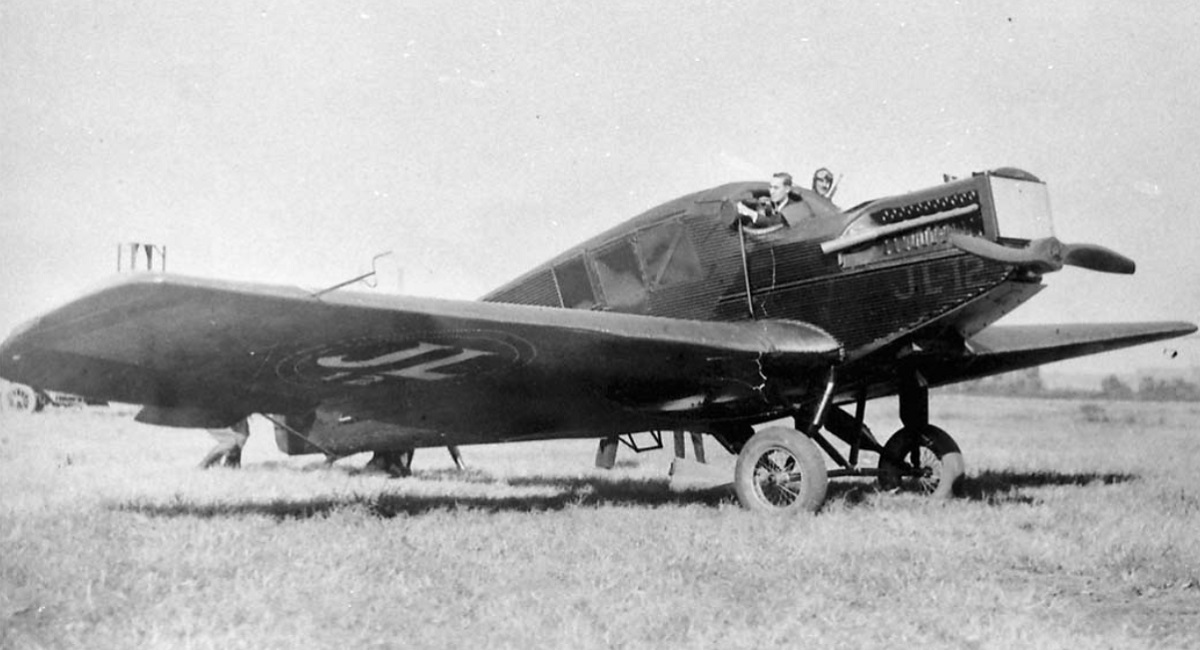
Another early attack aircraft worth mentioning was developed privately, unlike the previously discussed designs. John Larsen, owner of J.L. Aircraft Corporation – which supplied Junkers F13 passenger planes in the U.S. – created the JL-12. Based on the F13, the JL-12 was modified with armor and a more powerful Liberty engine. Both the two-person cockpit and the engine were protected by 3.57 mm (9/64 inch) armor plates. The wings and fuselage retained the corrugated sheet metal of the civilian F13, but at twice the original thickness, measuring 0.635 mm (0.025 inch).
The most striking feature of the JL-12 was its armament: thirty 11.43 mm Thompson submachine guns. Two were mounted on movable defensive positions in the cockpit windows, while the remaining 28 were installed in two fuselage-mounted batteries. The forward battery, positioned just behind the pilot’s seat, contained 12 Thompsons angled forward and downward. The rear battery had 16 guns: eight fired straight down, and eight were angled backward and downward. Three levers controlled firing: one for the front battery, one for the rear, and one to fire both simultaneously. Ammunition came from 100-round drum magazines, with three spare magazines provided for each Thompson.
According to the designer, reloading all 28 submachine guns should take the onboard gunner no more than four minutes. In practice, this proved much more difficult: handling the relatively heavy 4.5 kg magazines inside a cramped fuselage – especially on a maneuvering aircraft – took significantly longer. In combat conditions, it would likely have been impossible.
In November 1921, Larsen attempted to interest the Polish government in his “monster.” Since the JL-12 prototype was still overseas, Polish military personnel used a civilian Junkers F13 to get a preliminary sense of the aircraft’s capabilities. Even brief tests were enough to demonstrate that the concept was impractical for combat use. In December 1921, Larsen delivered the JL-12 to the U.S. Army for evaluation. The results were equally disappointing: the aircraft was difficult to handle, the armament was of “questionable effectiveness,” and Larsen’s asking price seemed excessive. This effectively ended the JL-12’s development, and it never entered service.
Larsen’s ideas resurfaced two decades later in the Soviet Union with the creation of an attack variant of the Tu-2, the Tu-2Sh, which was armed with as many as 88 PPSh submachine guns. However, like the JL-12, this aircraft remained a one-off prototype.
In a 1925 report on the state of U.S. Army aviation, the section on attack aircraft noted that “the experiment with heavily armed, armored GA-class aircraft failed.” The authors argued that the armor significantly reduced speed and maneuverability while failing to provide meaningful protection, as even rifle-piercing rounds could penetrate it. The angled machine-gun mounts were also criticized for making accurate aiming impractical. The conclusion was clear: effective close air support required much lighter, faster, and more maneuverable attack aircraft – topics that will be discussed in the next installment.
Read also: