Readers may recall that in the tenth article of this series on U.S. attack aircraft of the interwar period, we noted the gradual evolution of this class toward light bombers. Gun armament, which American specialists in the 1920s and early 1930s had considered the primary weapon of attack aviation, receded into a secondary role. Bombs became the main means of engaging ground targets.
In 1939–1940, the 3rd and 17th Attack Groups were reorganized into bomber units, replacing their single-engine Northrop A-17 attack aircraft with twin-engine Douglas B-18 bombers. As a result, attack aviation effectively ceased to exist as a distinct branch. However, aircraft designated with the letter “A” continued to be produced, although they were assigned to bomber and fighter-bomber units rather than dedicated attack formations.
This article provides a brief overview of these aircraft, focusing exclusively on production models. Experimental attack aircraft are left outside the scope of this discussion, as they merit separate, more detailed treatment due to the unusual and unconventional designs involved.
Read also:
- First American Attack Aircrafts: Development Path, Part 1
- First American Attack Aircrafts, Part 2: Alternative Projects of the Early 1920s
- American Attack Aircraft, Part 3: The First Production Variants
- First American Attack Aircraft, Part 4: On the Eve of the 1930s
- First American Attack Aircraft, Part 5: Production A-12 “Shrike”
- American Attack Aircraft, Part 6: Experiments of the 1930s
- American Attack Aircraft, Part 7: John Northrop’s “Gamma”
- American Attack Aircraft, Part 8: Contribution of Gerard Valtí
- American Attack Aircraft, Part 9: Northrop A-17
- American Attack Aircraft, Part 10: Douglas Export Models
TABLE OF CONTENT:
The Twin-Engine Boston
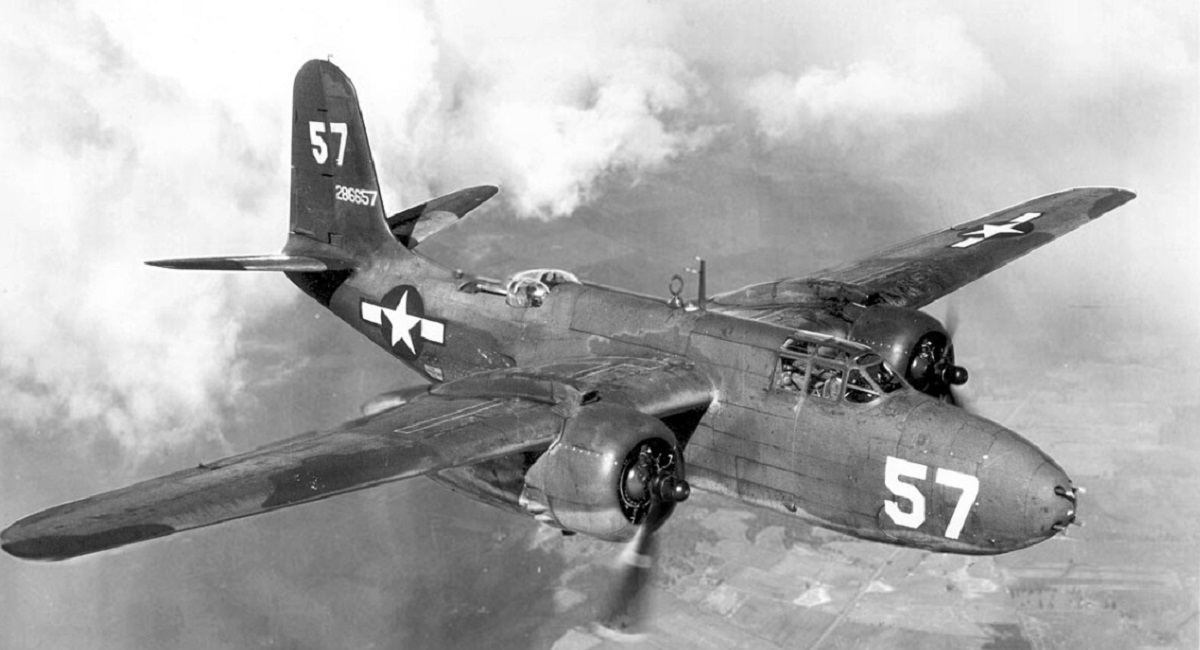
The first company to identify a path toward transforming the traditional attack aircraft concept was Curtiss – readers may recall the limited-production twin-engine A-18 discussed earlier. However, in competition for large-scale contracts, it lost out to another aircraft that became widely known as the Boston. Strictly speaking, this was not an American designation but the British name assigned to aircraft delivered to the United Kingdom under Lend-Lease. The same name was also used in the Soviet Union. In general, this aircraft – essentially a light bomber by role but designated as an attack aircraft – was known under several names, reflecting a relatively complex development and service history.
The story began in March 1936, when Ed Heinemann at Northrop’s design bureau produced the first drawings of the Model 7A. This was a twin-engine, all-metal high-wing aircraft featuring a tricycle landing gear with a retractable nose wheel – an advanced configuration for its time.
Initial design work was undertaken as a private venture, without a formal military requirement. This approach ultimately proved justified. In 1937, the U.S. Army issued official requirements for a new attack aircraft, calling for a minimum speed of 200 mph (322 km/h), a range of 1,200 miles (1,930 km), and a bomb load of 1,200 lb (544 kg). By that point, Northrop already had a developed concept in the form of the Model 7A. According to preliminary calculations, it met the speed requirement but fell short in bomb capacity.
The design was subsequently revised. More powerful Pratt & Whitney R-1830-S3C3-G engines were specified, fuel capacity was doubled, and the projected bomb load was increased to 908 kg. These changes brought the aircraft closer to the Army’s expectations and laid the foundation for what would become one of the most widely used light bombers of the early Second World War period.
The forward fuselage could be configured in two ways: a glazed nose with a navigator-bombardier position, or a solid nose housing a battery of machine guns, bringing the aircraft closer to a “true” attack role. In the first configuration, the crew consisted of three members; in the second, two. Defensive armament in both cases comprised two 7.62 mm machine guns mounted in retractable dorsal and ventral turrets. The aircraft received the designation Model 7B, and its further development was carried out by Douglas, which had acquired Northrop, with Ed Heinemann continuing his work there.
The Model 7B prototype made its first flight on 26 October 1938. During testing, the aircraft demonstrated good speed, notably high maneuverability for a twin-engine design, and no significant handling issues. It was flown with both nose configurations, which were designed to be interchangeable. Although the U.S. military was slow to place orders and the prototype was lost in a crash on 23 January 1939, the Douglas design was commercially successful as war loomed in Europe.
France became the first customer. On 17 August 1939, a revised prototype designated DB-7, modified to meet French requirements, took to the air, and series production began in October. Total production ultimately reached nearly 7,500 aircraft.
Variants
I will not cover the full range of DB-7 variants here, focusing instead only on those that entered service with the U.S. Army Air Forces. These were the versions that carried the “attack” designation A-20. Foreign operators – primarily France, the United Kingdom, and, notably, the Soviet Union – did not plan to employ these aircraft as attack aircraft even in theory, instead using them strictly in light bomber roles.

The first A-20 aircraft began entering U.S. Army Air Forces combat units in the spring of 1941, after the most urgent export orders for France (prior to its capitulation) and the United Kingdom had been fulfilled. All U.S. variants were powered by 14-cylinder, air-cooled Wright R-2600 engines in various subtypes, rated at approximately 1,600 hp.
The early versions – A-20 (63 aircraft), A-20A (123), A-20B (999), and A-20C (948) – featured a glazed nose with a navigator-bombardier position. These aircraft were essentially light bombers, capable of carrying up to 940 kg of bombs. At the same time, they retained elements of “attack” armament in the form of fixed forward-firing machine guns mounted in the nose: four 7.62 mm guns on the initial versions, and from the A-20B onward, two 12.7 mm guns. The primary purpose of this armament was the suppression of enemy air defenses during low-level attacks. In addition, the aircraft were equipped with defensive machine-gun positions, typically a twin 7.62 mm or a single 12.7 mm gun in the dorsal position and a single 7.62 mm gun in the ventral position.
A markedly different armament configuration was introduced on the A-20G variant. Its solid nose housed six 12.7 mm machine guns; the first production batch instead carried four 20 mm cannons and two 12.7 mm machine guns. Defensive armament consisted of two to three machine guns of the same caliber – one or two in the dorsal position and one ventrally. The bomb load was increased to as much as 1,800 kg (for comparison, the most widely used Soviet frontline bomber, the Pe-2, could carry a maximum of 900 kg).
The A-20G became the most widely produced version, with 2,850 aircraft built. Notably, this output was achieved over a relatively short production run of 15 months, from March 1943 to June 1944. In addition, between February and September 1944, 412 A-20H aircraft were produced. These were broadly equivalent to late-production A-20G aircraft but were fitted with a different engine variant. At the same time, the A-20J (450 units) and A-20K (413 units) were manufactured. These versions corresponded to the A-20G and A-20H respectively, but featured a glazed nose and retained only two forward-firing 12.7 mm machine guns.
From July 1942, U.S. A-20s operated over occupied Europe while based in the United Kingdom. Later, during operations over Sicily and mainland Italy, they gradually shifted from daytime to nighttime missions, functioning primarily as conventional bombers. During Operation Overlord in June 1944, three A-20G/J groups took part. In addition to supporting the landing forces, they were tasked with strikes against V-1 flying bomb launch sites. In the autumn of 1944, all three groups were redeployed to France.
In September 1944, A-20s participated in attempts to support British airborne forces at Arnhem and subsequently conducted bombing attacks against the Siegfried Line fortifications along Germany’s western border. In December 1944, A-20 units played a particularly active role in countering the German offensive in the Ardennes.
In the Pacific theater, during fighting in New Guinea and the Philippines, A-20s were employed more in line with their original role as attack aircraft. In this context, they were used against both ground and maritime targets.
Without going into detail on A-20 service in other countries, it is worth noting that the largest operator of these aircraft was the Soviet Air Force, which received 2,917 units (the U.S. Army Air Forces operated roughly 2,000 A-20s). The majority were the “attack” A-20G variant. As of 1 May 1945, two-thirds of the 995 “Bostons” in Soviet service belonged to this version.
However, due to their effective navigation and communications equipment and relatively large bomb load, Soviet A-20s were employed exclusively as bombers rather than attack aircraft. In Soviet Naval Aviation, they were also used as torpedo bombers. The last of these aircraft remained in service until 1945.
Read also:
- Everything About Three Generations of PC-7: Predecessor of Pilatus Turboprop Aircraft Family
- Light Fighters: Useful Option or an Unnecessary Substitute?
Invader
Beginning in January 1941, development of a successor to the A-20 was carried out under the direction of Ed Heinemann. The new aircraft was designed as a mid-wing monoplane with a laminar-flow wing, a single vertical tail, and Pratt & Whitney R-2800-27 engines rated at 2,000 hp. Compared with the A-20, the bomb bay was significantly enlarged, with capacity for up to 1,814 kg of bombs or two torpedoes. Defensive armament consisted of remotely operated dorsal and ventral turrets, each equipped with a pair of 12.7 mm machine guns.
The project was approved by the military, and in June 1941 three prototypes were ordered: the three-seat XA-26 bomber with a glazed nose, the two-seat XA-26A night fighter equipped with radar, and the three-seat XA-26B attack aircraft with a solid nose mounting a 75 mm cannon. Ultimately, the night fighter variant was abandoned, as was the concept of heavy cannon armament for the attack version. The aircraft, designated A-26 Invader, entered production in two main configurations: a machine-gun-armed attack aircraft and a bomber.
Series production began in September 1943, although only seven aircraft were completed by the end of that year; full-scale deliveries followed in 1944. By August 1945, a total of 2,523 production aircraft had been built. Of these, 1,359 were A-26B attack variants with a solid nose initially housing six 12.7 mm machine guns. During production, this number was increased to eight, with an additional six installed in the wings, bringing the total forward-firing armament to fourteen machine guns. Underwing hardpoints were also introduced, allowing the carriage of up to fourteen 127 mm unguided rockets. A further 1,144 aircraft were produced as the A-26C, featuring a glazed nose and only two forward-firing 12.7 mm machine guns.
In the Pacific theater, the A-26 made its combat debut in June 1944, while in Europe it entered service in September of the same year. As with the A-20, the aircraft were primarily used as bombers in Europe, whereas in the Pacific they operated in their original attack role.
The Invader also saw action during the Korean War, but by that time it was employed exclusively as a bomber rather than a designated attack aircraft. This change reflected a broader organizational shift: in 1948, the U.S. Air Force officially eliminated the attack aircraft category, and the A-26B/C were redesignated B-26B/C.
From 1951 onward, over 200 Invaders were delivered to France, which actively employed them during combat operations in Indochina and Algeria. During the 1950s, dozens of B-26 aircraft were transferred to various other countries, including Brazil, Chile, Colombia, Cuba, Guatemala, and Indonesia. They were also used in covert CIA operations. The last Invaders remained in service with the air forces of several “Third World” countries until the mid-1970s.
Almost two decades after the end of World War II, the Invader returned to U.S. military service. Between 1964 and 1965, forty aircraft were modified for counterinsurgency operations in Indochina. The upgrades included more powerful engines, eight underwing pylons for ordnance, and the removal of unnecessary defensive machine-gun positions. These aircraft were initially designated B-26K, and in 1966 this was changed to A-26A. In this way, the aircraft came full circle – returning to its original role as an attack aircraft.
Read also: