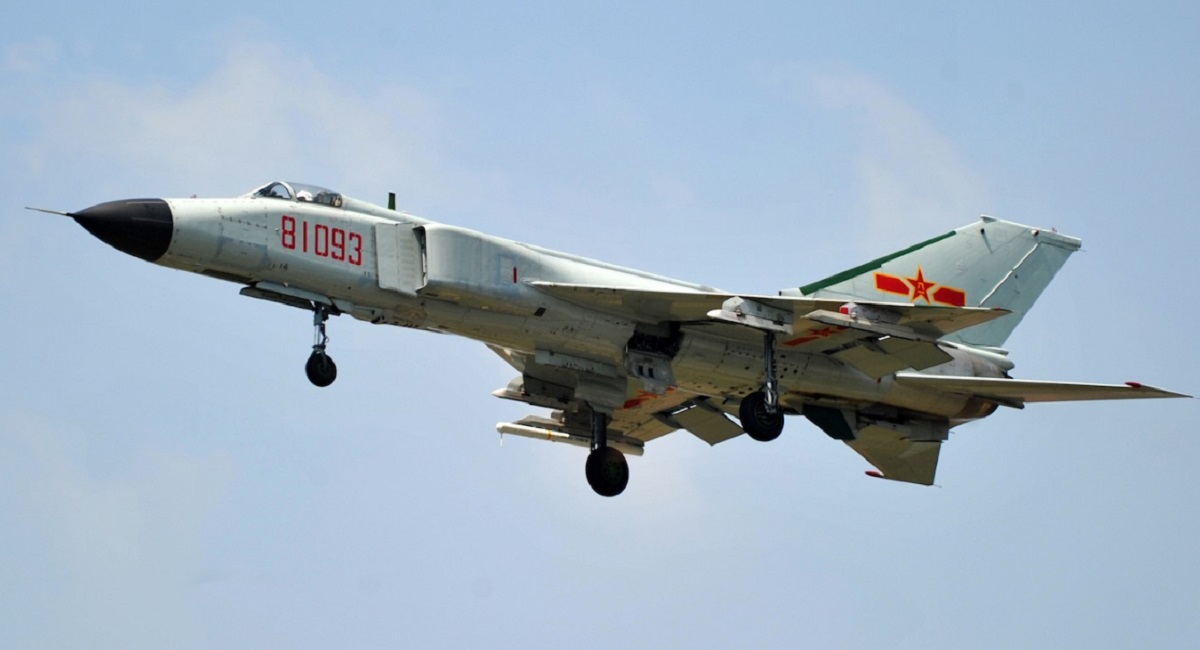
In June of this year, the J-8 was officially phased out of service – the first jet fighter designed in China and accepted into operational use. Its path toward full maturity was long, but ultimately remained unfinished.
TABLE OF CONTENT:
How It All Began
By the early 1960s, China had established licensed production of Soviet-designed jet fighters, including the J-5 (MiG-17) and J-6 (MiG-19), and was preparing to manufacture the J-7 (MiG-21). However, all of these aircraft belonged to the light fighter class. Within the future structure of the People’s Liberation Army Air Force, there was a need for heavy interceptor fighters intended to engage high-speed, high-altitude targets.
Development of such an aircraft began in 1964. As relations with the Soviet Union had deteriorated by that time, China had to pursue the project independently – albeit still drawing on certain Soviet technologies and design concepts. The primary requirements for the new aircraft were high speed, strong rate of climb, and a high service ceiling. Less emphasis was placed on achieving superior maneuverability.

The aircraft, which first flew on July 5, 1969, was designated J-8. It bore a strong resemblance to the Soviet experimental interceptor E-152 designed by A. Mikoyan. The twin-engine aircraft featured a nose air intake with a central cone housing the radar antenna. Its delta wing was mounted in a mid-fuselage position, and the tailplane was swept.
Development and refinement of the J-8 continued for nearly a decade. Low-rate initial production of the new interceptor began only in the second half of 1979. However, even by that time, Chinese engineers had not succeeded in developing a radar system capable of all-weather combat operations. As a result, the first production J-8 aircraft were built in a day-fighter configuration, equipped only with an optical sight and an SR-4 radar rangefinder.
The powerplant consisted of two WP-7A turbojet engines (the same type used in the single-engine J-7 fighter). Maximum thrust was 4,400 kgf, with afterburner thrust reaching 6,000 kgf. The aircraft’s armament included two 30 mm Type 30-1 cannons with 200 rounds each, as well as two PL-2 air-to-air missiles (a copy of the Soviet R-13, itself derived from the American AIM-9B Sidewinder). Only a small batch – around 20 aircraft – was produced. These J-8s did not enter operational combat units and were used exclusively in training centers.
On April 24, 1981, the improved J-8-I interceptor fighter made its first flight. This variant, also designated J-8A, was designed for all-weather operational capability. Serial production of the modification began the following year. The J-8-I was equipped with an SL-7A radar system with a detection range of up to 40 km. Its internal armament consisted of a single 23 mm twin-barrel Type 23-3 cannon, while external stores included up to four air-to-air missiles mounted on underwing pylons. The aircraft could also carry external fuel tanks to extend its operational range.
The J-8-I interceptor was formally accepted into service on July 27, 1985. Depending on different estimates, between 50 and 150 J-8-I aircraft were produced. They entered service with several units, including the 1st and 3rd fighter aviation regiments of the 1st Division.
From 1990 onward, J-8-I aircraft underwent modernization, including the installation of a new radar system and a radar warning receiver, among other upgrades. The upgraded version was designated J-8E. In the 1990s, a portion of the J-8-I fleet was converted into the reconnaissance variant JZ-8. These aircraft had their cannons removed, and a compartment for photographic equipment was installed in the nose section of the fuselage. An additional pod carrying aerial cameras or a side-looking radar could be mounted under the fuselage.
Read also:
- End of an Era: The Retirement of the American AV-8B Harrier II
- Last of Mohicans: A-4 Skyhawk Attack Aircraft in Argentina and Brazil
Radical Redesign
Even the modernized J-8-I no longer met contemporary operational requirements. One of its inherent limitations was the design of the forward fuselage, which featured a nose-mounted air intake with a central cone. This configuration prevented the installation of a more powerful radar system with a larger antenna. As a result, work on a radically upgraded variant, the J-8-II, began as early as April 1981. The aircraft received a completely redesigned nose section: the nose intake was replaced with twin lateral air intakes, similar in layout to those used on the MiG-23. The MiG-23 also influenced the adoption of a ventral folding fin.
These improvements became possible following detailed studies of several MiG-23 aircraft acquired from Egypt by Chinese engineers. Overall, the structural similarity between the J-8-I and J-8-II does not exceed 70%, which allows the J-8-II to be regarded as a fundamentally new aircraft rather than a simple upgrade of its predecessor.
The increased weight of the J-8-II required a corresponding upgrade of its propulsion system, and the aircraft was fitted with WP-13A-II engines, each delivering 6,700 kgf of thrust in afterburner. The fighter was equipped with an SL-4A (Type 208) monopulse radar with a detection range of approximately 40 km.
Its internal armament remained consistent with the previous model, while external stores included up to four air-to-air missiles of the PL-5 or PL-8 type. The PL-5 was an improved version of the earlier PL-2, whereas the PL-8 was a licensed copy of the Israeli Python-3 missile, introduced into service in 1988. Both systems were short-range missiles equipped with infrared homing seekers.
The J-8-II prototype (J-8B) first flew on June 12, 1984, while testing of the J-8-IIВ variant began in November 1989. There are significant discrepancies in available sources regarding its avionics and missile armament. Russian sources state that the J-8-IIВ is equipped with an SL-8A (Type 208A) radar with a detection range of up to 70 km, capable of guiding semi-active radar homing missiles. In contrast, American sources claim that the aircraft is armed only with short-range infrared-guided missiles. However, all sources agree that its internal armament consists of a single 23 mm twin-barrel cannon.
The J-8B entered serial production and was officially adopted into service by the Chinese Air Force in December 1995. Its naval aviation variant was designated J-8-IID (J-8D). This version featured an in-flight refueling system, with a probe installed on the right side of the cockpit, as well as improved navigation equipment. The J-8D prototype began testing on November 21, 1990. It is believed that only around a dozen aircraft of this type were produced.
Read also:
- Last Torpedo Carrier: Argentina’s IA-58 Pucará Experiment
- An old warrior ready for battle: Everything you need to know about Pakistan’s ‘Mirage’ jets
Looking Abroad
Despite the significant improvements in the combat capabilities of the J-8-IIB compared to the J-8-I, the aircraft still reflected a level of avionics and aerospace technology broadly aligned with the early 1960s. In an effort to narrow the technological gap with leading Western countries, the Chinese government signed an agreement with the United States in August 1987 to develop a J-8-II variant equipped with American avionics, including the AN/APG-66(V) multimode radar. In March 1989, two such fighters were delivered to the United States, where their modification work began. In total, the program envisaged upgrading up to 50 aircraft. However, in the summer of 1989, following the crackdown on student demonstrations in Beijing, the program – known as Peace Pearl – was suspended by the American side.
After the United States withdrew from cooperation, China turned to Russia and Israel. This led to the development of the J-8-III (J-8C), which featured WP-14 engines, a multimode radar based on the Israeli EL/M-2035 system, and a fly-by-wire control system tested on the experimental J-8-IIACT aircraft, which had been evaluated since 1988. The first flight of the J-8-III took place on December 12, 1993. However, the prototype was soon lost in a crash, and the program was subsequently terminated. Nevertheless, several of the innovations introduced on the J-8-III were later incorporated into the next production variant, the J-8F.
Into the 21st Century
The J-8F fighter began testing in 2000 and was formally accepted into service three years later. The aircraft is powered by WP-13B-II turbofan engines and is equipped with in-flight refueling capability as well as a Type 1492 radar system. Its armament includes PL-12 medium-range air-to-air missiles, an indigenous development comparable in concept to the American AIM-120 AMRAAM or the Soviet R-77, featuring an active radar homing seeker. Some aircraft were also produced in a reconnaissance configuration designated JZ-8F. In addition, naval J-8D aircraft were upgraded to the J-8F standard, receiving the designation J-8DF.
A somewhat simpler and more widely produced variant was the J-8H, which began testing in 1998. It is equipped with WP-13B engines producing 7,000 kgf of afterburning thrust and a Type 1471 radar. The aircraft can carry medium-range missiles such as the R-27 and PL-11, both using semi-active radar homing. The PL-11 itself is based on the Italian Aspide missile, which in turn was derived from the American AIM-7 Sparrow.
For export purposes, the F-8-IIM variant was offered. Its initial configuration entered testing on March 31, 1996. The aircraft was equipped with WP-13B engines and a Russian Zhuk-8II radar system. Its armament included R-27R medium-range air-to-air missiles. From 2004 onward, a revised F-8-IIM variant was proposed to potential buyers, featuring Chinese avionics. However, no country ultimately purchased the aircraft.
Two additional variants were not adopted by the Chinese Air Force: the J-8G, designed for air defense penetration missions and armed with two YJ-91 anti-radiation missiles, and the J-8T, which was intended to feature a new JL-10 radar and WS-12 engines. As of 2010, approximately 260 J-8 aircraft remained in service with the Chinese Air Force, with another 50 in naval aviation. In subsequent years, the fleet size declined significantly. By 2016, the Air Force operated 144 fighters (24 J-8B, 24 J-8F, and 96 J-8H) along with 32–48 reconnaissance aircraft (8–24 JZ-8 and 24 JZ-8F). An additional 24 J-8H served in naval aviation. By 2023, only 30 J-8F/J-8H fighters and up to 48 reconnaissance aircraft converted from fighters remained in service. The number of J-8 aircraft in naval aviation remained unchanged at 24.
J-8 fighters were involved in a number of incidents with aircraft approaching Chinese airspace. The most widely known occurred on April 1, 2001, when a J-8D fighter collided mid-air near Hainan Island with a U.S. EP-3E signals intelligence aircraft. The fighter pilot successfully ejected but was killed. The American aircraft made an emergency landing on Hainan Island and was returned only three months later.
Despite decades of development and incremental upgrades, the J-8 was never successfully brought up to fourth-generation fighter standards. By the early 21st century, it had become an anachronistic design from a previous era – a pure interceptor aircraft capable of engaging only aerial targets, and even then relying on outdated avionics and propulsion systems.
Read also: