In 1932, aviation enthusiast Gerard Valtí secured financial backing from automotive magnate E. L. Cord and founded the Airplane Development Corporation. The company’s first product was the V-1, a high-speed passenger aircraft: a single-engine, six-seat, all-metal low-wing monoplane with retractable landing gear. The aircraft made its maiden flight on February 19, 1933, and achieved modest commercial success, with 25 units sold by 1936, primarily the V-1A variant.

Read also:
- First American Attack Aircrafts: Development Path, Part 1
- First American Attack Aircrafts, Part 2: Alternative Projects of the Early 1920s
- American Attack Aircraft, Part 3: The First Production Variants
- First American Attack Aircraft, Part 4: On the Eve of the 1930s
- First American Attack Aircraft, Part 5: Production A-12 “Shrike”
- American Attack Aircraft, Part 6: Experiments of the 1930s
- American Attack Aircraft, Part 7: John Northrop’s “Gamma”
TABLE OF CONTENT:
Export attack aircraft
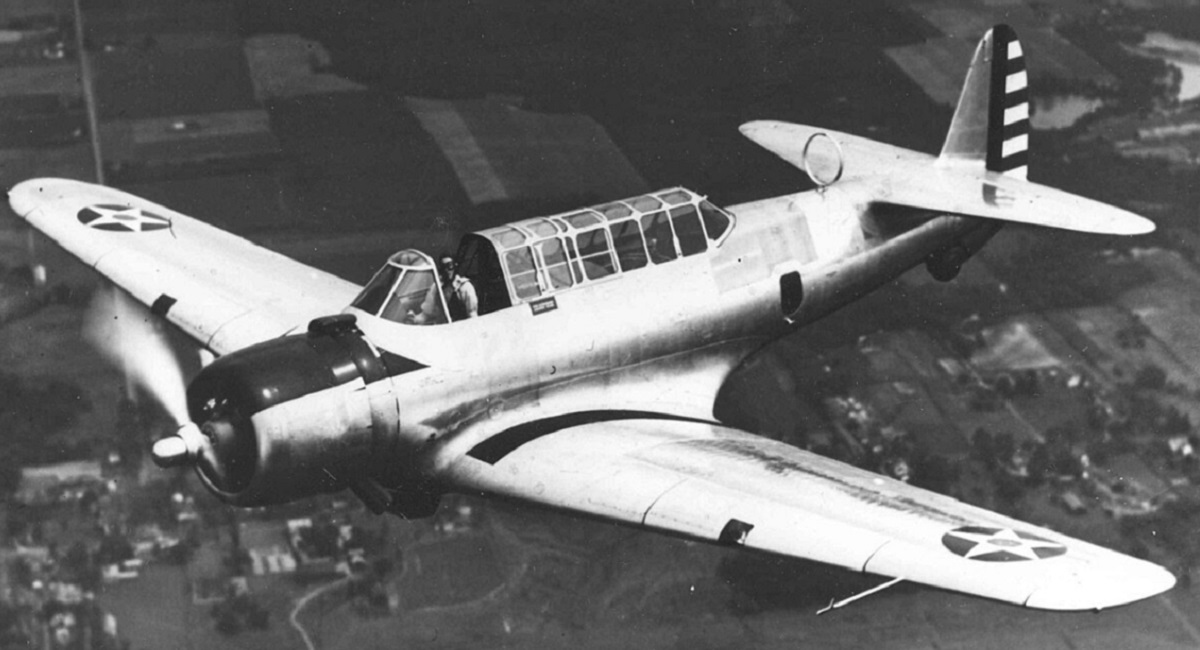
A combat variant based on the V-1 was developed as the light bomber/attack aircraft V-11. The prototype (factory no. 28, civil registration X14999) first flew on 17 September 1935. The wing and undercarriage remained largely unchanged from the V-1A, but the tail unit was revised; the new fuselage had an elliptical cross-section and a long, raised canopy that enclosed both crew stations. Instead of the 735 hp Cyclone fitted on the civil type, the military version used a slightly uprated derivative, the SR-1820-F53 (750 hp). Armament comprised two 7.62 mm machine guns in the wings and one on an upper flexible mount. Bomb load was carried in an internal bay (arranged in four cassettes) and on external hardpoints, with a total capacity of up to 490 kg.
The prototype’s career was short: on 18 September 1935, during its second flight, it crashed immediately after takeoff, killing the test pilot and engineer. Trials of the second airframe (factory no. 29, registration NR14980), designated V-11A, began on 9 October. The V-11A differed from the first example only by the use of a three‑blade propeller instead of a two‑blade unit. Its flight tests were successful, which cleared the way for the type to enter the military market.
The V-11 was initially marketed as an export aircraft, and in this regard it achieved some success. The first order, for 30 aircraft, came from China at the end of 1935. The version designated V-11G differed from the prototype by using an R-1820-G2 engine rated at 850 hp. The first V-11G (factory no. 30) was delivered in December 1936, with the remainder (factory nos. 36–64) supplied between July 1937 and April 1938. Aircraft were delivered without engines, and some were shipped as component kits to be assembled later in Shanghai and Hankou. V-11G aircraft, operated by the 14th Squadron, saw action in the early stages of the war with Japan, but were quickly destroyed.
V-11GB prototype
The V-11G was further developed into the V-11GB, which featured enhanced armament – four 7.62 mm machine guns in the wings, one on the upper mount, and one on a retractable lower mount – and accommodated a third crew member. Four of these aircraft (two complete and two without engines; factory nos. 32–35) were purchased by the Soviet Union in 1936. In 1938, the type was produced under license in the USSR as the BSh-1. Between 31 and 50 units were built, according to various sources, but none entered active service with the Soviet Air Forces, as the BSh-1’s flight performance was considered insufficient for an attack aircraft. In 1939, the aircraft were converted for mail transport and transferred to the Civil Air Fleet, where they were operated until 1945 under the designation PS-43.
The second buyer of the V-11GB was Turkey, which acquired 40 V-11GBT aircraft. Some sources cite 41, but this likely includes a company demonstration aircraft counted within the total of 40 units. The V-11GBT aircraft were assigned to the 2nd Regiment, based in Diyarbakır in southeastern Turkey near the Syrian border, and remained in service until 1948.
In 1938, Brazil purchased 26 V-11GB2 aircraft. These planes had slightly reduced armament, with two 7.62 mm machine guns in the wings instead of four. From 1942, they were employed for anti-submarine patrols along the coast and were retired shortly after the end of World War II.
Read also:
- Weapons of Ukraine’s Victory: Modern Long-Range ERAM Missiles
- Thrust Reversal: How and When an Aircraft Uses Engine Braking
For the US Army
As for the United States military, they were slower to adopt the type. In June 1938, they placed an order for seven V-11GB attack aircraft, becoming the last customer for this model.
The V-11GB variant for the U.S. Army received the military designation YA-19. It differed from other versions primarily in its powerplant, using a 14-cylinder Pratt & Whitney R-1830-17 engine rated at 1,200 hp. Armament consisted of six 7.62 mm machine guns – four in the wings and one each on the upper and lower defensive mounts. The aircraft could carry up to 1,080 pounds (490 kg) of bombs, and the crew comprised three personnel.
The YA-19s were assigned military serial numbers 38-549 through 38-555 (factory nos. 132–138). The first aircraft underwent testing on 27 January 1939, with the remaining units delivered between June and July of the same year.
In the autumn of 1939, five YA-19s were delivered to the 17th Attack Group at March Field, California, for service trials, but they remained there only briefly. The same five aircraft were later transferred to the Panama Canal Zone, where they were demilitarized and handed over to U.S. military attachés in Central American countries for use as courier aircraft.
Two YA-19 aircraft were used to test new aircraft engines. In particular, aircraft 38-555 was fitted with a 12-cylinder Lycoming O-1230-1 engine rated at 1,200 hp. To compensate for the lengthened fuselage caused by the new engine, the tail fin area had to be increased. This aircraft, redesignated XA-19A, began flight testing on 22 May 1940. Engine tests proved unsatisfactory, and the aircraft was later fitted with an R-1830-51 engine, receiving the designation XA-19C.
Aircraft 38-550 was transferred to Pratt & Whitney. Under the designation XA-19B, it was used to test the new 18-cylinder R-2800-1 engine, which later became one of the most widely used aircraft engines in U.S. aviation during World War II.
Like John Northrop’s Gamma, Gerard Valtí’s V-11 illustrates how a high-speed, single-engine passenger monoplane could be adapted for military use. Compared with its competitor, the V-11 featured more advanced design elements – such as retractable landing gear – and achieved notable popularity abroad. An interesting example is the Soviet Union, where the attack aircraft based on a civilian design ultimately returned to civilian service.
Both the V-11 and the Gamma represent transitional-generation aircraft, in which typical “attack” characteristics, such as heavy defensive armament, were balanced with “bomber” attributes, including substantial bomb loads. This trend was also common among the last American prewar attack aircraft. Coverage of those aircraft will follow next time.
Read also: