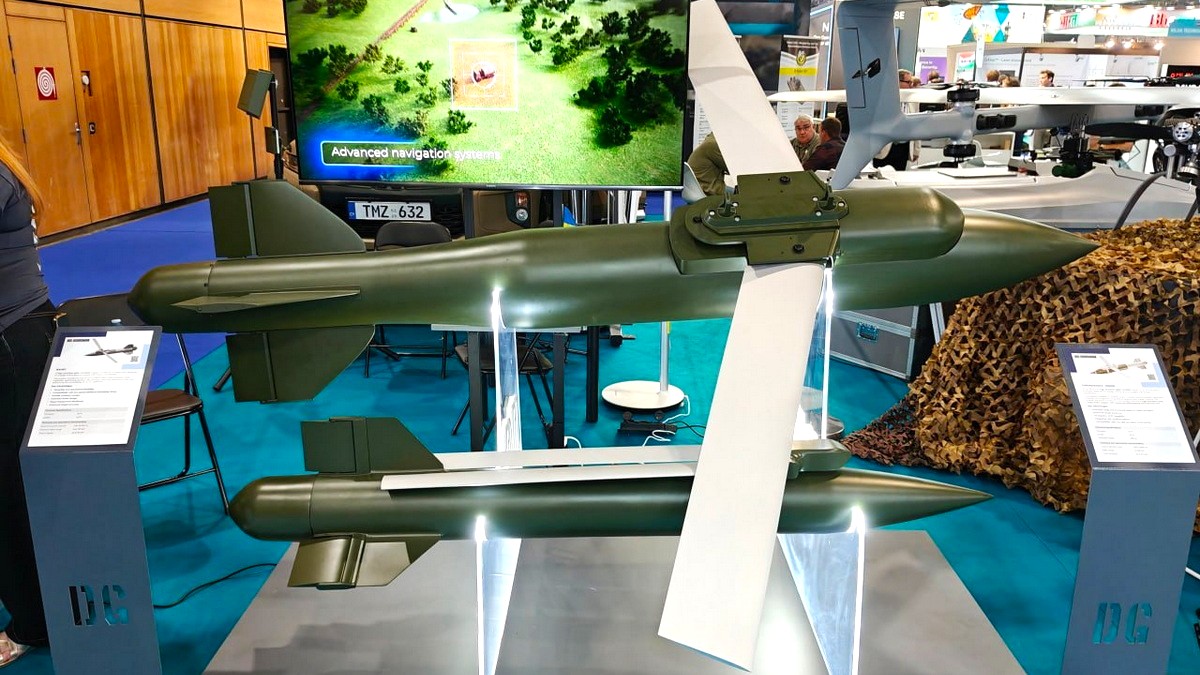
Today, we will take a closer look at the Ukrainian guided glide bomb Vyrivniuvach, developed by DG Industry with support from Brave1. It is one of those projects that could prove far more significant than it appears at first glance.
TABLE OF CONTENT:
Point of reference: what happened in May
In May 2026, the Ukrainian public–private platform Brave1, together with manufacturer DG Industry, announced the completion of testing and readiness for operational use of the first domestically developed guided aerial bomb. The system was named “Vyrivniuvach” (Leveler). The name reflects its intended role in a technical rather than rhetorical sense. The concept behind the weapon is to reduce an existing capability gap: between the operational need for an indigenous long-range aerial strike munition and continued dependence on foreign supplies, which have typically been subject to delays, allocation limits, and political constraints.
The first public video showed a typical set of elements for such demonstrations: release from an aircraft, deployment of folding wings, and a stable transition into gliding mode. The type of carrier aircraft was deliberately not disclosed; cropped framing and reduced image contrast are standard methods used to limit identification of aviation platforms. A full public presentation took place in June 2026 at the international defense exhibition Eurosatory in Paris, where the “Vyrivniuvach” system was shown in detail for the first time. At that stage, it became clear that the system is not a conceptual prototype or a technology demonstrator, but a manufactured product, with an initial experimental batch already procured by the Ministry of Defense of Ukraine.
At first glance, the system could be viewed as another item of military equipment. However, its significance extends beyond a single munition. If the stated performance characteristics are confirmed under operational conditions, Ukraine would obtain a domestically produced precision-guided aerial munition capable of reducing dependence on external supply chains and expanding the capabilities of its air force.
The development of “Vyrivniuvach” is also notable from an industrial perspective. Over approximately 17 months – a relatively short timeline even in wartime conditions – engineers produced a system that is neither a modernization of legacy Soviet-era bombs nor a direct copy of Western designs. It was developed from the ground up, incorporating lessons from modern warfare, the increasing role of unmanned systems, electronic warfare threats, and the requirement for relatively low-cost precision strike capabilities.
In practical terms, “Vyrivniuvach” represents an embodiment of a new Ukrainian defense philosophy: not attempting to match the adversary through sheer quantity, but instead offsetting its advantage through rapid development cycles, flexibility of design choices, technological adaptability, and cost efficiency. In this sense, the story of this bomb extends far beyond a single munition. It reflects a broader transformation of Ukraine’s defense industry under the conditions of a large-scale war.
Read also: “Rassvet” Over Russia: Or How to Catch Up with Starlink While Falling Behind
Design philosophy: kit or glide system
Understanding “Vyrivniuvach” starts with a fundamental question: is it a modular conversion kit or a standalone munition system? The answer determines both its capabilities and its limitations.
Publicly available information from Eurosatory 2026 helped refine the picture first suggested by the May video materials. “Vyrivniuvach” appears to be a conversion kit for 250 kg-class aerial bombs, consisting of two main components: a wing module attached to the bomb body using clamp fasteners, and a tail section that replaces the standard tail assembly and contains navigation and control systems. This architectural approach is consistent with several existing international systems, including JDAM-ER, Turkey’s KGK, Pakistan’s Takbir, and China’s LS-6. From a purely engineering standpoint, the modular concept itself is not unique; it follows an established global design pattern for converting unguided munitions into guided glide weapons.

The key difference between “Vyrivniuvach” and its closest analogues lies in the configuration of its control surfaces. In the JDAM-ER system, three out of four aerodynamic control surfaces are fully movable. The Ukrainian design, by contrast, uses smaller stabilizers and control fins with reduced surface area. This is a deliberate engineering choice that affects maneuverability and guidance behavior at different phases of the flight path. Such a configuration can influence how the system responds during mid-course correction and terminal guidance, although no comparative flight performance data is available in the public domain.
Thus, the product differs somewhat from the initial May narrative that described it as a “monolithic glide airframe.” In reality, it is a modernization kit rather than a bomb designed from scratch as a single integrated aerodynamic system. At the same time, the developers’ core claim remains unchanged: the system is not an adaptation of Soviet-era stockpiles and does not replicate either the UMPK or JDAM families. Instead, it was designed specifically for the operational parameters of the current war environment.
Read also: Middle Strike: How Ukraine Is Building a New Class of Medium-Range Strike Systems
Range: nominal vs real-world
The stated maximum range of “Vyrivniuvach” is over 130 km when released from altitudes above 10,000 m. When released from around 500 m, the range drops to roughly 10 km. This is not a contradiction or a marketing effect – it is a direct consequence of the physics of glide munitions, where release altitude is the primary determining variable.
The limitation is that the 130 km figure is largely theoretical in the context of the Ukrainian Air Force. High-altitude flight profiles for tactical aircraft are currently impractical: the adversary’s advantage in long-range surface-to-air missile systems and overall air defense density makes operations at such altitudes extremely hazardous.
In practice, a low-altitude approach with a climb (“toss bombing” or lofting) is used. In this profile, the aircraft approaches at low level, performs a pull-up before release, and then descends back to lower altitude after weapon separation. Under these conditions, the effective range of “Vyrivniuvach”, similar to JDAM-ER-class systems, is reduced to approximately 40 km.
Forty kilometers is not insignificant. It represents the depth of the operational rear, where logistical infrastructure, reserves, communication nodes, and elements of air defense systems are located. For comparison, JDAM-ER demonstrated a range of 72 km in U.S. tests when released from an altitude of 12 km. However, those conditions are not achievable for Ukraine for the same reasons. In practical terms, the effective range of both systems under Ukrainian operational conditions is comparable.
Read also: Weapons of Ukraine’s Victory: The Hornet UAV, Also Known as “Martian-2”
Comparative context: between three reference points
To assess the position of “Vyrivniuvach” within the hierarchy of glide munitions, it is useful to place three systems side by side that are already part of this war’s operational landscape. JDAM-ER is an American guidance kit for the Mk 80 family of bombs, with a theoretical range of 70–75 km and a unit cost of several tens of thousands of dollars. Deliveries to Ukraine have taken place, but in a controlled and limited manner, subject to approval from Washington.
In May 2026, the U.S. Department of State approved a potential sale to Ukraine of more than 1,500 JDAM kits, with a total estimated value of $373.6 million. This agreement is significant in scale, but it remains dependent on foreign decision-making processes and budget cycles. The next-generation JDAM variant with an integrated propulsion system and a range exceeding 300 km belongs to a different cost category altogether – approximately $200,000 per unit – effectively moving it out of the category of mass-consumable munitions.
The Russian UMPK is an extremely low-cost modular kit designed for stockpiled aerial bombs, primarily based on FAB-series munitions across various calibres, including those up to 3,000 kg. Its main advantage is scale and affordability; its primary drawback is high vulnerability to electronic warfare systems. Early versions demonstrated a noticeable degradation in accuracy under EW conditions, and subsequent upgrades (such as the “Kometa” series and additional anti-jamming modules) were developed as a direct response to this vulnerability.
“Vyrivniuvach” sits between these poles in terms of both cost and performance, but it follows a fundamentally different design logic. It is not an adaptation of stockpiled bombs. It is a system engineered specifically around a defined bomb calibre. Its price – roughly three times lower than JDAM-ER – effectively moves it out of the category of “expensive, priority-target-only” munitions and into the category of “serial-use expendables.” This distinction is not minor. In a protracted war, a consumable precision weapon that can be used without restrictive allocation constraints has a different operational value compared to a scarce, high-demand system that requires prioritisation and rationing in planning cycles.
Також цікаво: Зброя української перемоги: ЗРК Tempest з ракетами AGM-114L Longbow Hellfire
Seventeen months: what this timeline actually means
Seventeen months from technical specification to a finished product is a figure that needs to be understood in the correct context. It does not imply that Ukraine has followed the same development pathway as Boeing or Raytheon, only at a fraction of the time. A standard Western development cycle for an air-delivered munition typically takes four to six years or more. It includes full certification documentation, extensive safety testing under varied conditions, integration with multiple carrier platforms, flight testing under independent methodologies, legal compliance procedures, and NATO interoperability requirements. This is not bureaucratic excess in itself – it is a system designed for peacetime conditions, where tolerance for failure is effectively zero.
Ukrainian “seventeen months” represents a path to a demonstrator and limited serial production under wartime conditions, where documentation requirements are reduced, the feedback loop between the field and the laboratory is compressed, and the threshold for acceptable failure risk is fundamentally different. This is not a shorter version of the same process – it is a different development environment governed by different constraints and priorities. For the missions the “Vyrivniuvach” was designed to address, this level of maturity is sufficient. However, for certification under NATO standards and full integration with platforms such as the F-16 or Mirage 2000, it is not. The developers themselves acknowledge this limitation openly.
Carrier aircraft: where theory diverges from practice
The first public video of “Vyrivniuvach” showed a release from a Sukhoi Su-24 – a Soviet-designed frontline bomber that remains the primary carrier platform for glide munitions in Ukraine. Compatibility is also stated for the Sukhoi Su-27 and Mikoyan MiG-29, which together cover most of Ukraine’s existing combat aviation fleet.
In practice, the carrier problem is more complex than it may appear. Soviet-era aircraft were designed with hardpoints and data interfaces that were not intended for modern guided glide munitions with integrated navigation and control systems. Each integration case requires separate hardware and software modifications. These upgrades have reportedly been implemented for the Su-24 platform, but the scope and technical depth of the integration have not been disclosed publicly.
For Western platforms such as the F-16 Fighting Falcon and Dassault Mirage 2000, developers indicate potential compatibility but emphasize the need for additional certification.
At this level, the constraint is not purely technical. It also involves the positions of manufacturers such as Lockheed Martin and Dassault Aviation regarding third-party weapon integration on their platforms. Aircraft OEMs typically control this process through proprietary certification procedures that can take years and require full disclosure of weapon system technical data. Until such certification is completed, the operational carrier base for “Vyrivniuvach” effectively remains dominated by legacy Soviet-designed aircraft.
Read also: The Ukrainian “Tryzub” Laser System: From Testing Grounds to the Front Line
Navigation and electronic warfare: an open question
Resistance to electronic warfare (EW) is arguably the most critical technical parameter for any modern glide munition – and also the least transparently disclosed aspect of “Vyrivniuvach”.
Officially, the system is described as using satellite navigation combined with modern control algorithms. What exactly is meant by “modern algorithms” remains unspecified in public sources: this could range from anti-jamming modules, to redundant inertial navigation systems, or hybrid architectures combining optical and satellite guidance. However, none of these configurations have been confirmed in detail. There is, nevertheless, relevant operational context. Over the past two years, Ukraine has observed how EW systems – including the “Pokrova” complex – degraded the accuracy of early Russian UMPK-guided bombs, and how later upgraded UMPK versions incorporated anti-jamming improvements to partially mitigate these effects. Developers of “Vyrivniuvach” had access to this operational feedback loop.
Whether and how this experience has been translated into concrete navigation subsystem design choices remains unknown; it can only be assessed through combat use rather than exhibition demonstrations. In terms of precision, open-source estimates suggest a circular error probable (CEP) of 5–15 meters under GPS-based guidance. Under laser or electro-optical guidance modes, this could theoretically be reduced to 1–3 meters. However, it has not been publicly confirmed whether these guidance modes are implemented in “Vyrivniuvach” in operational configurations.
Read also: Weapons of Ukraine’s Victory: FP-1 – A Drone Capable of Reaching Moscow
Target profile: what this munition is realistically suited for
If rhetoric is set aside and “Vyrivniuvach” is evaluated strictly by the class of tasks it is optimized for, the picture becomes relatively clear. The primary target set consists of stationary or low-mobility assets located in the adversary’s operational rear, approximately 30–60 km behind the front line. This includes command posts and communication nodes, ammunition and fuel depots, elements of air defense systems, river crossings and bridges, as well as fortified positions and logistical hubs.
This is the forward operational belt where most of the material infrastructure supporting both offensive and defensive operations is concentrated. At the same time, it is an area that is not always effectively reachable by FPV drones due to range limitations and electronic warfare coverage, while the use of high-cost missile systems is often inefficient due to a mismatch between weapon cost and target value.
In heavily defended sectors such as the Donetsk and Zaporizhzhia directions, this type of munition is potentially in demand primarily due to its cost profile. It is inexpensive enough to be used not only against high-priority targets, but also for a broader set of operational objectives.
In areas with dense electronic warfare activity and layered air defense, however, system effectiveness will depend on how well the navigation and guidance challenges have been resolved. “Vyrivniuvach” is not a replacement for missiles and is not intended as a counter to heavy Russian glide bombs in the 1,500–3,000 kg class. These systems address different operational tasks. A 250 kg warhead is sufficient to destroy command posts, depots, or bridges, but it is not designed to разрушити (or fully collapse) heavily reinforced concrete fortifications or to achieve large-area destruction against dispersed targets.
Read also: Weapons of Ukraine’s Victory: The “Shvidun” Interceptor Drone
Institutional context: more than a single bomb
“Vyrivniuvach” is not an isolated project. It is embedded in a broader architecture that has been forming over the past two years. Brave1 functions as a public–private defense technology accelerator, reducing bureaucratic friction between concept development and funding, and providing a structured channel between defense startups and the Ministry of Defense. The Zbroyari initiative program, which has mobilized more than $1.5 billion from nine partner countries, provides a financial framework for scaling production.
Meanwhile, the UNITE–Brave NATO initiative, launched in November 2025 with a budget of up to €50 million for 2026, establishes a pathway toward standardization and potentially certification of systems under NATO requirements.
Taken together, this indicates that “Vyrivniuvach” has not been developed in an institutional vacuum. It is supported by an ecosystem capable of sustaining further refinement, scaling production, and – in the longer term – enabling integration procedures with NATO partners.
Read also: Everything About Ukrainian Interceptor Drone JEDI Shahed Hunter
Serial production: the unknown variable
Between “ready for operational use” and “delivered to units at scale” lies a separate gap – and this is precisely where publicly available information becomes most limited. It is known that an initial experimental batch has been procured by the Ministry of Defense. It is also known that “Vyrivniuvach” has already been delivered to the Ukrainian Air Force; this was confirmed in June 2026. However, production rates, monthly output targets, and unit cost at scale compared to prototype batches remain undisclosed.
Experience from other systems in this war suggests that a weapon described as “combat-ready” can remain in low-rate production for years if industrial capacity is not expanded in parallel with operational demand. Whether “Vyrivniuvach” follows this path will depend on how quickly DG Industry can scale production, and whether the program maintains priority status within Ministry of Defense budgeting decisions over time.
Read also: Weapons of Ukraine’s Victory: High-precision APKWS II Missile
Strategic significance: independence as a parameter
The most important consequence of the emergence of “Vyrivniuvach” is not tactical, but operational autonomy. For two years, deliveries of JDAM-ER and French AASM munitions have been subject to continuous political oversight. Quantities, delivery schedules, and even approved configurations were determined through decisions in the U.S. Congress, the Ukrainian executive branch, and the French presidency. Each aid package carried its own delays, conditions, and limitations.
A domestically produced glide munition removes one variable from this equation: the upper limit is now defined by Ukrainian industrial capacity rather than external legislative processes. This does not eliminate Ukraine’s broader dependence on partners in the field of armaments. That dependency remains. However, it does provide the air force with an additional strike capability that does not require external approval for each round of use. In a prolonged conflict where decisions are often delayed by months, this factor has independent operational value.
Read also: Weapons of Ukraine’s Victory: TRIDON Mk2 Mobile Air Defence Systems from BAE Systems Bofors
What this system means for modern warfare
“Vyrivniuvach” is a concrete product with defined parameters, but it also reflects a broader principle that this war has repeatedly reinforced: a military that can rapidly produce its own weapons tailored to current operational conditions gains a strategic advantage that even large-scale foreign deliveries cannot fully compensate for. Glide bombs have become one of the defining tools of this conflict not because the underlying physics is new – the principle of unpowered glide has been understood for decades – but because they enable aircraft to strike targets in depth without entering the engagement envelope of layered air defense systems. In this sense, “Vyrivniuvach” addresses a relevant operational problem. It does so with a cost structure that aligns with the tempo and consumption rates of a modern air campaign.
What determines whether all of this works is not the bomb itself. It depends on intelligence that can identify targets. On the carrier aircraft that can deliver the munition to the release point. On navigation systems that can withstand electronic warfare. And on production capacity that can provide enough units to turn a capability into sustained pressure.
There is one clear benchmark: the number of “Vyrivniuvach” units delivered to operational units by the end of 2026. If this figure reaches the hundreds, the system can be considered fully established. If it remains in the tens, it will stay closer to a demonstrator than a fielded capability.
Read also: