


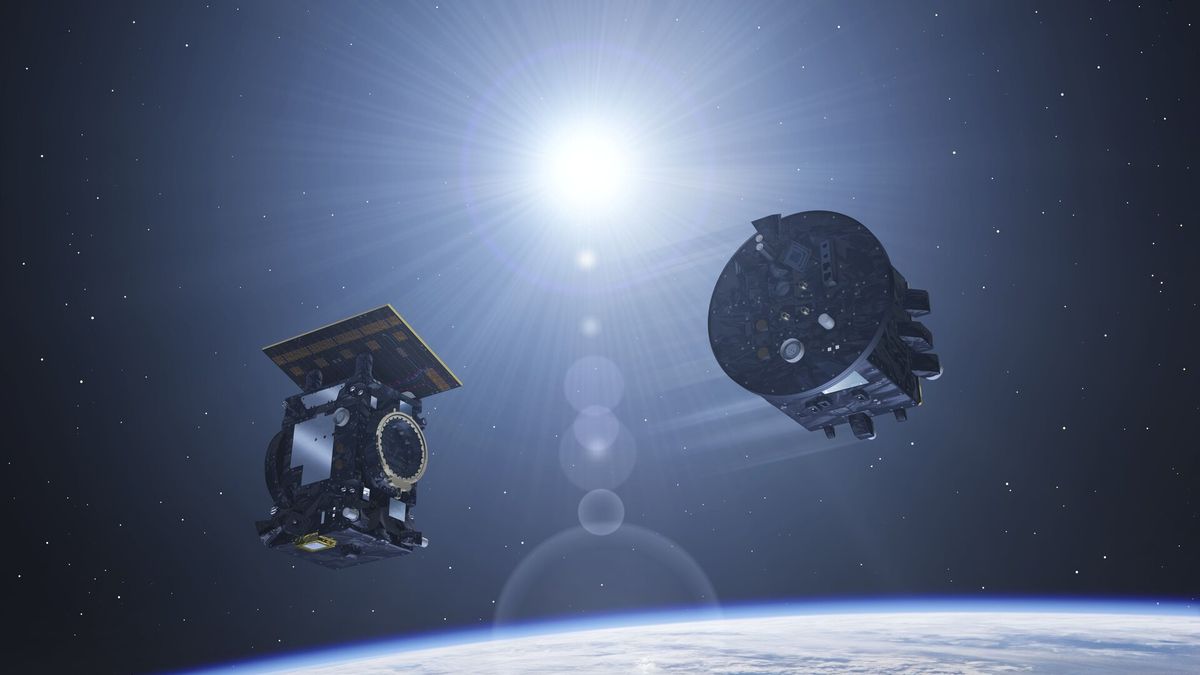
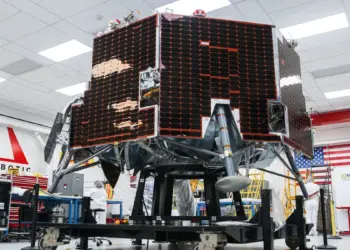
European Space Agency reported that contact has been reestablished with the spacecraft of the Proba-3 mission, which had been lost approximately one month earlier. The Proba-3 mission, launched in 2024 with a planned duration of two years, involves two spacecraft operating in extremely precise formation to reproduce the effect of a solar eclipse at an altitude of over 60,000 km above Earth. This level of synchronization enables the study of the Sun’s outer atmosphere, including the relatively less understood solar corona.

One of the satellites is equipped with a 1.4 m diameter occulter that functions as an artificial “Moon,” blocking direct sunlight, while the second spacecraft observes the solar corona from within the resulting shadow.
On February 14, however, an anomaly occurred with the second spacecraft, which carries the mission’s primary instrument – a coronagraph. A cascading failure led to a loss of attitude control, causing the solar array to turn away from the Sun and the batteries to begin discharging. As a result, the spacecraft entered a survival mode and remained unresponsive while drifting in space.
According to Josef Aschbacher, contact was unexpectedly restored during the night. Throughout the incident, the mission’s companion satellite continued to track and monitor the affected spacecraft.
As Josef Aschbacher explained, the spacecraft was rotating when the ESA team in Spain detected that some sunlight had reached its solar panels. Taking advantage of this window, engineers used the minimal available power to reestablish communication. The solar array is now properly oriented toward the Sun, allowing the batteries to recharge. The next steps planned by ESA specialists include gradually reactivating onboard instruments and conducting a series of checks to assess any potential damage.
The solar corona remains relatively poorly studied. It is invisible to the naked eye and standard telescopes because it is obscured by the Sun’s bright light. While total solar eclipses on Earth last only a few minutes and occur roughly 60 times per century, the Proba-3 mission, according to ESA, can provide 10 to 12 hours of observation per week over a two-year period.
Read also:
- U.S. Senate Extends ISS Operational Timeline Through 2032
- All About Starship V3: Technological Platform for the Next Spaceflight Era
Source: phys



THIS NEEDS TO BE DONE LATER