Recently, the Turkish aviation industry has been undergoing rapid development. In addition to an exceptionally broad range of unmanned aerial vehicles and several types of helicopters (I recently wrote about one of them – the T625 Gökbey), it is establishing production of the Hürjet jet-powered advanced trainer and light combat aircraft, while also conducting flight tests of the Kaan fighter. Somewhat in the shadow of these programs remains the aircraft that effectively marked the beginning of the modern phase of the Turkish aviation industry – the turboprop trainer Hürkuş.
TABLE OF CONTENT:
How it all began
At one point, Turkey made attempts to establish the production of aviation equipment based on its own designs. However, until recently, the last serial aircraft of Turkish origin was the MKEK-4 “Uğur,” a piston-engine trainer produced in small numbers in the 1950s.
Over the past decades, the corporation TUSAŞ Havacılık ve Uzay Sanayi (better known under its English name Turkish Aerospace Industries – TAI) has accumulated extensive experience in licensed production of aircraft, including F-16C/D fighter jets, CN-235M transport aircraft, and SF-260D trainers.
Building on this experience, the company’s leadership, together with the Government of Turkey, decided in March 2006 to launch the development of a turboprop trainer aircraft, the “Hürkuş” (Hürkuş; literally “free bird,” also the surname of Vecihi Hürkuş, one of the pioneers of Turkish military aviation and the aviation industry). The aircraft was intended to replace the T-37B/C jet trainers.
The design was initially based on the South Korean KAI KT-1. Between 2009 and 2011, the Turkish Air Force received 40 such aircraft; however, it declined an option for an additional 15 units, opting instead for its own indigenous design. Compared to the Korean aircraft, Hürkuş differs primarily in its more powerful propulsion system – the Pratt & Whitney Canada PT6A-68T turboprop engine, capable of producing 1,600 hp (versus the KT-1’s PT6A-62 with 950 hp), as well as a modified avionics suite and a redesigned wing. The tandem cockpit is equipped with ejection seats.
Read also:
- The Aircraft That Never Were: Convair Kingfish
- T625 Gökbey: Everything about Turkey’s New Helicopter
A complicated story
The first of four Hürkuş prototypes began flight testing on 29 August 2013. In 2016, the Hürkuş A variant received certification. However, the Turkish Air Force declined to procure it, opting instead for the more advanced Hürkuş B variant, whose cockpit layout is closer to that of the F-16 and F-35 fighter aircraft. An order was placed for 15 aircraft of this version, with an option for an additional 40. Deliveries were originally scheduled to begin in 2018, but by early 2023 the Turkish Air Force had received only four Hürkuş B aircraft. What followed was somewhat unclear: by 1 May 2023, it was announced that neither the Air Force nor the manufacturer had any Hürkuş B aircraft left in their possession. All 15 produced units of this variant had been exported.

Where did the aircraft go? In November 2021, reports emerged that Niger had ordered 12 aircraft. In October 2022, representatives of TAI stated that the first two aircraft would be delivered to Niger by the end of the year. In addition, deliveries of three Hürkuş aircraft to Chad were announced for the first quarter of 2023. Around the same time, in May 2022, it was also reported that a contract had been signed with the Libyan government for the supply of Hürkuş aircraft, although the exact quantities and delivery schedule were not disclosed.
According to some sources, Niger ultimately received only three Hürkuş B aircraft. Chad reportedly acquired another three, which would imply that Libya may have received the remaining nine units.
What about the aircraft intended for the Turkish Air Force? Evidently, even the improved Hürkuş B did not fully meet the operator’s requirements. In 2021, an upgraded variant – Hürkuş-HYEU (Hava Yer Eğitim Uçağı, “air-to-ground training aircraft system”) – was introduced, featuring updated avionics and a system for simulating weapons employment. However, this version also did not become the final solution.
In December 2024, the prototype of the Hürkuş 2 – officially referred to as the “next-generation Hürkuş B” – made its first flight. Through the extensive use of composite materials, the aircraft’s weight was reduced by 450–500 kg. The forward fuselage was redesigned to improve aerodynamics, while the wing received modified, smaller winglets. Changes were also introduced to the canopy contours and the tail section of the fuselage. The new nose landing gear unit was significantly lightened. It is this configuration that is intended for delivery to the Turkish Air Force. TAI has stated that in 2025 it plans to produce ten Hürkuş 2 aircraft (as part of a contract for 55 units). However, as of now, no aircraft appears to have been formally delivered to the customer, at least based on the absence of public reporting in the media.
Variants
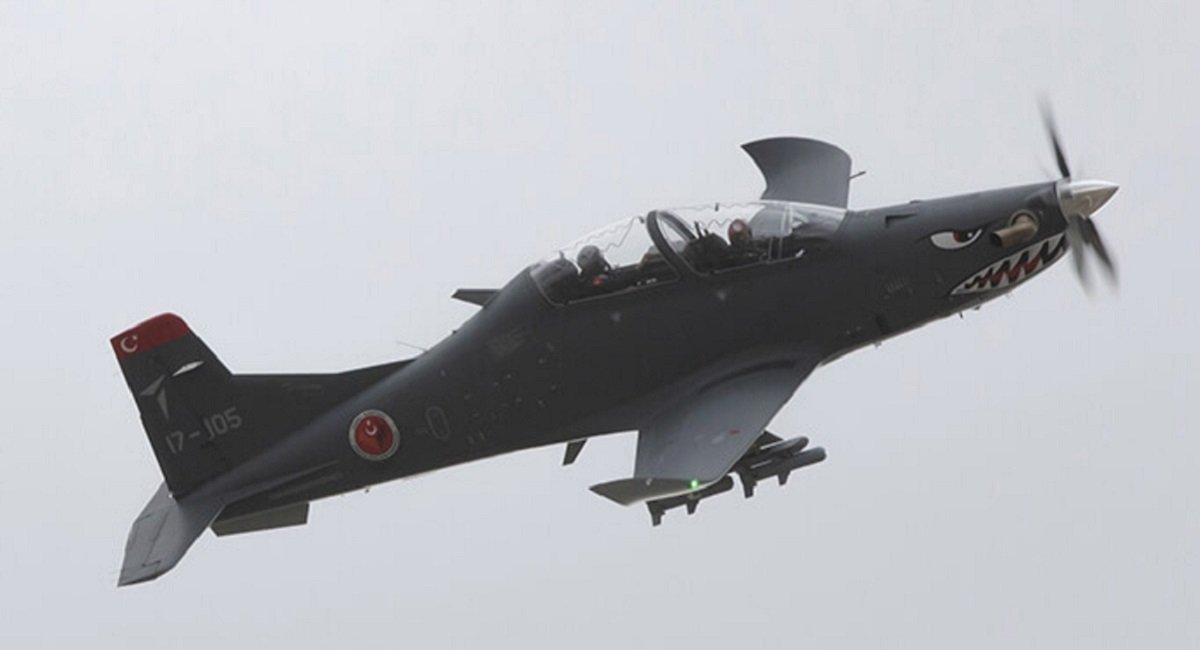
In parallel with the Hürkuş B, customers are also offered the Hürkuş C, a light attack aircraft. It was first presented in February 2017. The aircraft is equipped with an ASELSAN ASEFLIR-300 electro-optical targeting system installed in a ventral fairing, and features four underwing hardpoints capable of carrying a total payload of up to 1,500 kg.
In addition to unguided bombs, rocket pods, and 12.7 mm machine gun or 20 mm cannon gun pods, the Hürkuş C can employ Turkish-made precision-guided munitions, including L-UMTAS anti-tank guided missiles, Cirit light air-to-surface missiles, as well as KGK-82 and HGK-3 guided bombs.
In May 2017, the Turkish Ministry of Defence ordered 12 aircraft of this type, with an option for an additional 12. However, there has been no publicly available information confirming the start of deliveries so far. Based on the Hürkuş C, there are plans to develop an unmanned combat aircraft version, as well as a maritime patrol variant for the coast guard.
Although more than 12 years have passed since its first flight, the Hürkuş has still not entered service with the Turkish Air Force – the very customer for which it was originally developed. The aircraft has undergone several stages of refinement, but to date its only real commercial success appears to be the sale of roughly a dozen-and-a-half units to relatively undemanding customers in Africa.
Read also: