The highly effective use of German dive bombers during the Polish campaign and the Western Blitzkrieg naturally drew the interest of the U.S. Army in this type of aircraft. There was no need to start from scratch, as the U.S. Navy had already been operating dive bombers successfully for about a decade; these aircraft were well-suited for attacks against enemy ships. Consequently, the first Army dive bombers were modified naval aircraft. Although they were formally classified as attack aircraft and designated with the letter “A,” they were assigned to bomber aviation groups.

Read also:
- First American Attack Aircrafts: Development Path, Part 1
- First American Attack Aircrafts, Part 2: Alternative Projects of the Early 1920s
- American Attack Aircraft, Part 3: The First Production Variants
- First American Attack Aircraft, Part 4: On the Eve of the 1930s
- First American Attack Aircraft, Part 5: Production A-12 “Shrike”
- American Attack Aircraft, Part 6: Experiments of the 1930s
- American Attack Aircraft, Part 7: John Northrop’s “Gamma”
- American Attack Aircraft, Part 8: Contribution of Gerard Valtí
- American Attack Aircraft, Part 9: Northrop A-17
- American Attack Aircraft, Part 10: Douglas Export Models
- American Attack Aircraft, Part 11: Near-Bomber Designs of the Second World War
TABLE OF CONTENT:
Douglas and Curtiss aircraft
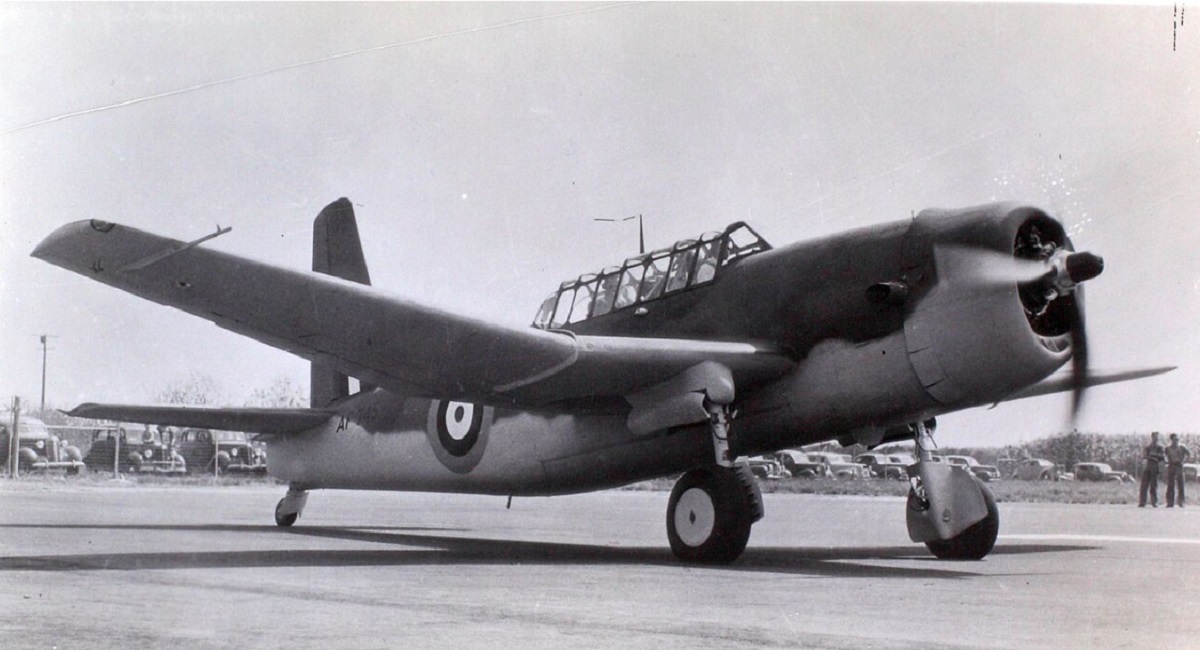
The first Army dive bomber was the Douglas A-24 Banshee, a “land-based” version of the well-known carrier aircraft SBD Dauntless, notable for its role at the Battle of Midway. When the aircraft entered Army service, however, it had not yet achieved fame, and the United States had not yet entered World War II. The A-24 was a sleek, single-engine, two-seat low-wing monoplane, featuring retractable landing gear and distinctive perforated dive brakes along the trailing edge of the wings. It was introduced into Navy service in May 1939 and entered Army Air Forces service in June 1941. By June 1944, a total of 5,936 aircraft had been produced, of which 953 were delivered to the Army.
The Army received the Banshee in three variants, which differed from the corresponding carrier versions by the absence of an arrestor hook and modifications to onboard equipment. The first variant was the A-24 (equivalent to the SBD-3), powered by a 1,000 hp Wright R-1820-52 engine. Its armament included two 12.7 mm synchronized machine guns and one or two 7.62 mm guns in the dorsal defensive position. The maximum bomb load was 1,200 pounds (545 kg), consisting of a single 1,000-pound bomb under the fuselage and two 100-pound bombs under the wings. This bomb configuration differed significantly from the standard loadouts of prewar attack aircraft, which typically carried a dozen or more small-caliber bombs. However, it should be noted that the Banshee was transferred from the Navy, and carrier-based dive bombers were designed to carry heavy ordnance – albeit only a single bomb – to target enemy ships rather than ground troops. Between June 1941 and October 1942, the Army received 168 of these aircraft, after which deliveries of the A-24A began. The A-24A, equivalent to the SBD-3, primarily featured 24-volt electrical equipment instead of the 12-volt system. By March 1943, 170 A-24A aircraft had been produced.
The third and most numerous variant was the A‑24B, equivalent to the SBD‑5. It was powered by a 1,200 hp Wright R‑1820‑60 engine and featured an almost twofold increase in maximum bomb load, reaching 1,021 kg. This consisted of a single 726 kg bomb carried under the fuselage and two 147.5 kg bombs mounted under the wings. The Army received 615 aircraft of this version, with an additional 60 delivered to the U.S. Marine Corps under the designation SBD‑5A.
The A‑24 aircraft were initially assigned to the 27th Bombardment Group, which had been planned for deployment to the Philippines. After the outbreak of war with Japan, the group was redirected to Australia. In February 1942, its Banshees saw combat on Java and later operated in New Guinea. The 8th Bombardment Group, also equipped with A‑24s, later joined this force. One squadron of Banshees operated in the Aleutian Islands from August 1942. Most A‑24A and A‑24B aircraft remained in the continental United States, serving primarily in a training role. Only the 531st Squadron continued to operate A‑24Bs in combat in the Gilbert Islands until early 1944.
In 1944, 40–50 A‑24Bs were transferred to France, equipping two bombardment groups: GB I/18 and GB II/18. The first group was stationed in Syria, while the second operated in France from September 1944 until Germany’s surrender. That same year, under Lend-Lease, two Latin American countries also received A‑24Bs: Mexico (30 aircraft) and Chile (12 aircraft). In Chile, these aircraft were retired in 1950, whereas the Mexican Banshees remained in service considerably longer, with the last examples flying until 1959.
The second dive bomber to transition from carrier decks to land-based airfields was the Curtiss SB2C‑1 Helldiver. Designed as a replacement for the Dauntless, it entered series production in June 1942, and deliveries of the Army version – the A‑25A Shrike – began in September of the same year. The designation is notable in that it repeated the name used for earlier Curtiss attack aircraft, such as the A‑8/A‑12 and A‑18. This reflected a company practice of assigning the same names to aircraft of similar roles: “Hawk” for fighters, “Helldiver” for carrier-based dive bombers, and “Shrike” for attack aircraft.
A distinguishing feature of the A‑25A, shared with its naval counterpart, was the presence of an internal bomb bay, as most dive bombers relied solely on external stores. The Shrike could carry either one 454 kg bomb or two 227 kg bombs internally. A single 726 kg bomb could also be carried, although in this case the bomb bay doors could not be fully closed. An additional pair of 45.4 kg bombs could be mounted under the wings. Armament consisted of four 12.7 mm machine guns in the wings and one 12.7 mm gun in the dorsal defensive position. The A‑25A was powered by a 1,700 hp Wright R‑2600‑8 engine.
A total of 900 A‑25A aircraft were produced, compared with 6,240 SB2Cs of various naval versions. Of these, 410 were immediately transferred to the U.S. Marine Corps, where they were redesignated SB2C‑1A and used for training. Unlike the Banshee, which did see combat, the service career of the A‑25A was routine and uneventful. The type was not deployed to either the European or Pacific theaters and did not participate in combat operations. Several squadrons equipped with the A‑25A were assigned to coastal patrol duties within the continental United States, but the majority of the aircraft were used as target tugs. Plans to transfer 150 A‑25As to Australia were ultimately abandoned after the Australians evaluated ten aircraft and declined the remainder.
Read also:
- Pilatus Turboprop Aircraft: An Overview of PC-9
- All About Lightweight Patrol and Counter-Drone Aircraft “Draco”: Reincarnation of Iconic “Vilga”
“Apache” is a relative of “Mustang”
The A‑36A was powered by a 12‑cylinder liquid‑cooled Allison V‑1710‑87 engine rated at 1,325 hp. Its gun armament comprised six 12.7 mm machine guns, with two synchronized weapons mounted in the lower part of the engine cowling and four installed in the wings. The bomb load was 454 kg, carried as two 227 kg bombs on underwing hardpoints. The aircraft was single‑seat.
The A‑36A aircraft were assigned to fighter-bomber groups. In spring 1943, the 27th Group, operating in North Africa, was the first to receive them, followed by the re-equipment of the 86th Group. By the end of May 1943, approximately 300 Apaches had been delivered to the Mediterranean theater. Both groups participated in large-scale raids on Pantelleria in June 1943, and after the Italian garrison’s surrender, they were relocated to the island to support the Allied landings in Sicily. Later, operating as dive bombers, the A‑36A played a significant role in the capture of Monte Cassino. They were also employed against ships, including the sinking of the transport Conte di Savoia. Although the Allison engine variant installed in the Apache was optimized for low-altitude performance, the aircraft was capable of engaging in aerial combat at altitudes up to 2,500 m. Pilots of the A‑36A claimed 84 aerial victories in Italy, but losses were substantial, totaling 177 aircraft. By June 1944, P‑40 and P‑47 fighters had replaced the Apaches in Italian operations.
In addition to the Mediterranean theater, the A‑36A was also employed in India, more precisely along the India–China–Burma frontier. From the summer of 1943, the aircraft served there with the 311th Fighter-Bomber Group. In this area, the A‑36A was used primarily as a ground-attack aircraft rather than as a dive bomber.
The A‑36A was regarded as a capable close-support aircraft. However, subsequent development of the Mustang followed a different path, focusing on more versatile fighter-bombers capable not only of attacking ground targets but also of conducting effective combat at medium altitudes. The P‑51A, in essence, was an A‑36A without dive brakes and fitted with an engine offering improved high-altitude performance.
Lend-Lease Vengeance
In 1940, Vultee received an order from France to develop a single-engine dive bomber and ground-attack aircraft, designated by the company as the V‑72. The aircraft was an all-metal monoplane with a single vertical stabilizer and retractable landing gear. The low-mounted wing featured a characteristic W-shaped planform. The design incorporated a powerful air-cooled R‑2600 engine. After France’s capitulation, development continued for the United Kingdom. The V‑72 prototype first flew on March 30, 1941. Series production continued until June 1944, with a total of 1,931 aircraft built.
The first production batches – 400 Vengeance Mk.I and 300 Mk.II aircraft – were built under British orders. These aircraft were armed with six 7.7 mm machine guns, four in the wings and two in a dorsal turret, and could carry 680 kg of bombs, consisting of two 227 kg bombs in the internal bomb bay and two 113 kg bombs on underwing hardpoints. An additional 300 aircraft, designated A‑31A by the U.S. Army but otherwise similar to the previous versions, were supplied to the United Kingdom under Lend-Lease as Vengeance Mk.III.
A relatively small batch of 99 aircraft, designated A‑35A, was delivered to the U.S. Army Air Forces. They differed from the A‑31A primarily in their armament, featuring five 12.7 mm machine guns – four in the wings and one in the dorsal turret. The final and most numerous variant, the A‑35B, added two more 12.7 mm guns in the wings and could carry up to 907 kg of bombs. A total of 831 A‑35Bs were produced, of which 562 were transferred to the United Kingdom, where they were designated Vengeance Mk.IV.
In the United States, the Vengeance was used exclusively for training and as a target-towing aircraft. The Royal Air Force tested the type in combat in March 1943 in Burma. This theater became the primary operational area for the Vengeance, but by mid-July 1944, they were replaced by fighter-bombers.
The Royal Australian Air Force operated the Vengeance in combat in New Guinea from June 1943 to March 1944. In jungle operations, the aircraft proved unsuited due to poor takeoff and landing performance and limited range. Approximately 60 A‑35A/B aircraft were delivered to Free France from August 1943, but the French were also dissatisfied, as the Vengeance’s dive-bombing accuracy was lower compared to the A‑24. Finally, Brazil, another Lend-Lease participant, received 28 Vengeance Mk.II and five A‑35B aircraft in 1943–1944, which remained in service peacefully until 1948.
Conclusions
This concludes the history of American attack aircraft in World War II. Experience showed that fighter-bombers such as the P‑40, P‑47, and P‑51 were better suited for close air support missions. After the war, this role gradually transitioned to jet fighter-bombers. As noted in the previous article, the attack aircraft category was officially eliminated in the U.S. Army Air Forces in 1948. Interestingly, the opposite occurred in naval aviation: postwar carrier-based attack aircraft replaced older dive bombers and torpedo bombers. In the Air Force, attack aircraft were eventually reintroduced several decades later under entirely new operational conditions – but that story will be covered separately.
Read also: