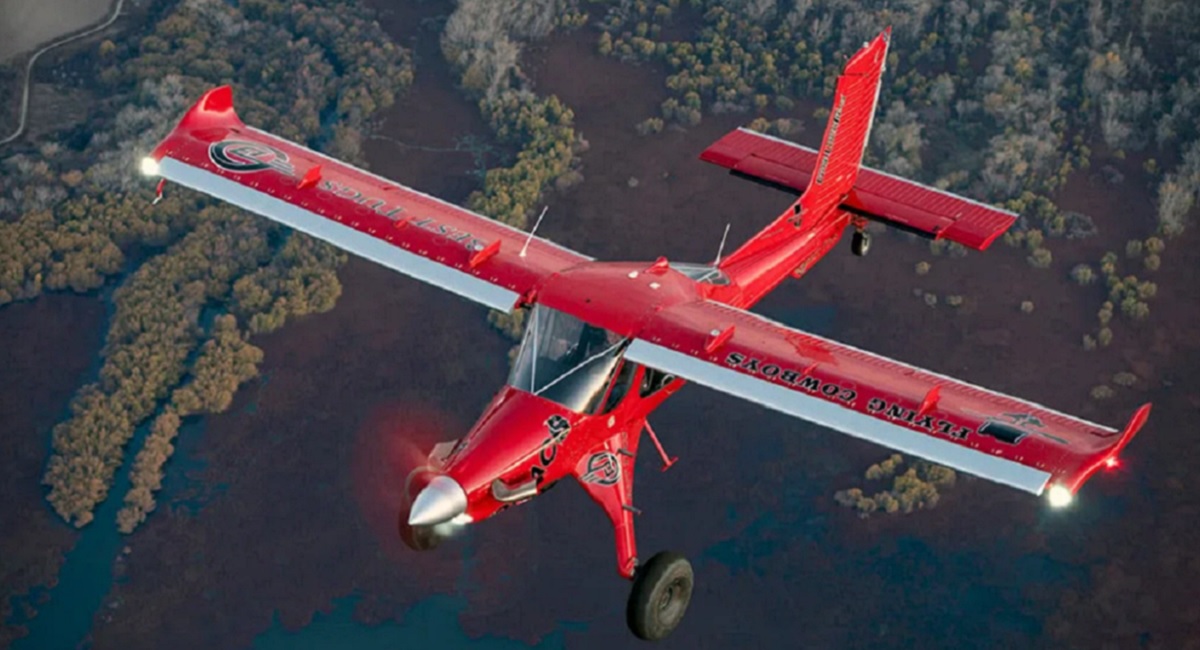
On December 17, 2025, the Warsaw-based company Draco Aircraft presented a concept for a military variant of the Wilga Draco aircraft, outlining potential weapon configurations and a proposed range of operational roles. This announcement raised the prospect of returning a widely regarded, almost iconic aircraft to serial production – not only in a civilian form, but also in a dedicated military configuration.
TABLE OF CONTENT:
A Brief History
The lightweight multipurpose aircraft PZL-104 Wilga was developed in 1960 at the design bureau of the WSK Okęcie aviation plant in Warsaw under the leadership of Ryszard Orłowski. Originally conceived as a four-seat sports aircraft, it was intended for glider towing and parachute training. The design featured a high-mounted wing with advanced control surfaces and a tailwheel-type tricycle landing gear.
The prototype Wilga 1, powered by a 195-hp Polish-designed PZL WN-6RB opposed engine, made its first flight on April 24, 1962. Over the next few years, the aircraft underwent modifications to improve structural strength and replace the engine, as the WN-6RB suffered from overheating at low speeds – a flaw that proved difficult to resolve. On December 31, 1965, the Wilga 3 took to the air for the first time, equipped with a 260-hp AI-14R radial air-cooled engine designed in Zaporizhzhia under Oleksandr Ivchenko and produced under license in Poland.
The AI-14 engine featured a reduction gearbox and was optimized for a low-RPM, large-diameter propeller (265 cm) with high static thrust. This configuration provided excellent short takeoff and landing (STOL) performance and strong results in glider-towing operations, solidifying the Wilga’s reputation as a versatile utility aircraft.

The Wilga 3 was produced in a limited series before its landing gear was redesigned: the wheel track was widened from 2.12 m to 2.83 m, the landing gear struts were reinforced, and several minor adjustments were made. The updated aircraft was designated PZL-104 Wilga 35 and completed its first flight on June 29, 1967, after which it entered serial production.
The base Wilga 35A was intended for aero clubs, while the Wilga 35P served as a liaison aircraft and differed only in the absence of a glider-towing hook. From 1978, an agricultural version, the Wilga 35R, was produced, equipped with a 300-liter chemical tank.
The Wilga was actively exported, not only to socialist countries – primarily to the USSR, where it was used in DOSAAF aero clubs – but also to Western markets. This was facilitated by the introduction of the Wilga 80 in 1979, which was certified under U.S. FAR standards. These aircraft were subsequently sold to the United States and Canada.
In the mid-1990s, the Wilga underwent a design update that included the installation of an American-made Lycoming opposed engine, a modified wing, and improved aerodynamics. Production resumed in 1998 under the designation PZL-104M Wilga 2000. The final modernization occurred in 2005 with the PZL-104MA Wilga 2000, featuring further aerodynamic refinements and updated onboard equipment.
Production of the Wilga ended in 2008. A total of 997 PZL-104 aircraft were built, making the Wilga the most widely produced Polish-designed airplane in the country’s aviation history. The majority – 935 units – were Wilga 35 and 80 variants. In addition to civilian operators, some aircraft were delivered to the military. The Polish Air Force received 27 Wilga 35P aircraft between 1971 and 1976, which served as liaison planes until 1993. In the 2000s, the Polish Border Guard acquired four PZL-104MF Wilga 2000 patrol aircraft equipped with thermal imaging systems.
Read also:
- Everything About Three Generations of PC-7: Predecessor of Pilatus Turboprop Aircraft Family
- Everything About the P1-Sun – SkyFall’s Ukrainian Interceptor Drone
Bush plane
In the United States and Canada, the Wilga 80 and Wilga 2000 were widely adapted into “bush planes” designed for operation from remote, unimproved airstrips. Modifications typically include a more powerful engine with a matched propeller, large low-pressure tires, reinforced landing gear, and other adjustments, giving the aircraft hyperSTOL (ultra-short takeoff and landing) capabilities.
One of the most extreme conversions was carried out by Mike Patey. His PZL-104 Draco Turbine Wilga – modified from the last serial PZL-104MA Wilga 2000 – is equipped with a 680-hp Pratt & Whitney PT6A-28 turboprop, a four-blade propeller 2.59 m in diameter, and modified wings, ailerons, flaps, tail assembly, and landing gear. The aircraft requires just 30 meters for takeoff and 25 meters for landing, with a stall speed of only 56 km/h.
On September 9, 2024, Airbus Poland – the current owner of the factory where the Wilga was produced – sold all production rights to the aircraft to Draco Aircraft, a company founded in Warsaw in 2023. The firm plans to launch production of a significantly modernized Wilga variant based on Mike Patey’s aircraft, and an agreement has also been reached with the designer regarding the rights to his modification.
Armed Variant
According to currently available information, the Wilga Draco airframe has been designed as a dual‑use platform intended for both civilian and military applications. Data and concept visuals released by the manufacturer indicate that the aircraft can be configured for intelligence, surveillance and reconnaissance (ISR), border patrol, special forces support, and counter‑drone missions. The design emphasizes adaptability, allowing the aircraft to be reconfigured for different roles with minimal turnaround time.
The military version of the Draco is based on a civilian platform certified by EASA and the FAA, with provisions for integrating weapons, electro‑optical surveillance systems, and modern communication and navigation equipment. Key characteristics of the military configuration include the ability to carry externally mounted payloads on four underwing hardpoints, rapid role reconfiguration for reconnaissance, logistics, or combat support tasks, and an option to operate either in piloted mode or in an autonomous (uncrewed) flight configuration.
Among the weapon configurations presented were a “heavy” option intended for ground-attack missions – such as Hellfire-class missiles or loitering munitions, as well as pods with 20 mm cannons or 12.7 mm machine guns – and a “light” configuration optimized for counter‑drone interception. The latter includes two seven‑round launchers for 70 mm laser‑guided rockets, with optional addition of gun or machine‑gun pods.
Any assessment of an aircraft in this category is inevitably framed by current Ukrainian requirements, particularly the need to counter Shahed-type drones. In this role, the Wilga Draco would offer several clear advantages. These include the ability to operate from austere locations with minimal infrastructure, without reliance on prepared airfields, as well as a proposed avionics suite combining surveillance, targeting, and communication capabilities.
At the same time, a potential limitation is apparent: endurance. While detailed performance figures for the Wilga Draco have not yet been published, the combination of a high-power engine and a relatively small airframe – one that cannot accommodate large internal fuel volumes – suggests a comparatively limited flight duration. This constraint would be further exacerbated when carrying external weapons. In operational conditions where counter‑drone aircraft are expected to remain on station for extended periods, often for several hours, this factor may significantly affect overall effectiveness.
Read also: