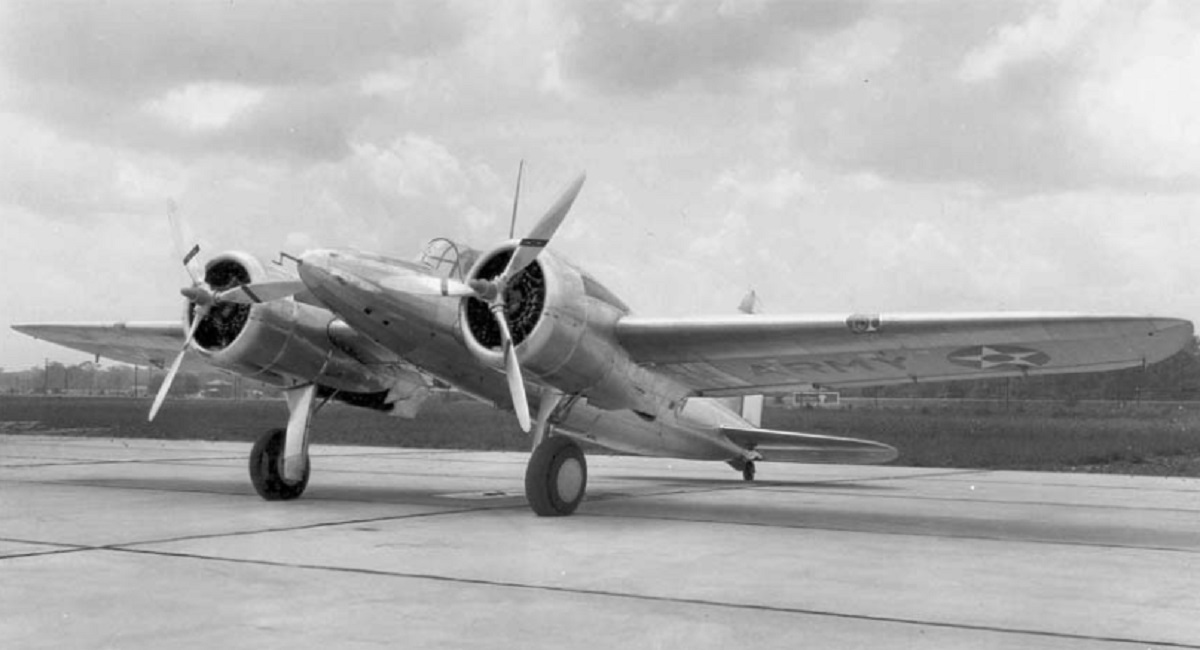
In parallel with the production and deployment of the A-12 attack aircraft, the U.S. Army Air Corps tested several other prototypes. These models never entered service, but they remain noteworthy.
Read also:
- First American Attack Aircrafts: Development Path, Part 1
- First American Attack Aircrafts, Part 2: Alternative Projects of the Early 1920s
- American Attack Aircraft, Part 3: The First Production Variants
- First American Attack Aircraft, Part 4: On the Eve of the 1930s
- First American Attack Aircraft, Part 5: Production A-12 “Shrike”
TABLE OF CONTENT:
Consolidated А-11
In 1930–1931, Lockheed and Detroit Aircraft, led by Robert J. Woods, developed a two-seat, single-engine monoplane fighter on their own initiative. The design was based on the high-speed passenger aircraft Lockheed Altair – one of the first airplanes to feature fully retractable landing gear. The fighter retained the Altair’s wooden wing almost unchanged but received a new metal fuselage. It was powered by a Curtiss V-1570-23 engine (600 hp) and armed with three machine guns: one 12.7 mm and one 7.62 mm synchronized gun, plus a 7.62 mm turret-mounted gun. The prototype was tested by the Army under the designation XP-900, and in September 1931, after being purchased by the Air Corps, it was redesignated YP-24 with serial number 32-320.
Test results were notably strong: the YP-24 outperformed not only its direct rival – the two-seat Berliner-Joyce P-16 (PB-1) – but also the Boeing P-6E, the Air Corps’ principal single-seat fighter at the time. Encouraged by those results, the military ordered a nine-aircraft pre-production batch. That batch included five fighters designated Y1P-24 and four attack variants designated Y1A-9. The A-9s differed from the fighters by carrying heavier offensive armament (four machine guns instead of two), having provisions for small bomb loads, and using a different Conqueror engine variant – the V-1570-27 – which was optimized for low-altitude performance.
But the contract fell through due to a string of setbacks. First, the YP-24 prototype crashed on October 19, 1931. Eight days later Detroit Aircraft declared bankruptcy, and in June 1932 Lockheed also became a casualty of the Great Depression. Lockheed did resume operations five days after the bankruptcy when new investors emerged, but by then YP-24’s designer Robert Woods had already moved to Consolidated.
At Consolidated he continued refining the YP-24 design: the new airplane received a metal wing in place of the original wooden one and adopted cleaner aerodynamic lines. In March 1932 the Air Corps ordered two prototypes of the revised fighter, designating them Y1P-25, but the contract was soon altered so that one of the aircraft would be built in an attack configuration as Y1A-11.

The attack version differed from the fighter mainly by the absence of an engine turbocharger, heavier armament (five 7.62 mm machine guns including a turret-mounted one), and the ability to carry bombs on underwing racks with a total weight of up to 400 lb (181.5 kg). The Y1A-11 prototype (serial 32-322) made its maiden flight in December 1932 and was handed over to the Air Corps for evaluation on January 5, 1933. Unfortunately, its service was short-lived: on January 20 the Y1A-11 was destroyed in a crash. Just a week earlier, the Y1P-25 had also been lost in an accident.
However, investigations into both crashes found that they were not caused by structural defects. On March 1, 1933, the company received new orders – four P-30 fighters and four A-11 attack aircraft. These aircraft featured a strengthened fuselage, a two-bladed propeller replacing the three-bladed unit, and a simplified landing-gear retraction/extension mechanism. The attack variant, designated Model 27, was fitted with a V-1570-59 engine rated at 675 hp (the fighter used the V-1570-57 – the same power but with better high-altitude performance thanks to a turbocharger). The A-11’s armament comprised five 7.62 mm machine guns (two synchronized, two wing-mounted, and one turret), and the external hardpoints could carry bombs with a combined weight of up to 220 kg.
The four A-11 aircraft, carrying military serials 33-208 through 33-211, were used in a variety of trials. They marked a milestone for the Air Corps as the first American attack aircraft with retractable landing gear. However, no large-scale production order followed. The main reason was the liquid-cooled engine, which the military deemed less suitable for an attack aircraft. One of the A-11s was transferred to Allison for testing the new XV-1710-7 engine. This particular airframe received the designation XA-11.
Curtiss XA-14/A-18
In 1934, alongside the start of work on the innovative Model 75 fighter – which later gave rise to the P-36/P-40 family and numerous export variants – Curtiss engineers began designing a new attack aircraft, the Model 76. Named Shrike II, the type was considered as a potential replacement for the A-8/A-12 attack aircraft.
Unlike earlier-generation attack aircraft, the Model 76 used a twin-engine layout. The result was a compact, clean-lined monoplane with retractable landing gear. The airframe was all-metal with duralumin skin, except for fabric-covered control surfaces, ailerons, and the rear portion of the wing. Crew composition matched single-engine attack types – two crew members – and so did the defensive armament: five 7.62 mm Browning machine guns (four in the nose and one in an upper turret). The internal bomb bay held 272 kg of ordnance (twenty 13.6-kg fragmentation bombs). The main gear retracted rearward into the engine nacelles; with the gear stowed, the wheels still protruded slightly to reduce risk during a forced landing with the gear up.
The Model 76 prototype was privately funded by Curtiss, so it initially carried a civil experimental registration – NX15314 (serial no. 11922). The aircraft first flew in September 1935, powered by 14-cylinder Wright XR-1510 engines producing 780 hp, paired with fixed-pitch, two-position metal Curtiss propellers. Later, it was upgraded with 9-cylinder Wright R-1670-5 engines delivering 775 hp and fitted with three-blade variable-pitch propellers. In this configuration, the prototype was acquired by the Air Corps, designated XA-14, and assigned the serial 36-146. It was used for various tests, including firing a 37 mm cannon, and was retired in August 1938 after logging just 158 flight hours.
The XA-14 tests satisfied the Air Corps, and in July 1936 they ordered 13 pre-production aircraft, designated Y1A-18 (Model 76A), at a unit price of $104,640. Compared to the XA-14, the main differences were in the powerplant: the Y1A-18 used Wright R-1820-47 engines producing 850 hp with three-blade variable-pitch propellers. The engine cowlings were changed from circular to oval in cross-section. The fuselage bomb bay was removed and replaced with two small bomb bays in the wing roots, and the aircraft gained the ability to carry bombs on external wing racks. Maximum bomb load reached 600 lb (272 kg): 400 lb in the internal bays and 200 lb on the external racks. The crew and armament remained the same as on the XA-14.
The Y1A-18 batch was delivered in the summer of 1937, receiving military serial numbers 37-52 to 37-64 (factory numbers 12187–12199). For experimental service, the aircraft were assigned to the 8th Squadron of the 3rd Attack Group. By September 1939, when war broke out in Europe, the aircraft – now redesignated A-18 – were still in operational service. However, in 1940 they were reassigned to the 15th, 16th, and 24th light bomber squadrons for use as training aircraft.
At the end of November 1941, four A-18s were assigned to the Caribbean Command at Albrook Field, Florida. Three were allocated to the headquarters squadron of the 12th Fighter Wing, and the fourth to the headquarters squadron of the 6th Bomber Command. By December 1942, three A-18s remained airworthy: one was used as a target tug, and the other two served with the 108th Reconnaissance Squadron. This unit was stationed at Howard Field (Panama Canal Zone) and was responsible for patrolling approaches to the Panama Canal. One of the “Panama” A-18s (serial 37-61) was damaged during landing at Howard Field on 22 February 1943 and subsequently cannibalized for parts to support the second aircraft (37-56), which continued in service for several more months.
The Shrike II did not enter mass production – it lost out to the more advanced Douglas A-20. Attempts to attract foreign buyers with the Model 76B, equipped with 1,200 hp Pratt & Whitney R-1830 engines and armor (which the A-18 completely lacked), were also unsuccessful. Consequently, the Y1A-18s became the last twin-engine combat aircraft built by Curtiss.
Although the A-11 and A-18 attack aircraft were quite advanced in terms of design, they failed commercially. At first glance, this may seem paradoxical, but aircraft based on fast civilian planes proved far more successful. We will discuss them next time.
Read also: