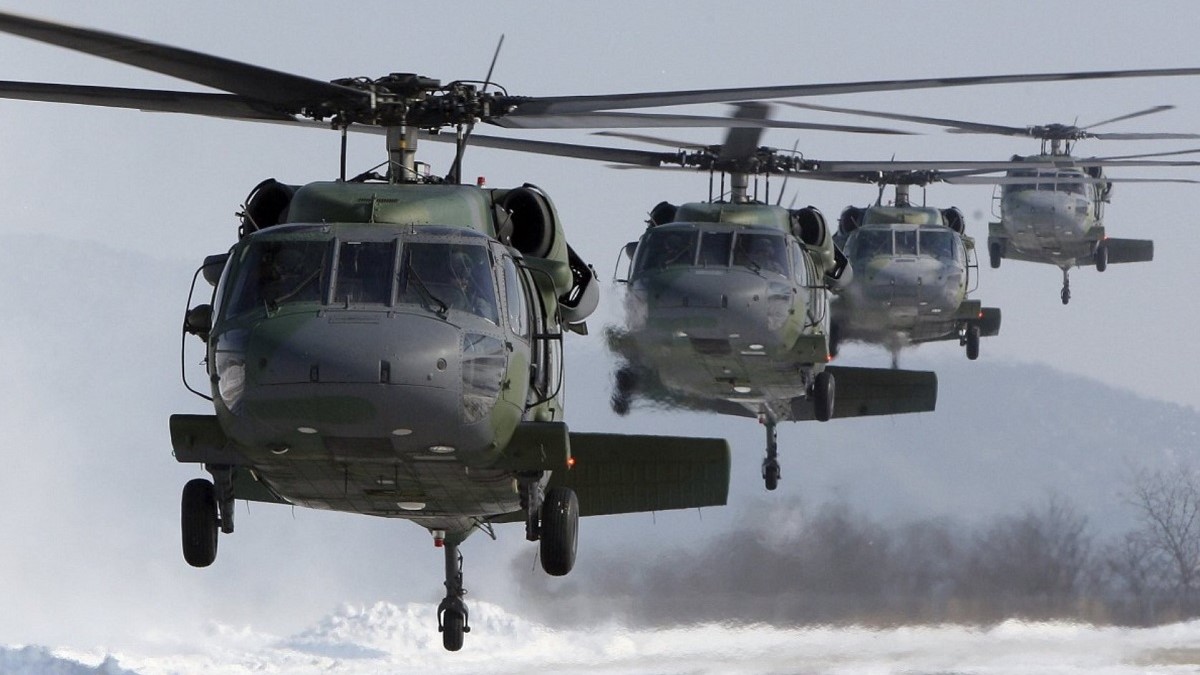
Ukrainian defenders have reportedly begun active use of the multi-role UH-60 / S-70A Black Hawk helicopter. Below is a concise technical overview.
The adage that the best means to defeat tanks is other tanks also applies, to some extent, to aircraft and helicopters. Rotary-wing aircraft are now an integral element of modern armies; they provide flexible, multi-role capabilities.
Contemporary rotorcraft perform a wide range of combat and support tasks. Typical roles include escort, insertion and fire support for assault teams, transport of personnel, cargo and combat vehicles, aerial reconnaissance, electronic warfare, patrolling, and casualty evacuation. A frequently discussed role at present is engagement of tanks and other armoured targets. In short, the helicopter is a versatile platform capable of executing many different mission profiles.

It is reasonable to expect the adversary to employ its helicopters and UAVs for similar purposes, and those rotary- and remotely piloted platforms must be countered. Man-portable air-defense systems (MANPADS) at the infantry level and a layered air-defence architecture are valuable elements, but they do not provide a complete solution against the threats posed by modern attack helicopters.
Historically, the United States was among the first to systematically consider helicopter-versus-helicopter air combat, driven by a large and diverse rotorcraft fleet and extensive operational experience with their use. The U.S. Army fields a wide variety of helicopters configured for different tasks; these platforms perform numerous specialized roles and are integrated into combined-arms operations.
Read also:
- First American Attack Aircrafts: Development Path, Part 1
- First American Attack Aircrafts, Part 2: Alternative Projects of the Early 1920s
- American Attack Aircraft, Part 3: The First Production Variants
- First American Attack Aircraft, Part 4: On the Eve of the 1930s
- First American Attack Aircraft, Part 5: Production A-12 “Shrike”
- American Attack Aircraft, Part 6: Experiments of the 1930s
- American Attack Aircraft, Part 7: John Northrop’s “Gamma”
- American Attack Aircraft, Part 8: Contribution of Gerard Valtí
- American Attack Aircraft, Part 9: Northrop A-17
TABLE OF CONTENT:
Is the UH-60 Black Hawk already in Ukraine?
Before the full-scale Russian invasion on February 24, 2022, the helicopter fleet of the Ukrainian Armed Forces and other security agencies consisted mainly of Soviet-era Mi-24, Mi-8, and Mi-2 helicopters. The Ministry of Internal Affairs also operated several French-made Airbus helicopters, including the H225, H145, and H125 models.
During the ongoing war, Ukraine received Mi-17 helicopters from the United States – originally intended for the Afghan Army – and Sea King helicopters from the United Kingdom in their search-and-rescue configuration. There have also been unconfirmed reports suggesting possible future deliveries of heavy-lift CH-47 Chinook and attack AH-64 Apache helicopters.
The UH-60 Black Hawk had not been publicly mentioned in Ukraine’s equipment lists over the past year. However, on February 21, 2023, the Defence Intelligence Directorate of the Ministry of Defence of Ukraine unexpectedly revealed its use. Official intelligence channels published photographs showing reconnaissance pilots standing beside a Black Hawk helicopter bearing Ukrainian identification markings.
With that in mind, let’s take a closer look at this well-known and widely used helicopter.
The history of the creation of the UH-60 / S-70A Black Hawk
In 1965, the Vietnam War was still in its early stages, and the UH-1 helicopter had yet to achieve the global recognition it would later gain. Nevertheless, the U.S. military had already begun searching for a suitable successor to the “Iroquois.”
By the end of 1965, the Department of Defense launched the UTTAS program (Utility Tactical Transport Aircraft System), aimed at developing a new general-purpose tactical transport helicopter. Progress was initially slow: the existing UH-1 fleet still met operational needs, while ongoing lessons from the Vietnam War frequently prompted revisions to the requirements for the new aircraft.
Work on the UH-60A began in 1968 under the requirements of a program to develop a multi-role tactical transport helicopter. The Pentagon awarded preliminary-development contracts to Bell, Boeing-Vertol, Lockheed, and Sikorsky for a general-purpose tactical transport helicopter intended for assault operations and battlefield resupply. The new type was to replace the Army’s multipurpose Bell UH-1s and the Marine Corps’ Boeing-Vertol CH-46 Sea Knight transport helicopters.
In 1971 the UTTAS development program was formally approved, defining key requirements: capacity to carry a combat unit of 11–15 personnel, a three-person crew, a twin-engine powerplant, and the ability to be transported without disassembly on Lockheed C-130 and C-141 aircraft.
In 1972 the Pentagon issued detailed technical specifications and flight-performance requirements to nine helicopter manufacturers and outlined the principal development stages. A production program for 1,100 helicopters – at the time the Army’s largest helicopter program – was planned for completion by 1985, with an estimated unit cost ranging between $2.0 million and $5.8 million.
Of the nine companies that submitted UTTAS helicopter proposals, the U.S. Department of Defense selected Boeing-Vertol and Sikorsky to build prototype aircraft. The contracts called for each company to produce three helicopters for flight testing and one for static testing.
Following the final selection of a manufacturer, five additional helicopters were to be built, bringing the total to eight aircraft for operational evaluation.
In mid-1972, the U.S. Army awarded Sikorsky a $61 million contract to build three experimental helicopters for flight testing and one for ground testing. Boeing-Vertol received a similar contract. In 1973, Sikorsky’s UTTAS helicopter received the company designation S-70 and the Army designation UH-60A. Under the UTTAS program, Sikorsky and Boeing-Vertol developed and built prototype aircraft designated YUH-60 and YUH-61, respectively. The YUH-60 made its first flight on October 17, 1974. Following evaluation trials and comparative testing, the Pentagon selected Sikorsky as the program’s winner in 1976 and signed an $83.4 million contract for production of the first UH-60A helicopters.
Read also: K-MAX Logistics Drone: An American Case Study
Three generations of Black Hawks
The main factors that led to the Sikorsky UH-60A’s selection were its lower technical risks and reduced operating costs over an estimated 20-year service life.
The UH-60A is the baseline variant, powered by two T700-GE-700 engines rated at 1,500 horsepower each. The helicopter follows a conventional single-main-rotor configuration with a four-blade rotor system. The rotor blades, made from titanium and composite materials, are designed to withstand hits from 23 mm projectiles.
The primary structural component of the fuselage is a reinforced “box” structure – comprising the cabin roof and floor connected by strong frames – which provides high rigidity and crash resistance. This structure, made of steel and titanium with aluminum skin, ensures durability, particularly during hard landings. The cockpit sides and sections of the floor are protected with Kevlar panels, while the crew and troop seats are armored.
The hydraulic system is fully redundant, enhancing the helicopter’s survivability. The UH-60A is also equipped with an onboard electronic countermeasures suite that includes a radar warning receiver, an infrared jammer, and dispensers for chaff and flares.
UH-60L – a modified production variant introduced in 1989. It is fitted with T700-GE-701C engines (1,900 shp) with digital engine control, features improved cockpit systems, and has an increased payload capacity from 3,600 kg to 4,100 kg. The third major update, the UH-60M, has been produced since 2006. It uses T700-GE-701D engines (2,000 shp), a fully digital avionics suite, and a new central mission computer. Its payload was further increased to 4,500 kg.
The S-70i is an export version of the UH-60M that omits some U.S. Army-specific equipment to allow sales without a special Congressional license. Produced since 2010 at the PZL Mielec facility in Poland, the S-70i is reportedly the variant employed by some Ukrainian special forces units.
Read also: All about the “passenger attack” Cessna AC-208 Combat Caravan: an air‑defense variant?
Special modifications of the UH-60 Black Hawk
Over the course of its production and operational history, several specialized versions of the UH-60 Black Hawk have been developed.
- EH-60A – an electronic warfare variant equipped with dedicated countermeasures and communications-interference systems.
- EH-60C and EH-60L – airborne command post versions fitted with expanded radio and communications equipment.
- UH-60Q, HH-60L, and HH-60M – medical evacuation variants based on the UH-60A, UH-60L, and UH-60M respectively.
- MH-60A – a special operations version featuring an infrared (FLIR) sensor, enhanced communications, and additional electronic warfare systems.
- MH-60K – a special forces modification introduced in 1986, equipped with a forward-looking infrared (FLIR) system, terrain-following radar, and T700-GE-701C engines.
- MH-60L – a counterpart to the MH-60A, but based on the UH-60L platform.
- VH-60N White Hawk – a variant derived from the UH-60A, configured for U.S. presidential and executive transport. Operated by Marine Corps aviation units, it is powered by naval T700-GE-401C engines, similar to those used on the SH-60B Sea Hawk.
- AH-60L ‘Arpia’ is an attack helicopter manufactured for Colombia. It is armed with an under-fuselage mount with a 20 mm cannon, as well as various types of missiles, and has the appropriate targeting equipment.
- UH-60J and UH-60JA are modifications produced under licence by Mitsubishi in Japan. The first is a search and rescue helicopter designed for the Air Force and Navy, while the second is designed to transport army units.
- UH-60P is a variant built under licence in South Korea (about 150 units). It is based on the UH-60L but features some improvements.
Numerous modifications are produced for export under the designation S-70A with corresponding digital indices – from S-70A-1 (for Saudi Arabia) to S-70A-50 (for Israel).
Read also: Weapons of Ukraine’s victory: Zozulya Deep Strike Drone
Combat experience of Black Hawks
The UH-60 / S-70A Black Hawk made its combat debut during the U.S. invasion of Grenada on October 8, 1983. Helicopters of this type were operated by the 82nd Airborne Division. Operational experience demonstrated that the UH-60A was a reliable and durable platform. One helicopter sustained 47 hits from small arms fire (7.62 mm) yet managed to return safely to base. Another Black Hawk had its fuel tanks pierced in five places, but the leaks were not detected until the following day.
No Black Hawk helicopters were lost during this operation. The same was true during the U.S. invasion of Panama in December 1989, in which UH-60A aircraft from the 82nd Airborne Division also took part. In that campaign, Black Hawks were used to deploy airborne troops tasked with capturing key infrastructure sites.
The helicopters saw their first large-scale deployment during Operation Desert Storm in February 1991. Prior to the start of the campaign, the U.S. had concentrated more than 400 helicopters of this type in Saudi Arabia – including standard UH-60s and special operations MH-60 variants. During the assault on February 24, around 300 aircraft participated simultaneously in a single operation to deploy the 101st Airborne Division. Black Hawks were also employed in other missions, with MH-60s conducting insertion and extraction of special operations teams. Overall losses of Black Hawks during Operations Desert Shield and Desert Storm were minimal – six helicopters in total, four of which were lost in flight accidents and only two due to enemy fire.
To be fair, there were also setbacks in the UH-60’s operational history. The most notable was the operation in Mogadishu, Somalia, on October 3–4, 1993, during which U.S. forces lost three helicopters of this type.
In 1994, U.S. troops deployed to Haiti in an effort to end the civil conflict and prevent a humanitarian crisis. During this mission, UH-60L helicopters were used to transport soldiers of the 10th Mountain Division from the aircraft carriers USS America and USS Dwight D. Eisenhower.
Starting in December 1995, Black Hawk helicopters served as part of UN and NATO forces in the territory of the former Yugoslavia. Since the beginning of the global war on terrorism in 2001, they have been a consistent presence in all major operations, including the wars in Afghanistan and Iraq. The 2003 Iraq campaign alone resulted in the loss of 24 Black Hawks – seven due to combat and the remainder in accidents and crashes.
Read also: Tomahawk Cruise Missiles – What You Need to Know
UH-60 Black Hawk design
The UH-60 Black Hawk is a single-rotor helicopter with a tail rotor, powered by two turboshaft engines and equipped with a tricycle landing gear.
Light alloy fuselage
The helicopter’s fuselage is an all-metal, semi-monocoque structure made from lightweight alloys. Composite materials based on fiberglass and Kevlar are used in the construction of the crew door panels, canopy, fairings, and engine cowlings. Access to the two-seat cockpit is provided through side doors that open upward. The crew seats are armored. The cargo compartment measures 4.95 × 2.21 × 1.87 meters, with a total volume of 11.6 cubic meters, and features sliding cargo doors on both sides measuring 1.5 × 1.75 meters. The cabin can accommodate up to ten fully equipped troops or six wounded personnel on stretchers. The rear section of the fuselage transitions into a monocoque tail boom with an upward bend and an asymmetrical end section, which supports the horizontal stabilizer and tail rotor assembly.
The stabilizer is controllable, straight, and has a span of 4.37 meters. Its angle of incidence is adjusted automatically through a control system that receives input from airspeed, angular rate, and lateral acceleration sensors. The tail boom can be folded for transport or storage. The fuselage features a crashworthy design capable of withstanding loads of up to 20g in a frontal impact and 10g in a vertical impact. The helicopter is equipped with a rescue hoist rated for 270 kg with a 69-meter cable, and a cargo hook capable of supporting loads up to 3,630 kg.
Tricycle landing gear
The tricycle landing gear is fixed and does not retract during flight. Each strut is fitted with a single wheel. The main landing gear is of the lever type and equipped with dual-chamber shock absorbers. The pneumatic-hydraulic damping system is designed to absorb ground impact forces of up to 40g without the fuselage contacting the ground.
The landing gear has a track width of 2.7 meters and a wheelbase of 8.83 meters. The main gear tires measure 660 × 254 mm with an inflation pressure of 0.88–0.93 MPa, while the tail gear tire measures 380 × 152 mm with a pressure of 0.6 MPa.
Screw design
The main rotor is a four-blade system with hinged blade attachments. The hub is a one-piece titanium alloy structure equipped with elastomeric bearings and dampers that require no lubrication. This design reduces rotor maintenance workload by approximately 60%.
The blades are rectangular in planform, featuring titanium alloy spars with an oval cross-section, a Nomex honeycomb core in the aft section, a trailing edge and root section made from graphite-based composites, and fiberglass skin panels. Fiberglass counterweights run along the length of each blade. The blade root is reinforced with a titanium fitting, while the swept blade tips are made of Kevlar. The blades are designed with damage tolerance in mind and can withstand hits from projectiles up to 23 mm in caliber.
The helicopter is equipped with an electric blade de-icing system and self-adjusting pendulum vibration dampers mounted on the rotor hub. A main rotor brake is also installed.
The tail rotor has four blades, a diameter of 3.35 meters, and a hingeless mounting system. Together with the tail pylon, it is canted 20° to the side, providing a vertical thrust component and improving center-of-gravity range. The hub consists of two cross-shaped beams. The blades are rectangular in planform and made from graphite-epoxy composite material. Each blade is 0.244 meters wide and fitted with an electric anti-icing system.
Read also: Saab JAS 39 Gripen as an Option for the Ukrainian Air Force: Understanding This Aircraft
UH-60 Black Hawk power plant
The UH-60 Black Hawk is powered by two General Electric T700-GE-701C turboshaft engines. Each engine produces approximately 2,000 horsepower, providing sufficient power for a wide range of missions, including cargo and personnel transport, search and rescue, and armed support operations.
The engines are mounted in nacelles on either side of the main pylon. This powerplant configuration was combat-proven, with its core design having been previously validated under operational conditions during the Vietnam War.
The modular design of the transmission simplifies maintenance. The main gearbox is capable of operating for up to 30 minutes after the loss of lubrication without seizing.
The internal fuel tanks have a total capacity of 1,360 liters. Additional fuel can be carried in two internal auxiliary tanks with a combined capacity of 1,400 liters, as well as in an external tank holding 1,740 liters.
The in-flight refueling probe is made entirely of composite materials and can extend beyond the main rotor plane within 20 seconds. The refueling system delivers fuel at a rate of 1,135 liters per minute under a pressure of 0.33 MPa. This capability allows the helicopter to refuel quickly and continue its mission without significant interruption.
Read also: Weapons of Ukraine’s Victory: AIM-132 Missile
Helicopter cabin
The helicopter is operated by a crew of three: a pilot and co-pilot seated in the cockpit, and one crew member stationed in the troop compartment.
The Black Hawk is equipped with a digital avionics suite. To reduce pilot workload, the helicopter can be fitted with a digital Automatic Flight Control System (AFCS), which provides primary flight and navigation displays for the crew.
Read also: Inertial Navigation Systems: How It Works
Communication tools of Black Hawk
The UH-60 is equipped with a wide range of communication and data transmission systems. These include VHF and UHF radios, a voice communication and data link system, and an Identification Friend or Foe (IFF) transponder. The Black Hawk features secure voice communication, satellite communication capabilities, and an intercom system connecting the crew and passengers. It is also fitted with covert communication systems operating in the decimeter, meter, and shortwave bands, as well as radio navigation equipment, identification systems, and radio beacons.
The main components of the navigation system include a Doppler radar and an inertial navigation system, with optional integration of satellite positioning equipment. The crew is equipped with night vision goggles. Defensive systems include an AN/ALR-39 radar warning receiver and an automatic dispenser for chaff and infrared flares.
Cargo compartment of Black Hawk helicopter
The cargo compartment can accommodate 11 fully equipped troops or four patients on stretchers along with a medical officer during medical evacuation missions.
The compartment is equipped with ventilation and heating systems. The Black Hawk can carry external loads of up to 9,000 pounds (4,072 kilograms) on its cargo hook, such as a 155 mm howitzer. The main section of the cabin can be cleared of troop seats to accommodate cargo, and additional storage pods can be mounted using the External Stores Support System (ESSS).
Read also: Weapons of Ukraine’s Victory: SDB Guided Bomb
Armament of UH-60 / S-70A Black Hawk
The UH-60 / S-70A Black Hawk can serve as a launch platform for laser-guided anti-armor Hellfire missiles. The helicopter can carry up to 16 Hellfire missiles when fitted with the External Stores Support System (ESSS), which is mounted along the sides of the airframe. These pylons enable the carriage of munitions, guns and electronic warfare pods with a total payload capacity of approximately 10,000 lb (4,500 kg). The cabin can also be used to carry additional missiles, supplies or personnel. Air-to-air FIM-92 Stinger missiles can be installed on external hardpoints as required.
The helicopter can be armed with two 7.62 or 12.7 mm machine guns.
U.S. Army Black Hawks are equipped with the Goodrich AN/AVR-2B laser warning receiver system.
UH-60 Black Hawk Technical Specifications
- Power plant: 2 × General Electric T700-401
- takeoff power: 1285 kW
- rotor diameter: 16.36 m
- fuselage length with refueling boom: 17.38 m
- helicopter height: 5.13 m
- takeoff weight: 9980 kg
- empty weight: 5,735 kg
- maximum speed: 268 km/h
- cruising speed: 237 km/h
- static ceiling: 3,170 m
- dynamic ceiling: 5,790 m
- flight range: 600 km
- over-the-horizon range: 2,220 km.
The UH-60A Black Hawk shown in the photo released by the Defence Intelligence of Ukraine features an unusual black-and-blue livery, atypical for the Armed Forces of Ukraine. Instead of being repainted, only Ukrainian identification markings were applied. This suggests that the helicopter may have been acquired from the civilian market.
Analysts at NMFTE located a helicopter with an identical livery registered to Ace Aeronautics, a company that specializes in cabin modifications for transport aircraft. The same airframe was exhibited in a combat configuration with an installed weapons kit at the International Helicopter Association show in Dallas in March 2022.
I am confident that such a reliable and secure helicopter is very necessary for our defenders. We are sincerely grateful to our Western partners, in particular the United States, for their support and provision of modern military equipment.
We believe in our defenders. The invaders will not escape retribution. Death to the enemies! Glory to the Armed Forces of Ukraine! Glory to Ukraine!
Read also: