Today we look at the new long-range UAV Zozulya, reportedly capable of flights up to 2,100 km, introduced by the Ukrainian company Warbirds of Ukraine.
Ukraine continues to face shortages across many classes of weaponry and has been integrating unmanned aerial systems at scale to fill capability gaps. In that context, long-range platforms for strikes against enemy targets have been developing steadily. The Zozulya project is a notable recent entry: according to available reports, the platform has entered production and is being deployed in operational conditions.
Read also: Tomahawk Cruise Missiles – What You Need to Know
TABLE OF CONTENT:
What the developers presented
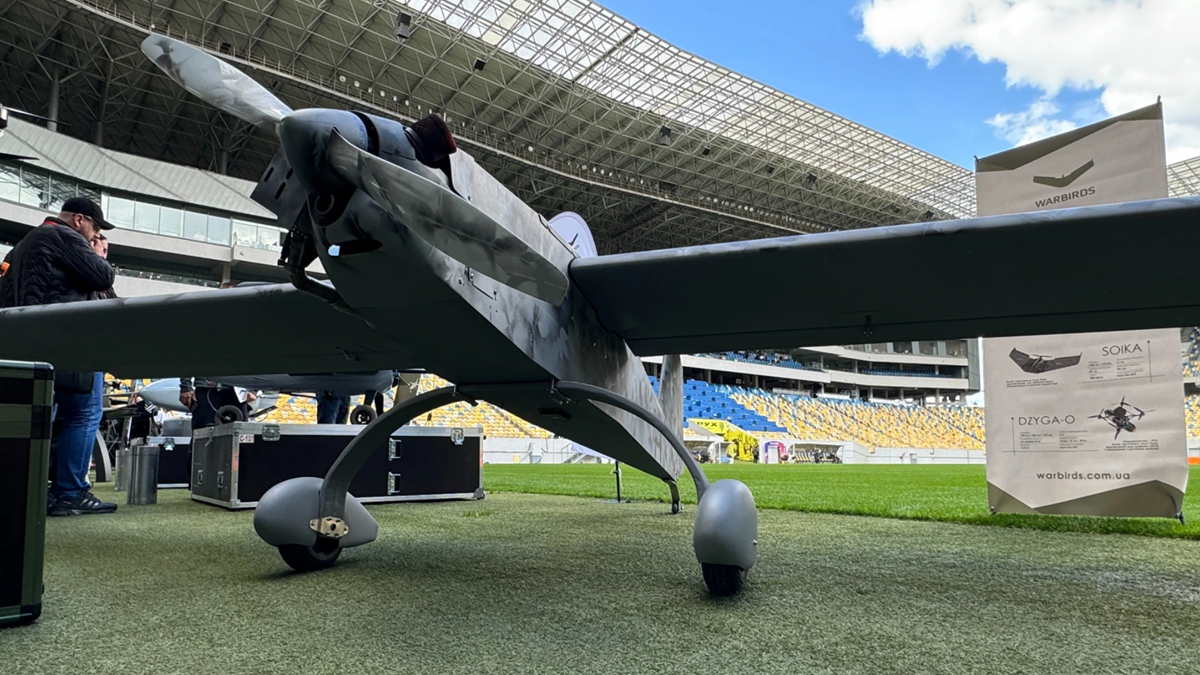
A few days ago Ukraine hosted a small exhibition focused on unmanned aviation developments. One exhibit came from Warbirds of Ukraine – a manufacturer that has previously taken several of its own UAV designs into production and now presented a new model.
The event included the first public showing of a strike loitering munition (kamikaze drone) called Zozulya. The manufacturer released the project goals, basic technical specifications and its own assessments of the platform’s potential. According to official statements, Zozulya has completed development and testing and moved into serial production. The Ministry of Defence is reported to have started procurement, with roughly 100 units allegedly manufactured and delivered to the customer. The company also refers to initial combat use, but no public details on operations or results have been provided so far.

It should be noted that the Zozulya UAV is presented as a long-range strike system intended to engage enemy targets well beyond the front line. The developers state it is capable of conducting precision strikes against infrastructure and military objectives at extended ranges.
Read also: Inertial Navigation Systems: How It Works
Features of the Zozulya kamikaze drone
The Zozulya is a medium-sized loitering munition with a simplified design, intended to deliver an integral warhead to a ground target at pre-determined coordinates. In terms of form and employment concept it resembles several other domestic systems, but it includes specific design and operational features that merit closer attention.
Design and chassis
The airframe has a rectangular cross-section; the wing is straight and high-mounted, and the tailplane is a T-tail. The aircraft uses a conventional three-point (tailwheel) undercarriage with main struts beneath the wing and a tailwheel. According to the manufacturer, the airframe is built from readily available, low-cost materials to simplify mass production and reduce unit cost, though that choice may compromise platform durability and survivability.
Size and weight
No official full data are available; open sources list a wingspan of approximately 5.6 m and a length of about 3.1 m. The declared maximum takeoff mass is up to 150 kg (approx.), which places the Zozulya loitering munition in the medium weight class for this type of UAV.
Engine and dynamic characteristics
A compact piston engine of unspecified type is installed in the nose, driving a two-bladed tractor propeller. Cruise speed is stated at approximately 130 km/h, with a maximum of up to 180 km/h. The claimed maximum range is 2,100 km. The UAV can carry a warhead of 10–50 kg depending on range: at 2,100 km the platform is reported to be capable of delivering 10–15 kg, while with the maximum 50 kg warhead its effective range drops to about 1,100 km. If these figures are accurate, they would make the platform suitable for striking distant targets, but practical operational range should be assessed against radio/link limitations and navigation requirements.
The loitering munition is reported to have an autonomous endurance of up to 9 hours. Takeoff requires a runway similar to those used by small aircraft.
Navigation and guidance
The aircraft carries a basic autopilot for following pre-programmed routes and, reportedly, uses satellite (GPS/GLONASS) and/or inertial navigation with the ability to maintain course autonomously if GNSS signals are lost. The developer mentions anti-spoofing measures and CRPA (controlled-reception-pattern antenna) capability, together with an onboard inertial subsystem designed to sustain navigation without GPS for extended periods. The exhibited example, however, lacked any visible optical sensors; that limits its reconnaissance and visual-correction capabilities and makes classic loitering-with-visual-homing employment impractical.
Ammunition and detonator
The declared payload is 10–50 kg. The most probable configuration is a fragmentation–HE warhead with a simple contact fuze, similar to many other domestic solutions. Other warhead types cannot be ruled out. Ukrainian forces have previously adapted systems to specific mission requirements, so field variants are possible.
Communication and control
The drone uses a unified operator interface compatible with the manufacturer’s other platforms, which speeds up crew training and requalification. The developer reports ongoing work to upgrade communication links and certain onboard systems.
Cost and production
The estimated price of the new Ukrainian UAV is about $40,000 per unit. Available information indicates that the Zozulya has completed testing, been codified by the Ministry of Defence, and is already being procured. During the demonstration the developers stated that roughly 100 airframes have allegedly been manufactured. There are also mentions of combat use, but public details about missions and outcomes are scarce – operators typically do not disclose such information.
Limitations and practical significance
The absence of optical sensors and, likely, a limited sensor suite reduce operational flexibility. This loitering munition is better suited to strikes against pre‑identified, fixed targets than to dynamic or visually corrected engagements. Its long claimed range makes the platform potentially useful for engaging distant targets, but actual effectiveness will depend on the quality of reconnaissance, the communications link, and enemy countermeasures (air defence and electronic warfare). Production reliability is also important – the use of readily available materials and a simplified design facilitates mass production but may increase the likelihood of technical failures under intensive use.
Warbirds of Ukraine state they have ambitious plans: they describe Zozulya as a modular platform. Beyond the baseline kamikaze role, planned configurations reportedly include a reconnaissance variant, a communications relay, a munition carrier, and even an interceptor drone, which would increase the platform’s tactical versatility.
Read also: Weapons of Ukraine’s Victory: SDB Guided Bomb
Technical specifications of the Zozulya UAV
- Antenna: CRPA
- Climatic conditions: all-weather.ь.
Read also: Weapons of Ukraine’s Victory: The Heavy Cruise Missile “Flamingo”
Replenishment has arrived
Ukraine has developed, both independently and with foreign partners, a range of strike loitering munitions in the medium and heavy classes. These systems are regularly used to engage Russian targets at distances well beyond the front line. Many designs share similar architectures and comparable performance characteristics. Typically these are simplified fixed‑wing UAVs produced with low unit cost; examples include the Zozulya, “Liutyi,” and others. At the same time, work continues on more complex cruise‑type systems. Projects such as “Palyanytsia,” “Peklo,” and “Flamingo” fall closer to conventional cruise‑munitions in concept and capability.
The developers highlight several defining advantages of these platforms. Primarily, their simple design and low cost enable mass production and operational flexibility. Modern navigation modules and GPS guidance are cited as improving strike accuracy. A warhead weighing several tens of kilograms can inflict meaningful material damage. In its class, the long‑range Zozulya does not differ fundamentally in form or in its claimed specifications. Consequently, its operational benefits and limitations broadly match those of other Ukrainian designs, although certain variants may offer an advantage in range.
However, these platforms have both individual and class‑wide limitations that materially constrain their practical capabilities and make them relatively easy to counter. Addressing most of these weaknesses typically requires disproportionate expense or technical measures that erode the primary advantages – simplicity and low cost. Operational use has shown that low energy and geometric observability, the use of radio‑transparent materials, and simplified structural solutions do reduce the chance of early detection. Nevertheless, modern reconnaissance systems – integrated radars, electro‑optical complexes, and infrared sensors – are increasingly able to detect and track such targets and forward their coordinates to strike systems.
Notable is the vulnerability of simplified electronics. A limited number of redundant channels, reliance on external navigation signals, and rudimentary protection against electronic warfare (EW) make these systems susceptible. That reduces guidance accuracy and increases the risk of losing the platform before it reaches its target.
The airframes of such UAVs are generally not highly robust, yet they often carry warheads weighing several tens of kilograms. As a result, any hit by shell fragments or parts of a surface‑to‑air missile can inflict fatal damage to the vehicle or trigger an airburst of the warhead.
Read also: Weapons of Ukraine’s Victory: Modern Long-Range ERAM Missiles
Why do we need such kamikaze drones?
Therefore, a significant operational effect from the Zozulya UAV and similar systems is achieved mainly through mass employment: only simultaneous or coordinated series of launches substantially increase the probability of breaching air defences and striking targets.
Beyond numbers, mission success depends on the quality of route planning. Optimal flight trajectories that account for threat zoning and minimise exposure to strong air‑defence nodes can either bypass hazardous areas or force the adversary to disperse forces, improving the chance of penetration. This requires reliable reconnaissance, flexible command and control, and close coordination among the units that prepare and launch the vehicles.
Strategically, such strikes have a dual effect. First, they inflict direct losses on the adversary – damage to personnel, equipment and forward‑area infrastructure. Second, precision attacks against rear‑area targets – logistics, depots and critical infrastructure – degrade the enemy’s economic capacity, force reallocation of resources to recovery and defence, and generally impose additional operational costs. A well‑planned, sustained campaign employing these UAVs can therefore reduce the opponent’s combat capability and lower risks to friendly units.
Whether the new Zozulya will reliably overcome operational challenges and effectively strike rear‑area targets remains to be demonstrated in service.
Read also: