In the ongoing Russo‑Ukrainian war, unmanned aerial vehicles (UAVs) have taken on numerous roles. Perhaps the least visible – but highly critical – role is logistics. UAVs have proven indispensable for delivering supplies to isolated positions, including food, water, and radio batteries. The U.S. military has faced similar challenges, but instead of using small quadcopters, they historically relied on full-sized remotely piloted helicopters, featuring a highly unusual design.

TABLE OF CONTENT:
Base
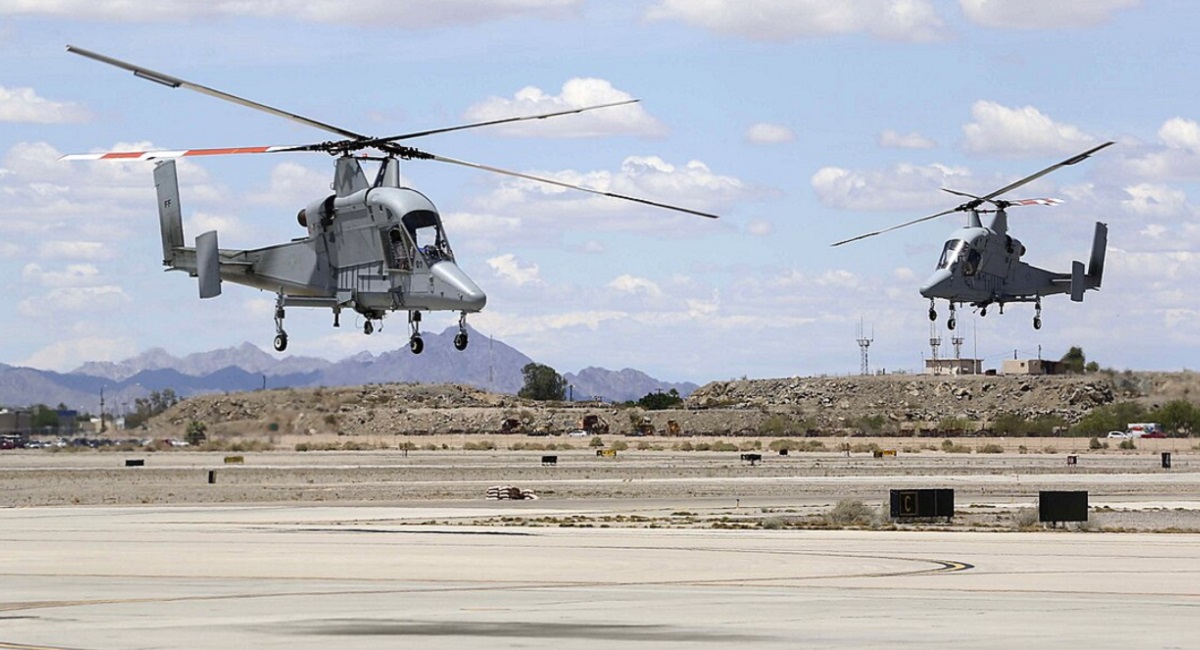
The unmanned cargo platform is based on the K-MAX (also designated K-1200) helicopter, produced by Kaman. The aircraft first flew on December 23, 1991, and represents a unique example of a single-purpose helicopter, designed exclusively for external cargo transport. The cockpit accommodates only a single pilot, and there is no dedicated cargo compartment; the airframe is tightly configured around the engine, transmission, and pilot cabin.
Equipped with a single Honeywell T5317A-1 turboshaft engine producing 1,350 hp, the K-MAX is capable of lifting up to 2,722 kg (6,000 lbs) externally – approximately twice the payload of a Bell 205 with a comparable engine and roughly equivalent to its own empty weight. Its maximum speed with a full external load reaches 148 km/h, and its range under maximum payload conditions is around 560 km, sufficient for typical transport missions.
Another notable feature of the K-MAX is its rare synchropter configuration, which employs intermeshing rotors. In this arrangement, the rotor hubs are positioned relatively close to each other compared to the rotor diameter. The rotors rotate in opposite directions, with their drive shafts angled relative to one another so that the rotor planes intersect. Rotor rotation is mechanically synchronized through a rigid linkage between the shafts, ensuring the blades do not collide. Charles Kaman developed his first synchropter in 1945, and the company he founded remains the only manufacturer producing helicopters of this type.
Read also:
- All about the “passenger attack” Cessna AC-208 Combat Caravan: an air‑defense variant?
- Weapons of Ukraine’s Victory: AIM-132 Missile
First experiments
Although the K-MAX was originally developed as a civilian aircraft, its capabilities attracted military interest. The U.S. Marine Corps identified the helicopter as a potential means for ship-to-shore transport. In this role, the K-MAX would operate optionally as a remotely piloted vehicle. A pilot would control the aircraft during long-distance flights, while shuttle missions carrying cargo between ship and shore could be conducted in unmanned mode.
At the end of August 1998, the U.S. Marine Corps Warfighting Laboratory conducted a four-day experimental exercise off the coast of Hawaii under the BURRO program (Broad-area Unmanned Responsive Resupply Operation). During these tests, the K-MAX carried out shuttle missions between the small Navy research vessel SLICE (a catamaran with a helicopter deck) and the shore, transporting various cargoes, including a Humvee vehicle. Flights were conducted via remote control, with a pilot onboard the helicopter as a precaution. The experiment produced promising results, although the findings were not immediately acted upon.
Eight years later, the U.S. Army conducted its own series of experiments. Between September and November 2006, the Army evaluated the K-MAX as an unmanned resupply platform for advanced expeditionary forces. By that time, the experiments had a practical focus, as U.S. forces were conducting operations in Afghanistan, a country with challenging terrain and a poorly developed road network. Although the Army ultimately did not pursue the K-MAX for operational use, testing continued. In March 2007, Kaman formed a consortium with Lockheed Martin to fully adapt the helicopter for remotely piloted operations, including integrating a mission control computer, data links, and a ground control station.
In 2008, the U.S. Marine Corps announced its intention to acquire autonomous aircraft with a payload capacity of 10,000 lbs (4,536 kg) under urgent operational requirements, intended to supply remote outposts in Afghanistan. No existing UAVs met these specifications. The K-MAX was the closest option, although its maximum payload was only 6,000 lbs.
The testing was conducted with the scope and pace typical of peacetime U.S. programs. The Lockheed/Kaman consortium received a $46 million contract to demonstrate the K-MAX’s capabilities in both remotely piloted and fully autonomous flights, following pre-programmed mission plans without ground operator intervention. The first series of demonstration flights took place in January 2010 at the Dugway Proving Ground in Utah. In August 2011, a five-day exercise at the Yuma Proving Ground in Arizona, involving personnel from the Marine UAV squadron VMU-1, confirmed the K-MAX’s readiness for deployment in operational environments.
Read also:
Afghanistan
Two K-MAX helicopters arrived in Afghanistan in October 2011. Operational cargo flights to forward outposts began in mid-December. Winter operations in mountainous terrain presented challenges, including icing, strong winds, and thunderstorms. Despite these conditions, the unmanned helicopters and their support personnel from VMU-1 successfully completed assigned missions. By April 2012, the intensity of cargo flights had increased to six missions per day.
On May 22, 2012, shortly after a personnel rotation (with VMU-2 replacing the VMU-1 detachment), the first “hot hook-up” operation was conducted, in which cargo was attached to the helicopter while it remained in hover. This procedure reduced the interval between flights, as previously the unmanned K-MAX had to land to attach cargo. By August 2012, the pair of helicopters had completed 485 flights totaling 525 hours and transported nearly 330 tons of cargo.
The K-MAX deployment in Afghanistan was initially scheduled to last until June 2012. Due to positive operational results, it was first extended to September 30, 2012, and then to March 30, 2013. In March 2013, it was announced that the K-MAX helicopters would remain in Afghanistan “as long as they were needed.” On June 5, 2013, one helicopter crashed near Camp Leatherneck in Helmand Province. The aircraft sustained significant damage but was successfully repaired. The incident temporarily halted flights pending an investigation, which ultimately did not determine a definitive cause; both operator error (the helicopter was flying autonomously) and mechanical failure were ruled out.
In 2014, the K-MAX received an official military designation: CQ-24A CRUAS (Cargo Resupply Unmanned Aircraft System). The Afghanistan deployment concluded in May 2014. During this period, the CQ-24A completed 1,700 flights and transported more than 2,000 tons of cargo.
In September 2015, both CQ-24A helicopters, including the one repaired after the crash, were transferred to Yuma Air Base as part of the VMX-22 test squadron (renamed VMX-1 in May 2016). Testing continued at this location. However, the Marine Corps had lost interest in the K-MAX, as operational requirements shifted toward a smaller UAV with a 1,500-pound payload – one-quarter that of the CQ-24A – but with higher speed and longer range. Following the completion of the test cycle, both CQ-24A helicopters were placed in museums.
Read also: