The Trump administration has approved the sale of 3,350 long-range ERAM missiles to Ukraine. In this piece, we’ll take a closer look at these modern munitions.
Current plans indicate that deliveries could begin within six weeks. The total package is valued at \$850 million, with a large share of the cost covered by European partners. The decision to proceed with ERAM supplies was delayed until after Donald Trump held talks with Russian President Vladimir Putin and Ukrainian President Volodymyr Zelensky. For now, the U.S. State Department has declined to comment on the deal.
It’s worth noting that the push to develop low-cost, long-range missiles is a relatively new Pentagon initiative. The program didn’t appear out of nowhere – the U.S. defense industry has been investing heavily in next-generation air-launched weapons, aiming to expand the capabilities of tactical aviation while also reducing operational costs. Several missile types of different classes and roles are currently in development, but the ERAM project has drawn particular attention from analysts and defense experts.
The goal is to develop an air-to-surface missile that combines high effectiveness with a relatively simple design and lower cost. In other words, it’s an attempt to deliver performance comparable to expensive, high-tech systems without the added industrial and financial overhead typically associated with the U.S. defense sector.

If the project is successfully implemented, ERAM could become something of a “gold standard” for future munitions in this category. It is intended as a versatile solution – expanding the range of weapons available to tactical aviation while also improving flexibility in combat scenarios. Modern warfare increasingly depends on volume and rapid replenishment of arsenals, rather than relying solely on unique, high-end systems. ERAM’s developers are aiming to address this trend by offering a weapon that balances cost, performance, and scalability in production.
In practice, this reflects a shift in approach: moving away from extremely expensive “wonder missiles” toward simpler but effective systems that can be produced in the hundreds or even thousands. In this context, ERAM stands out as one of the more promising experiments within the U.S. defense industry, with the potential to shape the direction of air-launched weapons development for the next decade.
Read also:
- First American Attack Aircrafts: Development Path, Part 1
- First American Attack Aircrafts, Part 2: Alternative Projects of the Early 1920s
- American Attack Aircraft, Part 3: The First Production Variants
TABLE OF CONTENT:
Impact munition
In January 2023, it became public that the U.S. Air Force planned to expand its arsenal with a new missile, launching the ERAM (Extended Range Attack Munition) program.
About a year earlier, the Air Force had issued a request for proposals to develop such a weapon. Sixteen American companies expressed interest, submitting their own concepts for evaluation. This not only reflects the high level of competition in the U.S. defense sector but also highlights the relevance of the idea itself: creating a next-generation air-to-surface missile that combines strong flight performance with relatively low production and operational costs.
ERAM is essentially designed as a balance between effectiveness and simplicity. This reflects an important trend: modern conflicts demonstrate that success depends not only on technological sophistication but also on the ability to produce weapons in large numbers and replenish stockpiles quickly. For this reason, developers are focusing on reducing design complexity to lower costs, while still maintaining combat effectiveness.
By mid-2023, new details had emerged. The Pentagon officially confirmed that it would be the first customer for ERAM, with plans to deploy the missile across both land-based and carrier-based aviation. Export prospects were also outlined early on, with Ukraine identified as a priority recipient. This makes sense, given that Ukraine’s Air Force faces a critical shortage of modern munitions and aviation platforms. In the current war, lower-cost, mass-produced missiles could help offset the lack of more expensive and complex systems.
In this sense, the ERAM program is more than just another U.S. defense industry project – it fits into a broader strategy. For the United States, it represents a move toward a more flexible and scalable arsenal. For allies, it offers access to modern weaponry at a lower cost. And for Ukraine, it could provide a way to strengthen its air capabilities and improve the effectiveness of strike operations in a situation where resources remain limited.
Read also: Swift Beat’s Shahed Interceptor Drone: What We Know
The rockets are still in the development stage
Recent reports have provided new details on the current status and prospects of the ERAM project. According to U.S. media citing official documents, the program is still in its early stages. While there are already completed munitions and even experimental prototypes, production and testing are ongoing, and the timeline for these processes remains uncertain.
The U.S. Air Force, together with participating companies, has spent considerable time refining the design concept for the future missile and establishing its basic technical requirements. Completing this conceptual phase will mark the starting point for full-scale design and the selection of a primary contractor. It is already clear that the program will be multi-staged, with plans to develop several ERAM variants featuring different equipment packages, warhead options, and complexity levels. This approach allows technologies to be developed incrementally while providing flexibility in production and enabling adaptation of the missile for various operational scenarios.
At the same time, plans for future launch platforms are being developed. The U.S. Air Force intends to use ten current tactical aircraft models for testing. The final selection, however, will depend on the outcome of the conceptual phase, which will determine how extensive modifications might be needed to integrate the missile. Given the typical caution of the U.S. defense sector in making public predictions, it is likely that even the first serial ERAM units will not be available before the end of next year. Testing is expected to be conducted on a condensed schedule to accelerate the start of full-scale production.
Interestingly, the project has had a clear export focus from the outset. Preliminary reports indicate that the first foreign recipients of ERAM could include Ukraine, Denmark, and the Netherlands. Ukraine, in particular, appears to be the primary target, as its Air Force faces an urgent need for modern strike capabilities. The new missile could serve as a “quick solution” to enhance operational effectiveness. This approach also aligns with U.S. strategic interests: by providing allies with effective yet relatively low-cost missiles, the United States is effectively testing the concept of “mass deployment” in real operational conditions.
Another notable aspect is the planned production rate. The Pentagon expects the contractor’s factory to produce at least 4,000 missiles over the first four years, averaging more than 70 units per month. For modern precision munitions, this is a high output, reflecting an intention to position ERAM not as an exclusive system, but as a widely available tool for warfare.
In this way, ERAM could symbolize a shift in the U.S. approach to air-launched weapons. The focus is less on uniqueness and more on volume, affordability, and scalability. If the project is successfully implemented, it could set a new standard for air-to-surface missiles not only in the United States but also among NATO allies.
Read also: Everything About the BLAZE Interceptor Drone from Latvian Company Origin Robotics
Desired appearance of the ERAM rocket
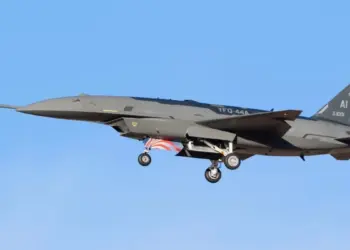
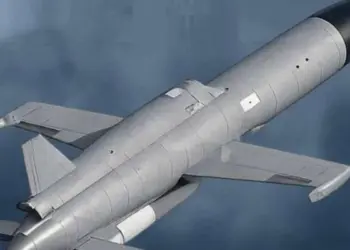
As early as 2023, the U.S. Air Force outlined the key requirements for the prospective ERAM missile. Around the same time, a slide showing a preliminary conceptual image of the munition was released. The exact design envisioned by competing contractors is not publicly known, but it can be reasonably inferred. Achieving the specified performance is expected to rely on a combination of existing technologies and various developments within the U.S. defense industry, which should help shorten development time and reduce production costs.
According to the technical specifications, ERAM is intended as an air-to-surface missile with a launch weight of around 500 pounds (≈230 kg). Exact dimensions and internal layout will be determined by the developer, and there are no specific requirements regarding the type of engine. The minimum target speed is set at 0.6 Mach, with a range exceeding 250 miles (≈400 km), putting ERAM in competition with more expensive modern munitions.
The missile is designed to carry either a high-explosive or fragmentation-high-explosive warhead, with particular emphasis on penetration capability for use against fortified targets. The warhead weight has not been disclosed, leaving room for multiple variants.
Special attention has been given to guidance and control systems. The missile is expected to maintain a circular error probable of no more than 10 meters, even under active enemy electronic warfare. In this context, reports have emerged about the potential integration of the Quicksink module into ERAM. Quicksink is a relatively recent U.S. Air Force development originally designed for aerial bombs. It is a compact module containing electronics and control surfaces that can significantly reduce the cost of integrating guidance systems. It is also possible that ERAM will feature a modified version of Quicksink or an entirely new guidance unit built on its hardware and software foundation.
Regarding launch platforms, the final list has not yet been determined. Priority is given to U.S. tactical aircraft, including the F-15E, F-16, and F-35. At the same time, considering plans to supply the missiles to allies, including Ukraine, compatibility with Soviet-era aircraft is likely. This would make ERAM a highly versatile system, capable of operating within NATO frameworks as well as in countries gradually transitioning to Western weapons standards.
In essence, ERAM is being designed as a bridge between high-tech, expensive missiles and the need for mass-produced, relatively low-cost strike options. The use of existing technologies like Quicksink, combined with potential multi-platform compatibility, makes it an appealing solution for rapid integration into a wide range of military arsenals.
Read also: Everything About Tempest – The UK’s Sixth-Generation Fighter Jet
A combined approach to the development of the ERAM missile
Every customer and developer of air-launched weapons seeks to balance maximum performance with acceptable production costs. In the case of the ERAM program, commissioned by the U.S. Air Force, the emphasis is clearly on cost. Reducing the price is not merely an additional goal – it is the core concept around which the missile is being designed.
The project is still in its early stages. Work continues on defining the missile’s technical layout, refining key ideas, and determining the optimal set of characteristics, while mass production has already begun. As usual, the Pentagon is cautious about releasing details, but the available information provides a clear sense of the program’s underlying logic.
The goal is to develop an air-to-surface missile with performance comparable to existing systems, but at a lower production cost and with easier integration. The approach is ambitious, yet pragmatic. Instead of another “unique” and expensive munition available only in limited quantities, the U.S. aims for a mass-produced weapon that can serve as a reliable workhorse for tactical aviation.
If successful, this concept would provide the U.S. Air Force – and likely the Navy – with a new capability that reduces operational costs without significant loss of effectiveness. Beyond that, ERAM could represent a step toward a new “economy of warfare,” where mass and reproducibility matter more than exclusivity. This approach addresses lessons from conflicts in Ukraine and the Middle East, where the availability of large quantities of affordable precision munitions often proved more decisive than having a small number of high-end “premium” weapons.
At this stage, however, optimism may be premature. The ERAM program is still far from complete, and any unforeseen challenges could reduce its initial performance or increase costs, undermining the project’s central rationale. A less favorable scenario is also possible: technical issues, bureaucratic delays, and budget overruns could turn ERAM into yet another “promising but prohibitively expensive” program. How the missiles are used in Ukraine could also play a decisive role in the future of this long-range weapon.
In summary, ERAM currently exists as a highly promising concept. If realized, it could reshape the U.S. approach to air-launched weapons, paving the way for large-scale production of missiles that are both more affordable and operationally effective.
Read also: History and Achievements of SpaceX: Elon Musk’s Great Space Passion
Technical characteristics of EPAM missiles
At present, only the “baseline” specifications expected for the new munitions are known:
- Estimated rocket weight: 226 kg (500 pounds)
- Estimated flight range: 463 km (250 miles)
- Maximum speed: at least 0.6 Mach (or 716 km/h)
- Warhead: weight unknown, explosive/fragmentation type with a certain degree of unknown variable penetration capability and detonator
- Ability to navigate in conditions of poor GPS signal
- Must have a terminal accuracy of CEP 50 within 10 m (the weapon hits within 10 m of the target centre at least 50% of the time), even in conditions of high radio-electronic interference
- Ability to transmit data from the weapon to the carrier
- Simple and inexpensive design that allows for the production of 1,000 rounds of ammunition in two years (more than 40 units per month).
Read also: Thrust Reversal: How and When an Aircraft Uses Engine Braking
Why ERAM long-range missiles are so important for Ukraine
The specific need for ERAM in Ukraine appears even more justified, as it is tailored to the conditions of this battlefield. The focus is primarily on countering Russia’s active use of electronic warfare, which significantly reduces the effectiveness of many Western weapons. A few exceptions – such as the GBU-39 SDB (Small Diameter Bomb) and the French AASM Hammer – have performed better than most other munitions under these conditions.
The need for long-range munitions like ERAM directly stems from the advantages already provided to Ukraine by Western precision weapons. The key limitation, however, has been the restricted quantities available from U.S. and European stockpiles. Producing ERAM in large numbers specifically for Ukraine could address this shortfall, giving the Air Force the ability to plan strikes without constantly performing a taxing “priority calculus,” where each munition had to be counted and the risk of use carefully weighed.
The challenge is further compounded by the limited number of aircraft capable of deploying such munitions: Ukraine currently relies primarily on MiG-29s, Su-27s, and Su-24s, all of which have technical and operational limitations. This makes the arrival of F-16s particularly important – they not only expand the range of possible strike missions but also enable full integration of next-generation weapons, including ERAM, into Ukraine’s air operations.
We believe in the Armed Forces of Ukraine, we believe that they will be able to break the backbone of the hordes of orcs from Muscovy. Victory will be ours! Glory to Ukraine!
Read also: