Today, I’ll discuss a weapon that was originally designed for aviation use but is currently employed in Ukraine solely as an anti-aircraft system. Specifically, this is the British AIM-132 “Air-to-Air” missile, which the Ukrainian Defense Forces are using – quite effectively – in improvised surface-to-air missile setups.

In general, using air-to-air missiles in air defense systems is not a new concept. Consider, for example, the American short-range Chaparral system (which used AIM-9 Sidewinder missiles) or the widely known NASAMS (with AIM-120 missiles) and IRIS-T systems in Ukraine. However, the British AIM-132 ASRAAM missile had not been used in this role until the summer of 2023. That changed with the Russia-Ukraine war. But before diving into that, let’s start with a history that goes back half a century.
TABLE OF CONTENT:
History of creation
The ASRAAM program traces its roots back to the early 1970s, when the British company Hawker Siddeley began developing a high-maneuverability short-range air-to-air missile called Taildog (SRAAM). Its standout feature was an unusual guidance system: instead of conventional aerodynamic control surfaces, the designers used a sustainer motor with thrust vectoring. During testing, Taildog demonstrated remarkable agility – so much so that in one launch it nearly hit the aircraft from which it had been fired. However, due to budget constraints, the UK Ministry of Defence had to cancel further development of the SRAAM in 1977 and opted to purchase American AIM-9 Sidewinder missiles instead.
The experience gained from developing the SRAAM proved valuable soon after. In the early 1980s, the USSR began developing a new short-range missile with advanced capabilities – the future R-73. In 1982, the UK, West Germany, Norway, and Canada launched a joint program to create a short-range air-to-air missile with an infrared homing seeker: the AIM-132 ASRAAM (Advanced Short Range Air-to-Air Missile). The American company Hughes also participated in the project, designing the missile’s seeker.
The AIM-132 was initially intended to become NATO’s standard short-range missile. However, significant differences in the technical and tactical requirements among the participating countries soon led to the termination of the joint program. In 1989, Germany withdrew, followed by Norway and Canada the next year, leaving the project solely under British control.
In May 1991, the UK Ministry of Defence announced a tender for the development of a short-range air-to-air missile. The competitors included BAe Dynamics with the ASRAAM, the German company BGT with an upgraded AIM-9L, and the French company Matra with the MICA missile. In March 1992, BAe Dynamics was declared the winner and received a contract to develop the new missile under the designation SR(A)-1234.
Read also:
- Weapons of Ukraine’s Victory: SDB Guided Bomb
- Weapons of Ukraine’s Victory: Modern Long-Range ERAM Missiles
Design
The AIM-132 missile features a tailless aerodynamic design and is powered by a dual-mode solid-fuel REMUS motor using a low-smoke composite propellant. Four independent aerodynamic control fins at the rear are actuated by high-torque servos. The combination of a refined aerodynamic shape, high thrust-to-weight ratio, and powerful control actuators gives the AIM-132 high speed, precise handling, and strong maneuverability. This allows it to engage targets in both the forward and rear hemispheres at considerable ranges, with the ability to withstand loads up to 50 g.
The missile is equipped with a 10 kg high-explosive fragmentation warhead featuring two fuzes: a laser proximity fuze and a contact fuze. Its guidance system is dual-mode, combining inertial navigation with an infrared seeker, similar in design to the seeker used in the American AIM-9X missile.
The AIM-132’s guidance system supports three deployment modes:
- Beyond-visual-range launch: The missile can engage a target along a trajectory guided by its inertial system, with the ability to reacquire the target if it is temporarily lost. This mode was previously available only on medium-range missiles.
- Seeker-on-launch mode: The infrared seeker locks onto the target immediately after launch from a pod or rail under the aircraft – standard for short-range missiles with heat-seeking guidance.
- “Over-the-shoulder” launch: For targeting angles exceeding 90°, the missile can acquire a target using its infrared seeker along a trajectory guided by the inertial system or a helmet-mounted cueing system. High maneuverability allows AIM-132 to operate in this mode, enabling it to serve as a self-defense option for the launch aircraft.
The AIM-132 weighs 88 kg, with a length of 2,900 mm and a body diameter of 166 mm. When launched from an aircraft, its range is around 25 km (significantly shorter when fired from a ground-based launcher), and its flight speed exceeds three times the speed of sound.
Read also:
- Weapons of Ukraine’s Victory: AASM/HAMMER Precision-Guided Bombs
- Swift Beat’s Shahed Interceptor Drone: What We Know
Service in the world
Flight testing of the missile began in 1994. Four years later, the first units were delivered to the Royal Air Force. During the trial period, several significant modifications were made to the missile. ASRAAM reached operational readiness in September 2002 and is officially designated AIM-132 in British service. Aircraft equipped to carry the missile include the Harrier, Tornado, and Typhoon.
In 1998, ASRAAM won an Australian Air Force tender, outperforming competitors including the American AIM-9X and the Israeli Python-4. Deliveries began in 2004. In Australia, AIM-132 missiles were equipped on F/A-18A/B Hornet fighters, but they were retired along with the aircraft in 2021. Currently, Australian F/A-18F Super Hornets and F-35A Lightning IIs use American AIM-9X short-range missiles.
In July 2014, India ordered 384 AIM-132 missiles. They were initially deployed on upgraded Jaguar fighter-bombers and have since been integrated into the armament of Su-30MKI and Tejas fighters. Bharat Dynamics Ltd. plans to produce these missiles under license.
In August 2016, the UK Ministry of Defence commissioned the development of an upgraded version of the AIM-132, primarily intended for use on F-35B Lightning II fighters. This version incorporates several technologies from the CAMM surface-to-air missile. By 2018, it was cleared for use on Typhoon fighters, and in 2022, on the Lightning II. The British have already used the AIM-132 in combat; on December 14, 2021, a Typhoon shot down a UAV over southern Syria using this missile.
Potential customers for the AIM-132 include Qatar and Oman, both considering it to arm their Typhoon fighters.
In Ukraine
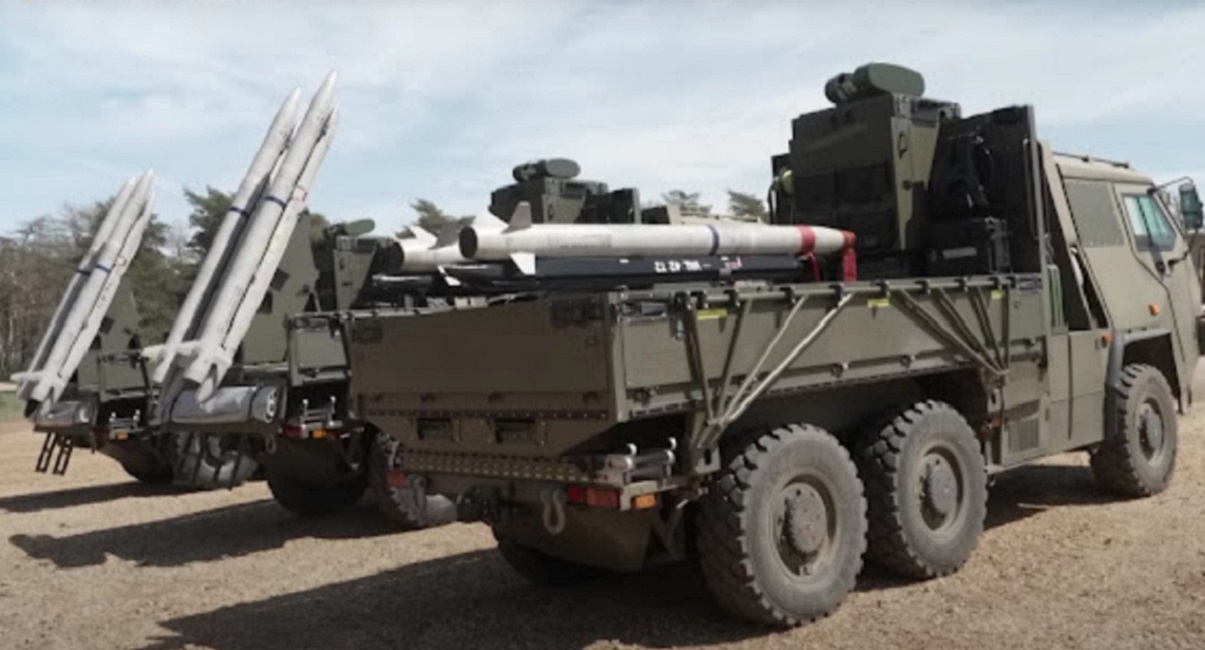
In August 2023, reports emerged that the UK had supplied Ukraine with new air-defense assets – improvised mobile launchers for AIM-132 ASRAAM missiles. The two-missile launcher, using rails taken from retired combat aircraft, is mounted on a Supacat HMT600 three-axle high-mobility vehicle. Spare missiles – likely four – are carried on the same platform. There is no radar; instead, an electro-optical sensor is installed on a mast behind the cab.
The name of the improvised air-defense system – Raven – was revealed in May 2025. At that time, it was reported that the UK had delivered eight of these systems, which had carried out around 400 launches (averaging about 50 per launcher) with an effectiveness of 70%. An additional five launchers were expected to be delivered soon.
Read also: