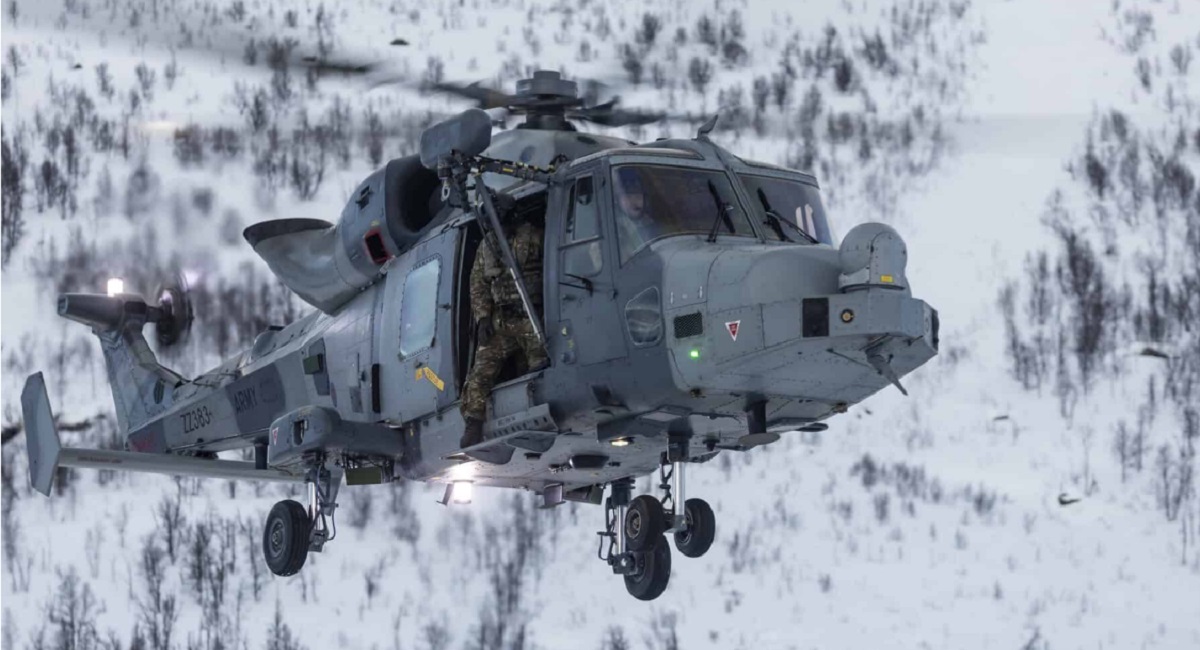
Following Germany, Japan, and the Republic of Korea, the United Kingdom has also begun reorganizing its Army Aviation capabilities in light of the lessons learned from the Russia–Ukraine war. The British Ministry of Defence has announced plans to retire all 34 Wildcat AH.1 helicopters starting as early as 2027. So, what exactly are these aircraft that are being phased out?
TABLE OF CONTENT:
The Pinnacle of Evolution
The Wildcat represents the culmination of the Lynx helicopter family’s evolution, a lineage whose development dates back to the second half of the 1960s. The Lynx is best known as a naval helicopter and has been operated – or is still in service – in around fifteen countries. Ukraine is also expected to join that list in the near future, although that is a topic for a separate discussion. By contrast, the land-based variant has been used only by the British Army Air Corps and the Qatari police, the latter operating just three aircraft.
British Army Aviation has fielded several versions of the Lynx over the years, including the AH.1, AH.5, AH.7, AH.9, and finally the AH.9A, which was retired in January 2018. The new multirole Wildcat helicopter was introduced as the replacement for the Lynx AH.9A fleet.
The Wildcat programme was launched in 2002 and envisaged the development of two variants: one for naval aviation and another for the Army Air Corps. The latter was conceived as a Battlefield Light Utility Helicopter (BLUH), intended for reconnaissance and target designation, troop and cargo transport, medical evacuation, support for special operations forces, airborne command-post duties, and, to a limited extent, the independent engagement of ground targets.
The programme aimed to recreate the Lynx family – already divided into naval and land-based versions – using modern technologies, a concept reflected in the project’s original designation, Future Lynx. The starting point for the design was the export-oriented Super Lynx 300 model. Initially, the plan was to convert existing Lynx helicopters into the Future Lynx configuration. However, in 2004 this approach was deemed impractical, as the conversion costs were considered too high and broadly comparable to procuring entirely new aircraft.
Read also:
- Turbojet Breakthrough from Türkiye: Everything You Need to Know About the TAI Hürjet Trainer and Light Combat Aircraft
- All About Proteus: Self-Contained Helicopter with Potential Implications for Future of Aviation
A Reconnaissance Helicopter
In 2004, the British Army revised its requirements for the new helicopter. It was decided that the service no longer needed a multirole BLUH platform, but rather an aircraft optimized for a narrower set of missions – battlefield reconnaissance and cooperation with the Apache AH.1 attack helicopter. Transport tasks consequently became a secondary consideration. As a result, the BLUH programme evolved into the BRH (Battlefield Reconnaissance Helicopter).
In 2009, Future Lynx was officially renamed Wildcat, with the army variant receiving the designation AH.1 and the naval version HMA.2. Both variants share the same airframe and powerplant, consisting of two CTS800-4N engines, and differ primarily in their onboard equipment and armament.
The Wildcat AH.1 is equipped with the Wescam MX-15Di electro-optical system, incorporating daylight and thermal imaging cameras as well as a laser rangefinder/designator. It is also fitted with the HIDAS-15 integrated defensive aids suite. The naval variant additionally carries a radar. The Wildcat HMA.2 can also employ a broad range of weapons, including Martlet and Sea Venom guided missiles, whereas the Wildcat AH.1’s armament is limited to machine guns mounted in the cabin doors.
Flight testing of the Wildcat prototypes began in 2009. Serial production of the Wildcat AH.1 commenced in 2011, and by 2017 the entire order for the British Army Air Corps had been completed, comprising 34 helicopters. The original requirement had called for 40 aircraft, but rising costs forced a reduction in procurement numbers. Since then, the Wildcat AH.1 and the Apache attack helicopter have formed the backbone of British Army Aviation.
Conceptually, the Wildcat AH.1 is a unique aircraft. It is the world’s only dedicated reconnaissance helicopter to have entered service in the 21st century. However, the rapid development of unmanned aerial systems has rendered the concept obsolete much faster than anticipated. Against this backdrop, the British Ministry of Defence’s decision appears entirely logical.
What lies ahead for the retired Wildcat AH.1 fleet? Some of the aircraft may eventually be transferred to naval aviation and upgraded to a standard closer to that of the HMA.2. Another possibility – this is purely my personal assumption – is that several helicopters could be transferred to Ukraine. With its modern electro-optical system and the ability to carry door-mounted machine guns, the Wildcat AH.1 could potentially serve as an effective hunter of Shahed-type drones.
Read also