


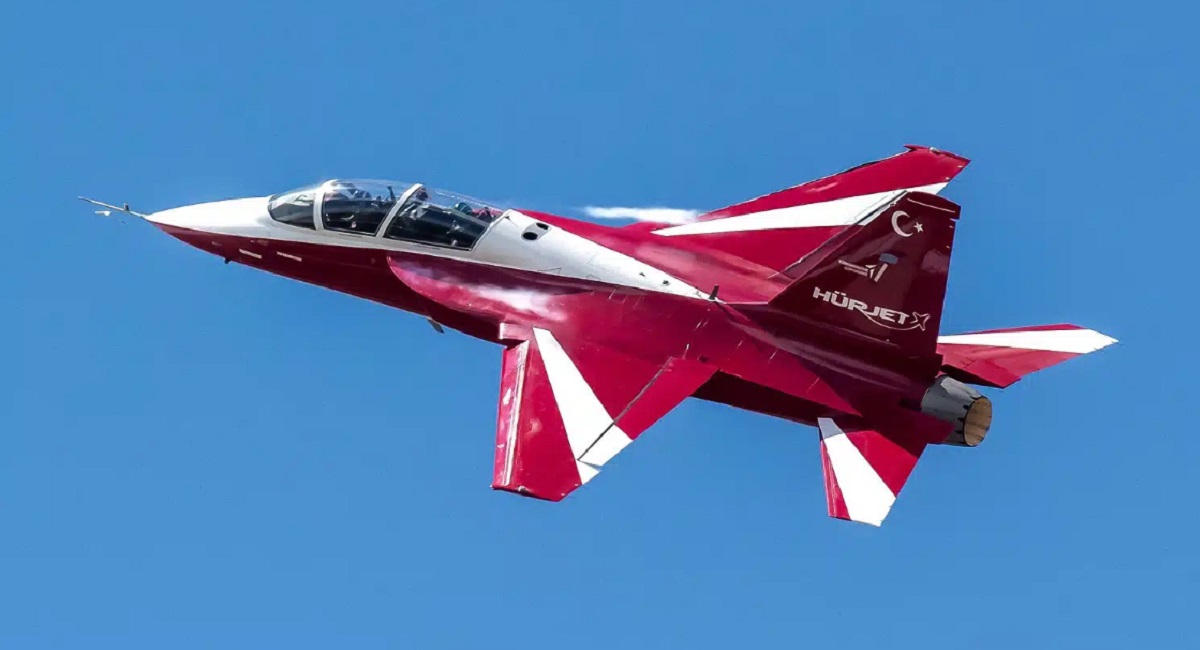
The development of the Hürkuş turboprop trainer marked only the first step in modernizing the Turkish Air Force’s training fleet. The next milestone was the creation of an indigenous jet trainer and light combat aircraft. That project, known as the Hürjet, has progressed steadily and has already secured its first export success on the global defense market. With the program gaining momentum, it’s well worth taking a closer look at what the aircraft has to offer.
TABLE OF CONTENT:
Concept
The Hürjet is intended to replace the Turkish Air Force’s aging supersonic T-38 Talon trainers, as well as the NF-5A Freedom Fighter fighters, which today remain in service only with the Türk Yıldızları (“Turkish Stars”) aerobatic team. The aircraft may also assume part of the close air support role currently performed by the F-16 fleet.
The Hürjet is being developed by Turkish Aerospace Industries (TAI). The program was launched as a company-funded initiative in August 2017, with early development financed from TAI’s own resources. On July 22, 2018, the company signed an agreement with the Turkish Air Force, officially bringing the project under the service’s modernization program and giving it formal government backing.

The Hürjet is a single-engine, twin-seat jet aircraft with a conventional single-fin tail configuration. Several elements of its aerodynamic layout and airframe design – such as the prominent leading-edge root extensions (LERX), the placement of the air intakes, and their overall shape – bear a resemblance to aircraft like the Yak-130 and the M-346. Because the Hürjet is intended to replace the supersonic T-38 Talon, it was designed from the outset to operate at supersonic speeds. That requirement placed particular emphasis on selecting an engine capable of delivering sufficient thrust. Two candidates were evaluated: the European Eurojet EJ200 afterburning turbofan, which powers the Eurofighter Typhoon, and the American General Electric F404-GE-102, the same engine family used in South Korea’s T-50 trainer. In the end, the developers selected the American powerplant. However, Turkey’s long-term objective is to replace it with an indigenous engine once a suitable domestic alternative becomes available.
Comprehensive technical specifications for the Hürjet have yet to be released. However, it is known that the aircraft is equipped with a full-authority fly-by-wire flight control system. The cockpit is compatible with night vision goggles (NVGs), features a head-up display (HUD), and has been designed to support the integration of helmet-mounted cueing systems. The Turkish Air Force has also specified the inclusion of an auxiliary power unit (APU) and an aerial refueling capability among the program’s key requirements.
In its light combat configuration, the Hürjet is expected to carry up to 3,000 kg of external payload. Its planned weapons suite includes the Gökdoğan beyond-visual-range and Bozdoğan short-range air-to-air missiles, SOM tactical cruise missiles, and a variety of precision-guided bombs. The aircraft is also expected to receive an active electronically scanned array (AESA) radar, as the full capabilities of the Gökdoğan missile cannot be utilized without a compatible fire-control radar.
Read also:
- “Free Bird” from Türkiye: Everything About the TAI Hürkuş Trainer and Light Attack Aircraft
- T625 Gökbey: Everything about Turkey’s New Helicopter
Prototypes
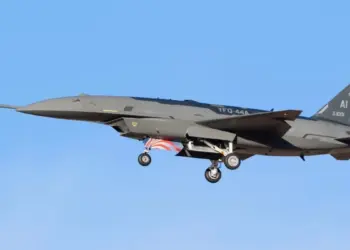
The first Hürjet prototype was officially rolled out and unveiled to the public on December 23, 2022. Engine ground tests began in January 2023, followed by the aircraft’s first taxi test on March 18. The ground test campaign was completed without any major issues, paving the way for the maiden flight, which took place on April 25, 2023.
On August 16, 2024, the Hürjet program reached another significant milestone when the first prototype completed its 100th flight. Just over two months later, on October 21, the aircraft exceeded the speed of sound for the first time. This achievement made the Hürjet not only the first jet aircraft designed and built in Turkey to reach supersonic speed, but also the country’s first indigenous supersonic crewed aircraft. That distinction is worth emphasizing, as Turkey’s Kızılelma unmanned combat aircraft reached the jet-powered milestone earlier, but without a pilot on board.
The second Hürjet prototype made its maiden flight on November 12, 2024. Compared with the first aircraft, it features redesigned engine air intakes, a revised forward fuselage with a lower profile ahead of the cockpit, and wingtip launch rails for air-to-air missiles.
Around the same time, additional details about the combat variant were revealed. The Hürjet is expected to be equipped with the Murad radar, an AESA system currently under development by Aselsan, a domestically produced 20 mm cannon – most likely the three-barrel M197, the same weapon used on the T129 ATAK attack helicopter – and seven external hardpoints for weapons.
It is in this configuration, with four additional underwing pylons and one centerline pylon, that the second prototype has been undergoing flight testing since May 2026. The decision to incorporate an internal cannon, which was not part of the aircraft’s original design, likely reflects an effort to strengthen the Hürjet’s competitive position against the South Korean KAI T-50, which has featured an internal gun from the outset.
Prospects
In 2024, the Turkish Air Force placed an order for four Block 0 pre-production Hürjet aircraft, along with an option for 12 Block 1 production aircraft. The option was later converted into a firm order, with deliveries scheduled to begin this year.
Another noteworthy development is the proposed naval variant of the Hürjet, which is being considered for operations from Turkey’s future aircraft carrier currently under development under the MUGEM program.
The Hürjet also competed in Spain’s advanced jet trainer program to replace the Spanish Air Force’s SF-5M fleet. In July 2024, the first prototype was demonstrated in Spain, where reports also emerged of a potential agreement involving the delivery of 24 Hürjets in exchange for six A400M military transport aircraft required by the Turkish Air Force.
By 2025, Spain’s projected requirement had grown to as many as 45 aircraft. The two sides ultimately signed a contract for 30 Hürjets, with the remaining 15 widely believed to have been retained as a future option. In Spanish service, the aircraft will be known as the Saeta II, a tribute to the HA-200 Saeta, Spain’s domestically developed jet trainer that entered production in the late 1950s and remained in service throughout the 1960s.
The total value of the Spanish agreement is approximately $2.6 billion. As is typical for contracts of this scale, the package extends well beyond the aircraft themselves, covering simulators, maintenance support, and personnel training. It also предусматриes substantial participation by Spanish industry in fulfilling the program.
Beginning in 2028, Spain is scheduled to receive 21 aircraft assembled in Turkey. One of these will be transferred to Airbus, where it will serve as the platform for integrating Spanish-developed avionics and mission equipment. Between 2031 and 2035, Airbus, working alongside other Spanish companies, is expected to retrofit the remaining 20 Turkish-built aircraft to the Spanish configuration while also manufacturing an additional nine aircraft domestically.
With the Hürjet, Turkey’s aerospace industry is entering the global defense market with an aircraft that occupies a relatively specialized niche: the supersonic advanced jet trainer/light combat aircraft. In many respects, it is comparable to South Korea’s T-50, which remains its most obvious competitor.
Competing against the T-50 family will not be easy. The South Korean aircraft has already established a strong international presence through both its training and combat variants, giving it a significant advantage in the export market. The relatively limited number of additional export orders secured by the Hürjet so far reflects this challenge, although TAI continues to express confidence that future customers could emerge from Egypt, the Gulf states, and even Latin America.
| Specifications | Hürjet |
| Wingspan, m | 9.8 |
| Aircraft length, m | 13 |
| Aircraft height, m | 5.1 |
| Wing area, square meters | 23.70 |
| Engine type | F404-GE-102 |
| Engine thrust, kgf:
– maximum – with afterburner |
5,410 8,025 |
| Empty aircraft weight, kg | 6,500 |
| Maximum speed, km/h | 1,480 |
| Range, km | 2,200 |
| Service ceiling, m | 13,715 |
Read also:



After reading it, it appears that the author trusts Google Translate more than the other authorities. The flight is still undergoing testing, and the text has already begun an international flight: starting from Turkey, landing in Spain, and production seems to have ended in the USA.