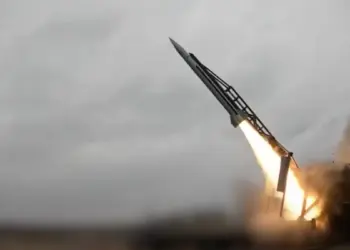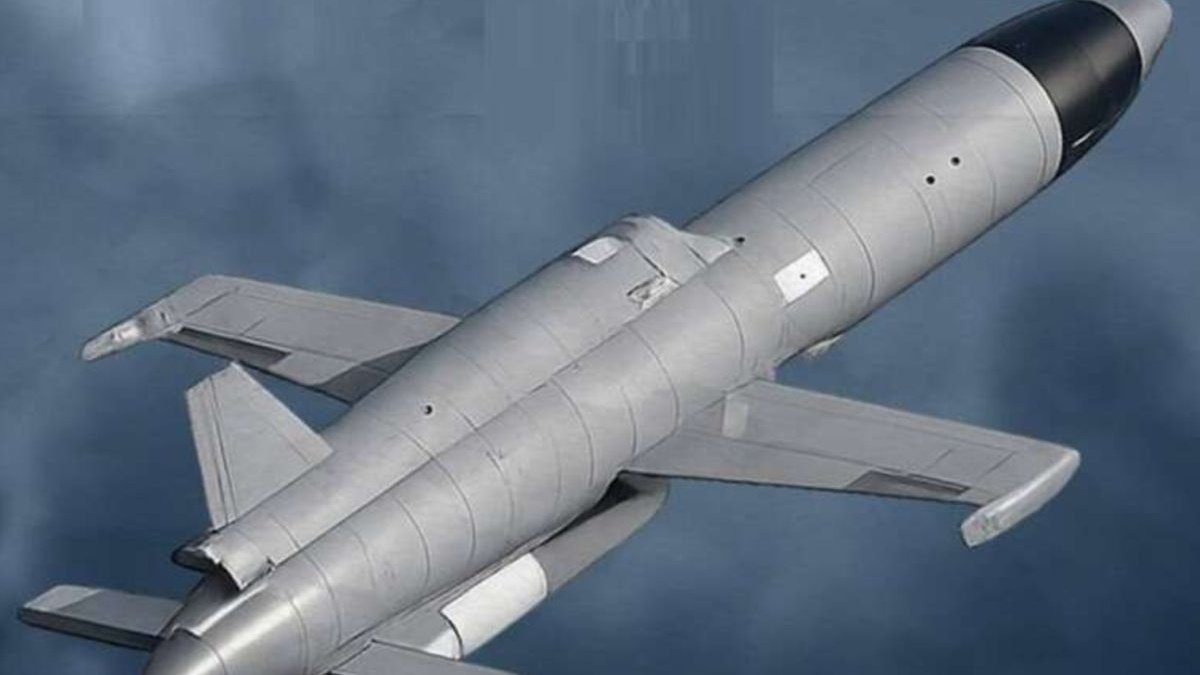
Today, I have a rather unusual guest. Let’s take a closer look at the S8000 “Banderol” – a system that some describe as a loitering munition and others classify as a cruise missile. So, what is it really? Let’s find out.
The introduction of a new weapon system into an adversary’s arsenal is rarely accidental. More often than not, it reflects a specific problem that the defense industry is attempting to solve, and the S8000 “Banderol” is no exception. Rather than an effort to develop a technologically groundbreaking weapon, it appears to be a pragmatic response to several challenges: a shortage of long-range precision-guided cruise missiles, increasing pressure on production capabilities under sanctions, and the need to saturate Ukrainian air defenses with a greater number of simultaneous targets. For this reason, the story of the S8000 is interesting not so much because of its warhead or individual technical characteristics, but because of the strategic logic that appears to have driven its development.
Read also: Project Freyja: How Fire Point Aims to Close a Gap in Ukraine’s Air Defense
TABLE OF CONTENT:
From Isolated Launches to Systematic Employment
The first reports of an unidentified jet-powered unmanned system appeared in Ukrainian monitoring channels as early as the spring, when an object exhibiting speeds uncharacteristic of conventional loitering munitions began to appear in attack tracking data. At the time, it was unclear what exactly air defense forces were dealing with – a new-generation drone or a missile. Greater clarity came when the Main Directorate of Intelligence of the Ministry of Defense of Ukraine officially disclosed the technical characteristics of the new munition on the War&Sanctions portal and identified it as the S8000 “Banderol.”

Since then, the missile’s employment pattern has changed significantly. Isolated, almost experimental launches have given way to the regular inclusion of the “Banderol” in large-scale strike packages, including during one of the most extensive air attacks of the summer on the night of June 15, when Russia launched a total of 611 unmanned aerial vehicles and 70 missiles of various types. This shift suggests a transition from combat testing to serial, albeit still limited, operational use of the weapon.
Read also: Weapons of Ukraine’s Victory: FP-1 – A Drone Capable of Reaching Moscow
A Sanctioned Manufacturer and a Dual-Platform Launch Concept
According to Ukrainian intelligence, the developer and manufacturer of the “Banderol” is the sanctioned Russian company “Kronstadt,” best known for producing the Orion reconnaissance and strike UAV. The Orion became the missile’s initial launch platform, which is a logical choice given that both systems are developed by the same company and the drone already possesses a proven suspension and weapons control system.
At the same time, Ukraine’s Main Directorate of Intelligence notes that the missile is being adapted for launch from Mi-28N attack helicopters, significantly expanding the range of potential launch platforms and, consequently, the geography and tactics of its employment. The transition from an exclusively unmanned carrier to a helicopter-based platform suggests an intention to integrate the “Banderol” into a broader portfolio of strike capabilities rather than leaving it as a niche system intended for a single type of platform.
Read also: Everything About the P1-Sun – SkyFall’s Ukrainian Interceptor Drone
Aerodynamics and Maneuverability as the Key Differentiator
Compared with established Russian cruise missiles such as the Kh-101, the 3M-14 Kalibr, and the 9M727 used by the Iskander-K system, the “Banderol” stands out for its ability to execute tighter turns while maintaining the conventional flight profile of a cruise missile. This characteristic suggests that the developers deliberately prioritized route flexibility, a feature that is particularly important for penetrating dense air defense networks over large cities or maneuvering in environments with extensive electronic warfare activity.
The missile’s appearance has also attracted attention. Analysts at Defense Express have pointed to its resemblance to the American AGM-158C LRASM long-range anti-ship missile. However, the similarity appears to be limited primarily to the general aerodynamic configuration rather than representing a direct copy of the American system’s internal design or combat capabilities.
Dimensions, Propulsion, and Flight Performance
The missile is approximately 5 meters long, has a fuselage diameter of 30 centimeters, and a wingspan of 2.2 meters, making it noticeably more compact than heavy cruise missiles such as the Kh-101. It is powered by a Chinese-made Swiwin SW800Pro turbojet engine fueled by aviation kerosene, enabling a cruising speed of up to 560 km/h and a maximum speed of up to 650 km/h.
The missile’s range is estimated at approximately 500 km, allowing the “Banderol” to strike targets deep in the rear without requiring the launch platform to approach the front line. Its OFBCh-150 warhead has a total mass of 114.3 kg, of which 49.5 kg consists of explosive material. This configuration indicates a high-explosive fragmentation payload designed primarily to engage unprotected or lightly protected targets rather than penetrate hardened structures.
Commercial Electronics as the Foundation of a Weapon System
Perhaps the most revealing aspect of the HUR investigation is not the missile’s aerodynamics but its component base. Instead of relying on specialized military-grade electronics, the “Banderol” is built around components that, in their original intended use, have no connection to weapon systems whatsoever. The Swiwin SW800Pro turbojet engine, for example, was developed for the model aviation market and is openly available on platforms such as AliExpress for approximately $16,000.
The RFD900x telemetry module is of Australian origin, or possibly a Chinese equivalent, while the inertial navigation system is believed to be manufactured in China. The batteries are supplied by the Japanese company Murata, and the Dynamixel MX-64AR servomotors are produced by the South Korean manufacturer Robotis.
The missile also incorporates a jamming-resistant Kometa-M8 antenna developed by the Russian company VNIIR-Progress – the same component already used in Geran drones, as well as in UMPK and UMPB guided munition kits. This commonality effectively standardizes navigation and guidance systems across several categories of Russian weaponry. Completing the picture are nearly two dozen microchips manufactured in the United States, China, Japan, South Korea, and Switzerland, highlighting the extensive use of internationally sourced commercial components in the system’s design.
Read also: Weapons of Ukraine’s Victory: The Heavy Cruise Missile “Flamingo”
Sanctions Evasion Logistics
Ukrainian intelligence has identified more than twenty key components of the missile and approximately thirty companies involved in its production or the supply of its parts. Most of the electronics are reportedly procured through the Chip and Dip network, one of Russia’s largest distributors of electronic components, which effectively serves as a legitimate front for the acquisition of dual-use technologies.
This case illustrates the broader model through which the Russian defense industry continues to gain access to foreign technologies despite international sanctions: through civilian marketplaces, intermediary procurement networks, and the re-export of components that formally fall outside export-control restrictions because they were originally designed for non-industrial or even consumer applications. According to statements by President Volodymyr Zelenskyy, Ukrainian specialists have already identified more than 82,000 foreign-made components across various types of Russian weaponry, and the “Banderol” represents yet another example of this systemic issue.
Low Cost as a Strategic Advantage
The defining characteristic of the S8000 is not its destructive power but its cost. Unlike heavy cruise missiles such as the Kh-101 or Kalibr, whose production depends on sophisticated specialized electronics and is constrained by manufacturing capacity, the “Banderol” is built around widely available, mass-produced, and relatively inexpensive commercial components. This approach makes it possible to scale production far more rapidly than is feasible with traditional precision-guided missiles and to employ the system not as a limited tool for striking high-value targets, but as a means of saturating the airspace with a large number of threats simultaneously.
Conceptually, the missile is closer to the Geran family of drones than to the Kalibr or Kh-101. However, its cruise missile-like aerodynamics and more precise satellite navigation effectively make it a hybrid between a strike UAV and a conventional cruise missile.
A Mirror Image: Ukraine’s Experience with Missile-Drones
Conceptually, the “Banderol” bears a strong resemblance to solutions previously introduced by Ukraine, namely the Peklo and Palyanytsia missile-drones. These systems similarly combine a jet engine, simplified electronics, and an emphasis on mass production rather than the costly, highly specialized precision associated with conventional cruise missiles. In effect, both sides of the conflict are moving in the same technological direction: seeking to reduce the cost of aerial strike capabilities to the point where they can be employed not individually, but in dozens or even hundreds at a time. This reflects a broader trend characteristic of a war of attrition, in which the cost of a weapon system becomes just as important a tactical factor as its accuracy or range.
Read also: The Ukrainian “Tryzub” Laser System: From Testing Grounds to the Front Line
A New Challenge for Air Defense
The emergence of a low-cost, maneuverable, and mass-producible cruise missile places a fundamentally different burden on Ukrainian air defenses than isolated high-end targets. Traditional, expensive cruise missiles are employed in limited numbers and therefore justify interception with the most capable – and costly – air defense assets. The large-scale use of “Banderol” missiles, however, forces air defense operators to allocate resources against targets that are individually less valuable but far more numerous.
The missile’s ability to execute sharp maneuvers further complicates trajectory prediction by radar tracking systems, while its low production cost means that even a high interception rate does not inflict significant financial losses on the attacker. This is the principal danger posed by the “Banderol” – not its individual destructive power, but its potential to become a mass-produced instrument for the gradual attrition of air defense resources.
A Pragmatic Rather Than Revolutionary Weapon
The S8000 “Banderol” is not a breakthrough in missile technology. Instead, it is a pragmatic solution driven by sanctions pressure, the loss of manufacturing capacity, and the need to increase the scale of strikes against Ukraine without a proportional rise in costs. Its design, built around commercial electronics sourced from more than a dozen countries, highlights both the vulnerabilities and the adaptability of Russia’s defense industry under conditions of restricted access to legitimate technologies.
At the same time, the emergence of this type of weapon underscores a broader trend in modern warfare: success in the air domain increasingly depends not on possessing a limited number of highly sophisticated precision systems, but on the ability to produce sufficient quantities of relatively inexpensive strike weapons – and the means to intercept them. In this sense, the “Banderol” is more than just a new missile. It serves as an indicator of the direction in which the technological competition between offensive strike systems and air defense capabilities is evolving at this stage of the war.
Read also: Weapons of Ukraine’s Victory: Tempest Air Defense System with AGM-114L Longbow Hellfire Missiles