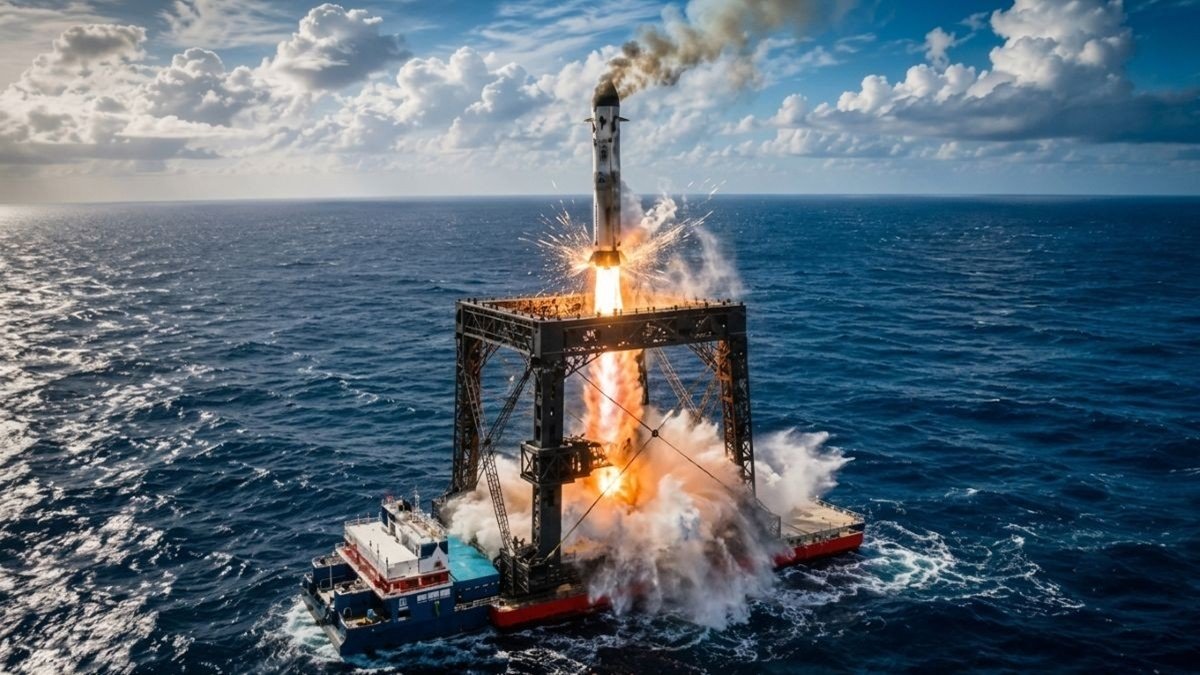
On July 10, 2026, China’s new Long March 10B rocket lifted off from the Wenchang Space Launch Site on Hainan Island. Its upper stage successfully delivered a satellite into the planned orbit, while the first stage returned to Earth just six minutes after separation – not by landing on deployable legs like the Falcon 9, and not on a concrete landing pad, but directly into a prepared net mounted on an offshore platform.

This marks the first successful controlled recovery of an orbital-class launch vehicle stage achieved through a fundamentally different approach from the one that has dominated the industry for the past decade thanks to Elon Musk’s company. China has not simply copied an existing recipe – it has proposed one of its own. That is precisely why this event deserves to be viewed as more than just another milestone in China’s space program.
Read also: Project Freyja: How Fire Point Aims to Close a Gap in Ukraine’s Air Defense
TABLE OF CONTENT:
How the Recovery Was Performed
The launch took place at 12:15 p.m. Beijing time from Commercial Launch Pad No. 2 at the Wenchang Space Launch Site. After the first stage completed its burn using seven engines and separated from the vehicle, the second stage continued the mission on a single methane-fueled engine. It proceeded through the main ascent phase, a coast period with reorientation maneuvers, and a restart sequence before accurately delivering the satellite into its target orbit. The upper stage’s total powered flight time was approximately fifty minutes.
Meanwhile, the first stage began its controlled return sequence. After performing a braking burn and passing through the denser layers of the atmosphere, it did not attempt to land on a solid surface using deployable legs. Instead, the stage hovered above a specialized recovery vessel waiting approximately 300 km from the launch site in the South China Sea and slowly descended onto a system of tensioned cables, engaging them with specially designed hooks.
The cable system is mounted on rail-based carriages that automatically adjust their position, increasing the probability of a successful capture. According to eyewitness accounts, the stage executed an additional avoidance maneuver at the moment of recovery, appearing to steer around the platform itself before settling into its final hover position – a detail that suggests a remarkably high degree of precision in the descent control system.
The recovery vessel, named Navigator (“Linghan Zhe,” or “The One Who Guides the Ship”), was purpose-built for this mission from the outset rather than being converted from an existing barge.
The China Aerospace Science and Technology Corporation (CASC) officially confirmed that this was the country’s first controlled recovery of a launch vehicle’s first stage and, at the same time, the world’s first stage recovery accomplished using a net-based capture system.
A Rocket Seeking to Become China’s Falcon 9
The Long March 10B is a substantial launch vehicle, standing approximately 63 m tall with a diameter of 5 m and a liftoff mass of around 760 tonnes. Its first stage is powered by seven kerosene-oxygen engines that collectively generate roughly 890 tonnes of thrust, while the second stage uses a methane-oxygen propulsion system. In its reusable configuration, the rocket is capable of delivering at least 16 tonnes of payload to low Earth orbit – a performance level that makes it suitable for deploying satellite constellations and launching large commercial spacecraft.
The rocket is derived from the first stage of the Long March 10A and is being developed by the China Academy of Launch Vehicle Technology (CALT), a subsidiary of CASC. The broader Long March 10 family is being designed primarily to support China’s crewed lunar program. The heavy three-core variant is intended for cargo missions to the Moon, the single-core Long March 10A is planned for crewed launches to low Earth orbit, and the Long March 10B discussed here serves as the commercial version for satellite deployments. The success of the 10B’s maiden flight effectively clears the way for the first orbital mission of the uncrewed Mengzhou spacecraft aboard a Long March 10A rocket. CASC has already hinted at this mission by unveiling the official insignia for Mengzhou-1.
The comparison with the Falcon 9 is almost inevitable because SpaceX built its market advantage on a combination of low-cost, high-frequency launches and the reusability of first stages. For years, Chinese companies have been trying to replicate this model, but they lacked the most critical element: a proven recovery of a first stage after a genuine orbital mission rather than a suborbital hop. That barrier has now been overcome.
Read also: Everything About the P1-Sun – SkyFall’s Ukrainian Interceptor Drone
Why a Net Instead of Landing Legs?
The Falcon 9 returns using deployable landing legs and touches down either on a concrete landing pad or on an autonomous drone ship at sea. It is a well-proven approach, but it requires the stage to carry a relatively heavy landing system throughout the entire mission, including the ascent phase, when every additional kilogram of structural mass comes at the expense of payload capacity.
China’s approach shifts part of the engineering burden from the rocket itself to the recovery platform. The stage only needs compact hooks to engage with the cable system and does not have to carry bulky landing legs and their deployment mechanisms. In theory, this reduces the vehicle’s dry mass, allowing either additional propellant reserves for the re-entry and landing sequence or an increase in payload capacity. The flexible net system may also distribute impact loads more gently than a rigid landing, potentially reducing structural wear and simplifying refurbishment between flights.
At the same time, these advantages remain largely theoretical. A moving recovery vessel, ocean waves, wind conditions, the need to maintain constant cable tension, and the challenge of securing a multi-tonne structure immediately after capture all create an entirely new set of engineering problems that the Falcon 9 largely avoids by landing on a stationary or relatively stable platform. The Chinese system is not inherently better than the American one – it is simply different. And it is precisely this diversity of engineering approaches to rocket reusability that makes this achievement so interesting.
A Maritime Relative of Mechazilla
SpaceX has also come to the conclusion that a rocket does not necessarily need to carry its own landing legs. The company’s Super Heavy booster, which serves as the first stage of Starship, is designed to be caught by the massive mechanical arms of the launch tower known as Mechazilla. During recovery, the booster returns directly to the launch site and hovers next to the tower, where it is captured by the arms.
The Chinese method follows the same underlying philosophy: remove the landing mechanism from the rocket itself and transfer that complexity to external infrastructure. However, it implements this idea in a very different way. Instead of rigid mechanical arms on land, China uses a flexible net system at sea; and instead of capturing the world’s largest rocket on its launch tower, it is recovering a smaller booster aboard a purpose-built vessel. The space industry appears to be exhausting the most obvious approaches to rocket reusability and is increasingly experimenting with concepts that, only a few years ago, would have seemed far too unconventional to be taken seriously.
Read also: Weapons of Ukraine’s Victory: The Heavy Cruise Missile “Flamingo”
Not the First Attempt – and Not the Only Contender
It is important to note that December 2025 had already seen two unsuccessful attempts at controlled recoveries by Chinese rockets. The commercial Zhuque-3, developed by LandSpace, and the state-backed Long March 12A both crashed during descent near their planned landing sites in Gansu Province. Against this backdrop, the success of the Long March 10B appears particularly significant. The winner was not the vehicle that had previously been regarded as the most likely candidate to achieve China’s first successful recovery, but rather a new rocket employing a fundamentally different return architecture.
Another noteworthy development occurred just weeks before the Chinese flight. In November 2025, Blue Origin successfully recovered and reused the booster of its heavy-lift New Glenn rocket for the first time, landing it at sea, although the payload from that mission was ultimately delivered to an incorrect orbit. As a result, China formally becomes the third country – following the United States through the achievements of SpaceX and Blue Origin – to demonstrate the controlled recovery of an orbital-class rocket stage. However, the Chinese net-capture approach is the first of its kind.
The reaction of China’s financial markets was almost immediate. Shares of aerospace companies, including China Spacesat and China Satellite Communications, rose by the maximum daily limit, underscoring how strongly investors associate rocket reusability with the prospect of lower launch costs and faster deployment of satellite constellations.
Read also: Privacy as a Business Model: Proton Services and Efforts Toward a Surveillance-Free Internet
SpaceX Is Still Ahead – and Has Reasons to Pay Attention
One successful recovery does not mean that China has caught up with SpaceX. Falcon 9 first landed after an orbital mission back in December 2015, and since then the company has transformed booster recovery from a spectacular experiment into an industrial routine. Today, SpaceX performs roughly 150 launches per year – around three per week – and some individual boosters have flown dozens of times. Over the past decade, the company has built an extensive network of factories, launch sites, and drone ships, accumulated an enormous amount of operational data, and even deployed its own satellite constellation, which serves simultaneously as both a customer and a proving ground for sustaining an exceptionally high launch cadence.
For now, China has recovered exactly one stage from a single rocket. It remains unknown how much time and effort will be required to inspect, refurbish, and prepare it for another flight, how frequently the net-recovery platform can operate in adverse sea conditions, or whether the cable system can withstand regular use without significant wear. CASC has stated its intention to fly this very booster again before the end of 2026. That second mission – not the recovery itself – will be the true test. It will determine whether China has merely retrieved a piece of hardware from the ocean or has genuinely created a reusable launch vehicle in the same sense that the term is applied to the Falcon 9.
Read also: The Ukrainian “Tryzub” Laser System: From Testing Grounds to the Front Line
Synthesis: Competition Between Concepts, Not Just a Race to Catch the Leader
The main takeaway from the events of July 10 is not that SpaceX has suddenly gained an equal rival – there is still a long way to go before that. Rather, it is that the global space industry has definitively entered an era in which first-stage reusability is no longer the exclusive know-how of a single company or a single engineering tradition. Instead of simply replicating an existing formula, China has introduced an alternative recovery architecture with its own set of trade-offs: a lighter booster and potentially gentler load absorption in exchange for greater dependence on a maritime recovery platform, extremely precise hovering capabilities, and the reliability of a cable-based capture system.
The coming months – focused on inspecting the booster, refurbishing it, and, most importantly, attempting a second flight before the end of the year – will determine whether this architecture can become the foundation of a genuinely reusable Chinese launch system or remain an impressive, yet so far singular, demonstration of technological capability.
Read also: Weapons of Ukraine’s Victory: FP-1 – A Drone Capable of Reaching Moscow