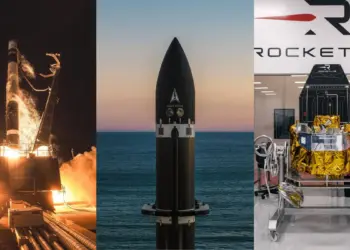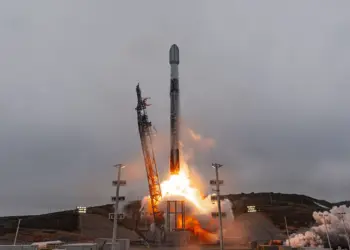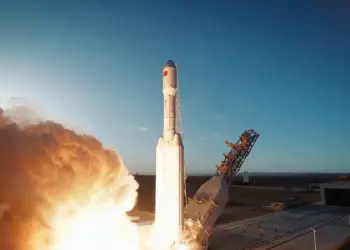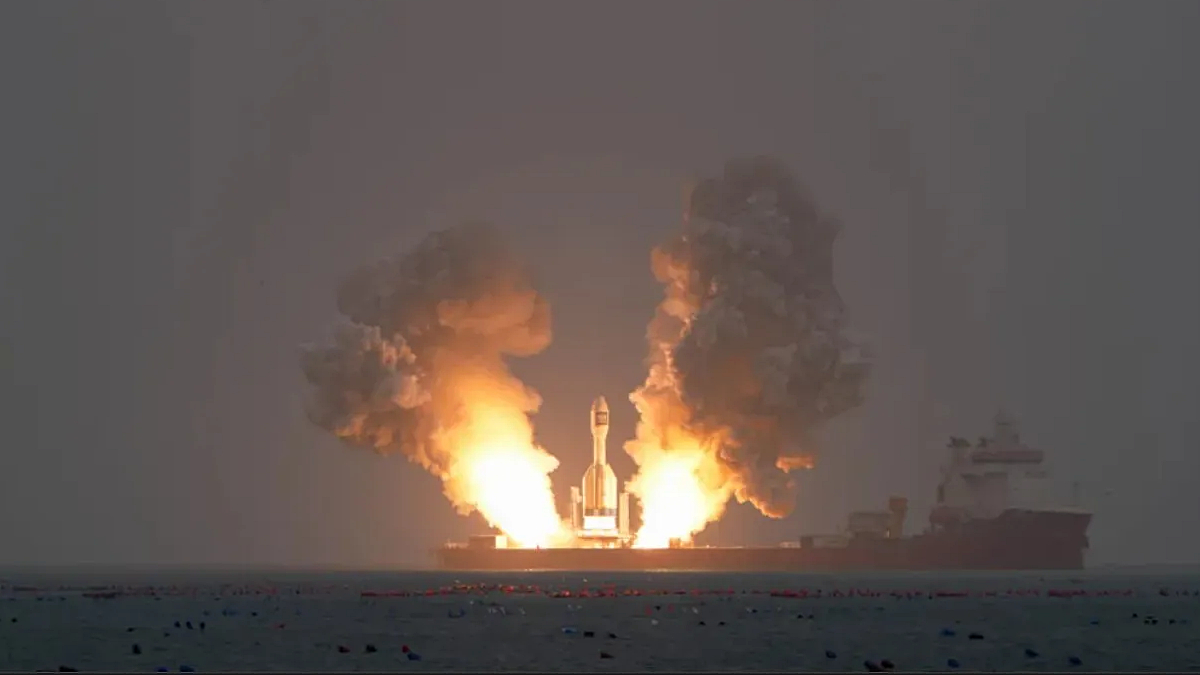
The Chinese startup Orienspace has successfully completed its second launch, sending its Gravity-1 solid-fuel rocket into orbit from a sea platform in the Yellow Sea late Friday night. The rocket lifted off at 01:20 Kyiv time on October 11, from a barge near Haiyang, Shandong Province, with support from the Haiyang Oriental Spaceport. During ascent, Gravity-1 passed through cloudy skies as exhaust and debris dispersed safely over the designated launch platform.
The mission deployed three satellites into orbit: the Jilin-1 Wideband 02B07 Earth observation satellite for Changguang Satellite Technology (CGST), and two Shutian Yuxing-01 and Shutian Yuxing-02 satellites developed by Geespace, the aerospace division of automaker Geely.

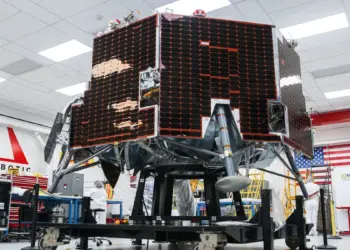
The Jilin-1 satellite is an optical wideband Earth observation satellite capable of capturing images with a 0.5-meter resolution and a 150-kilometer swath width. The two Shutian Yuxing satellites are based on Geespace’s GSP50 multipurpose platform, each weighing around 50 kilograms.
This mission marks only the second orbital flight for Orienspace, a company founded in 2020, following the debut of the Gravity-1 rocket in January 2024. According to the company, the rocket has undergone several internal upgrades aimed at improving production consistency, reliability, and overall build quality. The design features a nonstandard body shape intended to optimize aerodynamics during sea-based launches and enhance flight stability. In terms of dimensions and configuration, Gravity-1 remains the largest solid-fuel rocket in the world. Orienspace also conducted an official live broadcast of the mission – a relatively uncommon practice for Chinese launch operations.
Gravity-1 uses a three-stage configuration with four side boosters. It can carry up to 6,500 kilograms of payload to low Earth orbit, or 3,700 kilograms to a 700-kilometer sun-synchronous orbit when equipped with a third stage powered by kerosene and liquid oxygen.
Last month, Geespace completed the first phase of its Internet of Things satellite constellation by launching a Jielong-3 rocket from the Haiyang Oriental Spaceport, deploying a total of 64 satellites.
The successful second launch has further demonstrated Orienspace’s reliability and its growing capability in deploying satellite constellations from sea-based platforms. The company is among several commercial startups competing for contracts related to major Chinese megaconstellation projects such as Guowang, Qianfan, and Thousand Sails.
In August, Orienspace secured between $27 million and $124 million in its second round of funding to support its long-term plans, including the development of the reusable, liquid-fueled Gravity-2 rocket, which may conduct its first test flight by the end of the year. This funding surge reflects a broader trend among Chinese private space companies, with Galactic Energy and Space Pioneer also reporting significant investment rounds.
Gravity-2 is a two-stage reusable rocket powered by kerosene and liquid oxygen. It stands 70 meters tall, with a 4.2-meter core diameter and a 5.2-meter payload fairing. In July, the company carried out static fire tests of the first stage. According to earlier statements, the version equipped with nine Yuanli-85 engines will be capable of lifting 21,500 kilograms to low Earth orbit or 15,000 kilograms to a 500-kilometer sun-synchronous orbit. A configuration featuring solid-fuel side boosters could deliver up to 29,000 kilograms to low Earth orbit or about 20,000 kilograms to sun-synchronous orbit. Gravity-2 is one of several new commercial rockets in China expected to make their debut flights before the end of the year.
This launch marked China’s 60th orbital mission of 2025, with only one failure recorded so far. The next launches are expected to involve the Long March 8A and Long March 12 rockets, both scheduled to lift off from the commercial spaceport on Hainan Island. China also plans to conduct equipment tests for its crewed lunar program, along with maiden flights of new reusable launch vehicles being developed by both state-owned and private companies.
Source: Spacenews