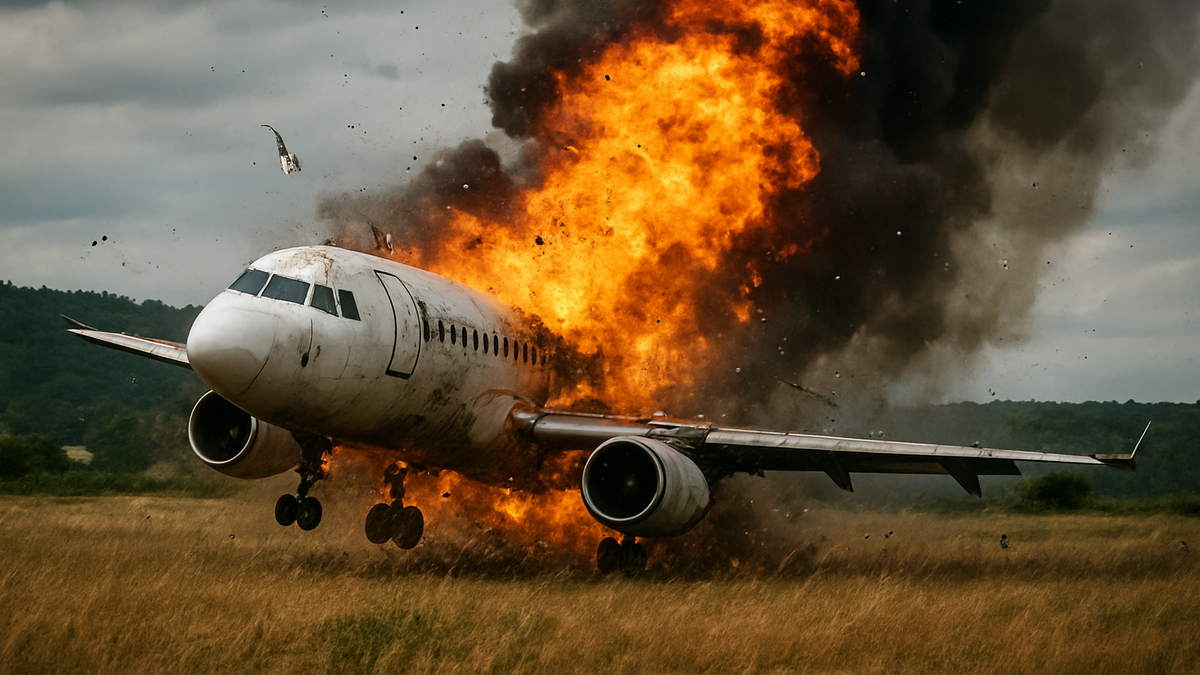
The Air India Flight 171 accident in July this year came as a shock to both the public and aviation experts, given the high reliability of modern aircraft. The Boeing 787 Dreamliner, one of the most advanced commercial planes, had never been involved in a fatal accident prior to this incident. What makes it even more striking is that the crash occurred within an unusually short timeframe.
Warning: This article includes descriptions of plane crashes and aircraft accidents, which may be distressing for sensitive readers.
The pilots had only about 40 seconds after takeoff to identify a problem affecting both engines, assess the situation, and attempt to save the aircraft – far less time than most people take to read this paragraph. Despite the rarity of such tragedies, air travel today remains safer than ever. In 2024, over 4.5 billion passengers flew without incident, and the lifetime risk of dying in a plane crash has dropped from roughly 1 in a million in 1990 to about 1 in 15 million in 2025.

The paradox is that rare accidents attract the most attention precisely because of their rarity. In this article, we’ll look at how aviation has become so safe, why accidents still occur, and what modern pilots and experts learn from them.
Read also: Everything About Tempest – The UK’s Sixth-Generation Fighter Jet
TABLE OF CONTENT:
How aviation became safe: lessons from past disasters
Air safety has been shaped by the worst moments in aviation history. Each serious accident provided valuable lessons and prompted changes in approach. In the 1930s, crashes exposed the weaknesses of wooden aircraft structures, leading to a shift toward metal construction.
The introduction of the first jet aircraft with pressurized cabins brought new challenges. The mysterious Comet crashes in the 1950s highlighted the need to consider cyclic stresses, metal fatigue, and even small details – such as square window corners, which could lead to catastrophic cracks. This led to the adoption of rounded windows, fatigue testing, and fail-safe structural designs as standard practice.
Even ground operations underwent significant upgrades thanks to lessons from the sky. After a devastating mid-air collision over the Grand Canyon in 1956, which killed all passengers on both planes, the United States invested \$250 million in modernizing air traffic control – a substantial sum at the time. This led to the creation of the Federal Aviation Administration, which today centrally oversees flight safety.
The deadliest aviation accident in history was not caused by a technical failure, but by a communication error. Two fully loaded Boeing 747s collided on a foggy runway in Tenerife, resulting in hundreds of fatalities. The tragedy demonstrated that even the most advanced aircraft cannot ensure safety without proper crew coordination and prompted major changes in cockpit procedures and crew resource management.
The response to this disaster was the development of Crew Resource Management (CRM), which fundamentally redefined teamwork in the cockpit. CRM introduced clear communication protocols, “call-and-response” procedures, and a culture that encourages any crew member to voice concerns or seek clarification. Today, CRM trains pilots to collaborate effectively under stress without relying solely on hierarchy, significantly enhancing flight safety.
Read also: History and Achievements of SpaceX: Elon Musk’s Great Space Passion
From micro storms to millions of lines of code: modern flight safety challenges
Invisible weather used to be a serious challenge for pilots, as there was no way to “see” the dangers lurking in the air. One notable example was the crash of an L-1011 approaching Dallas-Fort Worth during a thunderstorm. The aircraft encountered a micro storm – an intense downward air current that can rapidly reduce speed and lift within seconds. The plane crashed just 1.5 km from the runway, and most passengers did not survive.
This accident prompted seven years of research by NASA and the FAA, which led to the mid-1990s introduction of onboard wind shear detection radar. Since then, similar accidents have become extremely rare, demonstrating how scientific research and technology can directly improve safety in the air.
Challenges were not limited to external conditions – aircraft systems themselves could pose serious risks. In 1996, a TWA 747 departing from New York exploded in flight. Initially, terrorism was suspected, but the investigation revealed an unexpected cause: an almost empty center fuel tank likely ignited by faulty wiring, leading to a fuel vapor explosion. Addressing the issue required a comprehensive approach: wiring was reinforced and insulated, and in many aircraft designs, empty fuel tanks began to be filled with inert gas to prevent flammable mixtures. What was once a source of risk – the “empty” tank – was transformed into a safe space through engineering solutions.
While past accidents were mostly caused by mechanical issues – particularly engine failures in the 1940s to 1960s – today’s crashes increasingly occur at the intersection of human and automated systems. A modern aircraft functions not only as a flying machine but also as a data-processing center and software laboratory. For example, the Airbus A350 contains tens of millions of lines of code, and its sensors, actuators, and onboard computers must operate in perfect coordination. When something goes wrong, confusion can arise, increasing the risk of an accident.
The Boeing 737 MAX tragedies showed how a single angle-of-attack sensor error could confuse an automated system, causing the aircraft to repeatedly pitch downward. Crews attempted to correct the situation but lacked sufficient training and documentation to quickly understand the automation’s behavior and reasoning. The outcome led to software redesigns and updated pilot training to ensure their mental models aligned with the system’s actual behavior.
Other incidents have revealed additional challenges. An Airbus near the Australian coast experienced severe pitch oscillations due to a software anomaly. This highlighted that even “correct” code can behave unpredictably in operational conditions, even after passing certification.
The main takeaway is not that software is inherently dangerous, but that today’s primary safety challenge lies in the interaction between humans and automated systems. Pilots need to understand instantly what the aircraft is doing and why – especially when its behavior is not obvious – and respond quickly to avoid danger.
Read also: Thrust Reversal: How and When an Aircraft Uses Engine Braking
Invisible risks: why aircraft maintenance requires perfection
Human factors are always present in aviation, and they don’t necessarily equate to pilot error. Sometimes even small details can have unexpectedly significant impacts. For example, a maintenance flashlight once found melted inside an engine after overheating did not cause any specific accident, but it clearly illustrates how minor human mistakes can affect the operation of highly complex machines. In some cases, serious consequences result from improper repairs – such as when a China Airlines 747 broke apart in flight years after incorrect tail reconstruction, resulting in the loss of all passengers on board.
However, this does not mean that negligence is common in aviation. On the contrary, modern maintenance operates at an extremely high level of precision. Engines and systems function with remarkable accuracy, tolerances are strict, and repair manuals often run into thousands of pages. Airlines and third-party service providers understand that human lives are at stake. Yet the complexity of these systems inherently carries risk: a misread diagram, a skipped lubrication step, or a moment of inattention can start a chain of events that only becomes apparent if the system ultimately fails.
Read also: The Mi-26: Rise and Decline of the World’s Largest Production Cargo Helicopter
From the simulator to real flight: how pilots prepare for the unexpected
Takeoffs and landings are usually performed manually, while most of a modern airline flight is managed by complex automated systems. This raises a question: does reliance on technology lead to a gradual decline in pilots’ manual flying skills? To counter this, training programs place significant emphasis on operating in situations where automation is unavailable or ineffective. Flight crews spend hundreds of hours in simulators, practicing engine failures, spins, severe wind gusts, and turbulence, as well as takeoffs and landings under conditions that replicate real airports.
During these training sessions, instructors require pilots to fly the aircraft manually. This is essential for maintaining proficiency in situations where automated systems cannot assist. Passengers are rarely aware of these details, yet in extreme scenarios, a pilot’s ability to react quickly can determine the outcome of the flight, as decisions often must be made without complete information.
Achieving a high level of skill requires thousands of hours of practice, but sometimes just a few seconds determine the difference between life and death. This was the case in the Air France 447 disaster: at cruising altitude, the airspeed sensors iced over, producing incorrect readings. The autopilot disengaged, and the disoriented pilot instinctively raised the aircraft’s nose, leading to an aerodynamic stall from 11,582 meters. All passengers on board were killed.
&pp=ygUOQWlyIEZyYW5jZSA0NDc%3D
A similar incident occurred in Amsterdam with a Turkish Airlines flight. The crew did not realize that the automatic thrust control system was relying on a faulty radio altimeter, which incorrectly indicated that the aircraft was on the ground. As a result, the automation reduced thrust during a critical phase of the landing approach. When the pilots noticed the drop in speed and pushed the throttles forward, the engines needed time to reach the required power – seconds that proved insufficient.
These incidents should not be dismissed as simple incompetence. They highlight the limits of human perception under uncertainty and underscore why modern aviation training emphasizes the ability to recognize and respond quickly to unexpected situations that arise at the interface between automation and human control.
Read also: Why Airplane Portholes Are Round
The invisible burden on dispatchers and its fatal consequences
As passenger traffic increases, the airspace around major airports becomes increasingly congested, while radio communication between crews and air traffic controllers remains prone to errors. In the United States, for example, there is a shortage of controllers, and those on duty often work long shifts, take on overtime, and carry excessive workloads. Such conditions inevitably raise the risk of runway incidents and misinterpreted instructions. A recent example is the mid-air collision over the Potomac River in Washington in January 2025, which was linked to an overloaded schedule and accumulated staff fatigue.
Even these tragedies drive improvements in safety systems. When a passenger plane in Colombia crashed into a mountain while flying a shortened route, the investigation revealed vulnerabilities that led to the development of two layers of protection: enhanced human procedures and stricter technological safeguards.
Modern Enhanced Ground Proximity Warning Systems (EGPWS) now issue alerts such as “Terrain, pull up!” well before a hazard becomes visually apparent. Meanwhile, Crew Resource Management (CRM) trains crews to verify assumptions and challenge each other’s actions before they escalate into critical errors.
Read also: The First American Attack Aircrafts: Development Path, Part 1
Anatomy of a rare disaster
When an aviation accident occurs, it almost never has a single cause. It is not a broken part or a single fatal mistake. Rather, it is a chain of events that stretches from minor failures to unexpected decisions. A sensor provides incorrect readings. A fatigued crew encounters a storm. The autopilot functions exactly as programmed, but not as humans expect. A previous repair conceals a microcrack that becomes dangerous only under specific flight conditions. When these gaps align, the multi-layered safety system can fail, and what seems improbable – a tragedy – happens.
Yet it is precisely these tragedies that drive improvements in aviation safety. After each accident, experts meticulously reconstruct the chain of events. Wreckage is pieced together like a puzzle. Black box recordings are analyzed down to the second. Every crew action is recreated in simulators and computer models. Procedures are then revised.
Training changes. Equipment changes. Software changes. Most importantly, the lessons learned are shared across companies and borders. Even with more than one hundred thousand flights every day, aviation continues to learn – constantly, collectively, through the unseen efforts of thousands of specialists – ensuring that the skies remain safe for millions.
The uncomfortable truth is that no complex system can be completely safe. Its limits are defined by both human and technical factors, and some risk always remains. Commercial aviation illustrates how to manage this risk: errors are never ignored, every weak link in the system is investigated and addressed, and crew training continuously adapts to new challenges.
This is why even major tragedies occur against a backdrop of unprecedented safety. Billions of people fly every day, and nearly all do so without incident. Each accident becomes a lesson that drives improvements in procedures, technology, and pilot training, making future flights more reliable.
Every flight that takes to the skies serves as a reminder that the system learns from mistakes, turning each journey into a testament to human ingenuity and enduring hope.
Read also:
- First American Attack Aircrafts, Part 2: Alternative Projects of the Early 1920s
- American Attack Aircraft, Part 3: The First Production Variants
- First American Attack Aircraft, Part 4: On the Eve of the 1930s