Middle strike has become one of the defining phenomena of this war – not something conceived in the offices of military theorists, but a capability shaped directly by battlefield pressure.
War rarely waits for an army to finish developing the weapons it needs. More often, it forces those weapons to be built in the middle of the fight itself – without extra time, without ideal conditions, and under constant pressure from losses and shortages. This is exactly how Ukraine arrived at medium-range strike systems: not through a planned modernization program, but as a direct response to an operational gap that none of the existing tools could effectively fill.

What analysts now describe as middle strike barely existed three years ago outside of niche technical discussions. Today, it has evolved into a distinct and rapidly expanding class of weapon systems that is already shaping the course of the conflict in a systemic way. What follows is an examination of how this transformation happened – and what it ultimately means.
Read also: The Ukrainian “Tryzub” Laser System: From Testing Grounds to the Front Line
TABLE OF CONTENT:
Background: The Gap Between the Front Line and Strategic Depth
Modern warfare rarely leaves room for convenient classifications. Artillery typically operates at ranges of up to 40–60 kilometers, while strategic strikes extend hundreds of kilometers beyond the front. Between these two extremes, there long existed a zone in which Ukrainian forces faced a systemic shortage of effective tools. It is precisely this space – conventionally defined as the 60 to 500 kilometer range – that is now being filled by what analysts increasingly refer to as middle strike capabilities.
This is not merely a technical category. Middle strike is a conceptual response to a specific operational problem: how to strike enemy logistics, command posts, ammunition depots, and critical infrastructure when they are beyond the reach of conventional artillery, but do not justify the use of strategic assets. Ukraine arrived at this class of systems not through doctrinal preference, but through necessity – and that is precisely why its approach proved unconventional and, as practice has shown, effective.
Read also: Weapons of Ukraine’s Victory: The Hornet UAV, Also Known as “Martian-2”
The Origins of the Concept: From Improvisation to System
At the beginning of the full-scale invasion, Ukraine possessed only a limited arsenal for strikes against operational depth targets. Multiple launch rocket systems supplied by allies partially addressed this gap. However, systems such as M142 HIMARS and M270 Multiple Launch Rocket System depended on external ammunition supplies, had finite operational resources, and could not fully replace an indigenous capability. At the same time, another line of development was emerging in parallel – unmanned systems.
The first Ukrainian-made strike UAVs were, in essence, adapted commercial platforms fitted with improvised munitions. They demonstrated the principle, but not the scale. The real turning point came when the state and the private sector began investing in a coordinated manner in the development of specialized strike systems with ranges from 100 to well over 1,000 kilometers. From that moment, middle strike ceased to be a tactical experiment and evolved into a distinct direction in weapons development.
Read also: Everything About the Chaklun Jet UAV Designed to Intercept the “Geran-3”
What Middle Strike Means
Middle strike refers to a class of strike systems designed to engage targets at ranges beyond conventional artillery but below the threshold typically associated with strategic weapons. The approximate range spans from 60 to 1,000 kilometers, although the boundaries remain flexible and context-dependent.
In practical terms, this involves strikes against operational rear-area targets: ammunition depots, fuel storage facilities, railway hubs, command posts, and air defense positions located too far from the front line for artillery to reach, yet not important enough to justify the use of a ballistic missile. This intermediate zone – the enemy’s logistical and command depth – has become the primary operational space for systems of this category.
Technically, middle strike capabilities are most often implemented in the form of subsonic one-way strike UAVs equipped with GPS-based navigation and optical terminal guidance. In essence, they occupy a space somewhere between a cruise missile and a kamikaze drone – significantly cheaper than the former, yet considerably longer-ranged than the latter. It is precisely this balance of cost, range, and sufficient accuracy that makes the class an attractive tool for a state fighting a prolonged war under constrained resources.
Technical Architecture: Between a Drone and a Cruise Missile
The defining characteristic of Ukrainian middle strike systems is that they occupy an intermediate position between a conventional strike UAV and a one-way cruise missile. This is not accidental – the approach is shaped simultaneously by the technological capabilities of the domestic defense industry and by operational requirements.
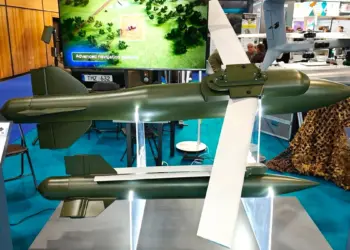
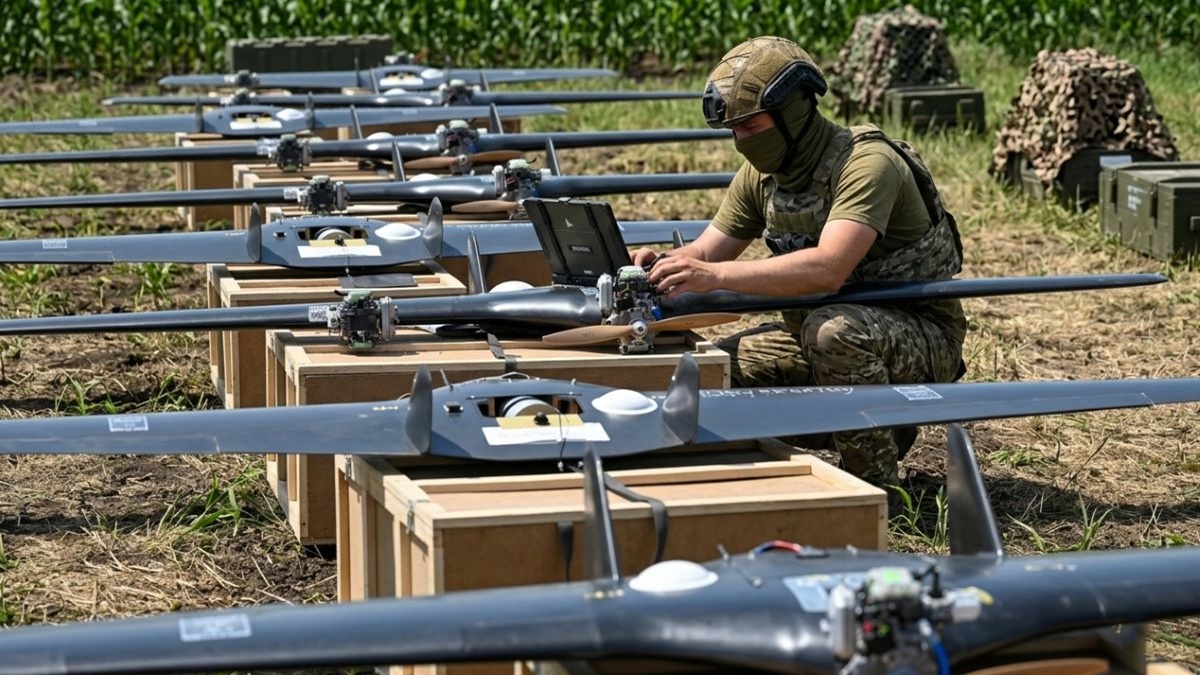
A typical system in this category is a subsonic aerial platform powered by either a piston or turbojet engine, carrying a warhead of roughly 30 to 75 kilograms and using a combination of GPS navigation, inertial guidance, and optical terminal targeting. Range varies by platform, but the key operational envelope lies between 300 and 1,000 kilometers, usually at low altitude to reduce radar visibility. Their relatively small size and radar cross-section make such systems difficult targets for traditional air defense systems, particularly when flight paths are planned around terrain features.
The most illustrative examples of this class are the “Bober” family (UJ-22 and its derivatives), as well as “Liutyi”, developed within state programs. Both reflect a defining feature of the Ukrainian approach: maximum technological simplicity at the component level combined with non-trivial system-level design. Engines are often adapted from civilian aviation or light aeronautical equipment, airframes are built from composite materials, and electronics are largely standardized using commercial off-the-shelf solutions. This approach reduces unit cost and shortens production cycles.
Read also: Weapons of Ukraine’s Victory: FP-1 – A Drone Capable of Reaching Moscow
Operational Logic: Why This Class Exists
Understanding middle strike purely as a “cheap cruise missile” is a fundamental misconception. This category fulfills a role that cannot be effectively covered by any other available system.
Artillery, even in its long-range variants, remains tied to the front line and depends on continuous logistical supply of ammunition. Aviation – where available at all – carries significant operational risk and cannot sustain constant presence. Ballistic missiles are effective but extremely expensive and exist only in limited quantities. Middle strike fills this gap: as a relatively low-cost, mass-producible capability able to operate at significant distances from the line of contact, it enables sustained strikes against enemy operational depth at a tempo that other systems cannot match.
Primary targets include railway hubs and fuel depots, ammunition and equipment storage sites, forward command posts, maintenance bases, and air defense positions. These targets are not always valuable enough to justify the use of a strategic missile, yet their systematic destruction significantly degrades the logistical and command capacity of the opposing force. It is precisely this systematic nature – the ability to strike repeatedly and in volume – that constitutes the core operational value of middle strike.
Read also: Weapons of Ukraine’s Victory: The Hornet UAV, Also Known as “Martian-2”
Industrial Response: From Startups to State Programs
A defining feature of the Ukrainian approach is the parallel development of the state and private sectors without a strict separation of roles. Companies such as UA Dynamics, Skyeton, Ukrspecsystems, and a range of others that emerged or were significantly reoriented after 2022 have become active suppliers of combat systems alongside state-owned enterprises.
The state has acted primarily as a customer and coordinator rather than a monopolistic producer. The Ministry for Strategic Industries, together with the Ministry of Defense, has defined technical requirements, financing mechanisms, and procurement pathways – structured in a way that allows systems to move from prototype to serial production in months rather than years. This represents a fundamental departure from traditional defense-industrial cycles, where the same process typically spans decades.
At the same time, scaling production remains the most significant systemic challenge. Manufacturing a few hundred units per month is a fundamentally different task from producing an experimental batch. Shortages of microelectronics, navigation modules, and engines of a specific class of thrust remain persistent limiting factors, and no level of engineering expertise can fully compensate for gaps in the component base under sanction-driven constraints on supply chains tied to Russia.
Read also: Weapons of Ukraine’s Victory: The “Shvidun” Interceptor Drone
Countermeasures: How the Opponent Is Adapting
The large-scale use of Ukrainian medium-range strike UAVs has forced Russian forces to significantly reconsider the architecture of their air defense at operational depth. Positions of surface-to-air missile systems, including Pantsir-S1 and Tor missile system, have increasingly appeared far from the front line – near logistical hubs, fuel depots, and command posts that were previously considered outside the immediate threat envelope.
This adaptation is itself an indicator of effectiveness: each air defense unit redeployed to protect rear infrastructure is a resource withdrawn from frontline engagement. In addition, deploying air defense deeper in the rear requires its own radar coverage, communications infrastructure, and personnel – creating substantial organizational and logistical burdens.
In parallel, the opposing side has been improving electronic warfare systems in an effort to disrupt the GPS navigation of strike UAVs. The response has been the integration of redundant navigation layers – inertial systems and optical terrain recognition during the terminal phase of flight. This technological competition between strike systems and countermeasures has become one of the defining characteristics of the current phase of the conflict.
Read also: Everything About Ukrainian Interceptor Drone JEDI Shahed Hunter
Range as a Strategic Dimension
It is notable that as the class has evolved, the boundary of “medium” range has gradually shifted upward. Systems that in 2022 were considered long-range at 300–400 kilometers are no longer at the edge of capability today. A number of Ukrainian developments now demonstrate the ability to engage targets at distances exceeding 1,000 kilometers – effectively placing them in the category of strategic strike systems.
This blurring of the boundary between “medium” and “strategic” strike has important implications. First, it complicates the classification of systems under international law and allied restrictions – which is why questions about where and how far from a border a given system may be employed acquire both legal and diplomatic significance. Second, increasing range changes the very nature of the threat for Russia: assets that were previously physically out of reach become vulnerable, directly affecting adversary defense planning.
Read also: Mission Control: How Ukraine Is Building a Unified Digital Brain for Drone Warfare
Coordination With Other Components: The System Effect
Middle strike achieves its maximum effect not as an isolated tool, but as part of a coordinated system. Strikes by medium-range UAVs, when synchronized with artillery fire, FPV drone operations, and reconnaissance platforms, create an effect that significantly exceeds the sum of individual components.
A reconnaissance UAV identifies the target. A light strike drone suppresses or distracts air defense systems. The middle strike system delivers the primary удар. Artillery then engages targets that have come within range following the disruption of the enemy formation. This scheme, implemented with increasing regularity, demonstrates that the value of middle strike is not limited to the number of destroyed targets. Rather, it lies in its role as a system-forming element that enables the effectiveness of other components within the broader operational structure.
Read also: Everything About the P1-Sun – SkyFall’s Ukrainian Interceptor Drone
Limitations and Unresolved Challenges
A rigorous assessment requires acknowledging systemic constraints that do not disappear even in the presence of successful strikes. The first and most significant is accuracy. Despite advances in navigation systems, engaging small and heavily fortified targets remains more difficult than striking large infrastructure objects. A 30–75 kg warhead is effective against unprotected structures but insufficient against reinforced concrete shelters and deeply buried command posts.
The second limitation is vulnerability to electronic warfare and air defense systems. Despite improvements in navigation redundancy, these platforms still incur significant losses in environments saturated with electronic suppression. While the loss rate is considered acceptable given the low cost of the systems, it requires constant attention in the context of constrained production capacity.
The third is production scale. An operational doctrine that relies on mass employment comes into tension with industrial realities. As long as the number of simultaneously deployed systems is measured in dozens rather than hundreds, full saturation of enemy air defense remains difficult. This limitation is being addressed, but gradually – and the pace of its resolution directly determines the operational value of the entire class.
Read also: Weapons of Ukraine’s Victory: Sting UAV Interceptor
Middle strike as a Mirror of the New War
The development of medium-range strike systems in Ukraine is arguably one of the clearest examples of how modern warfare is reshaping traditional doctrinal categories. A class of equipment that effectively did not exist in the national arsenal in February 2022 has, in a little over three years, evolved into an independent and strategically significant component of the state’s combat capability.
This transformation was made possible by the convergence of three factors: an acute operational need with no viable alternatives; the technological accessibility of components, which allowed private developers to enter the field without relying on a traditional defense-industrial base; and sufficient flexibility within the state system to integrate non-standard suppliers and non-standard solutions.
Middle strike today is not only a specific category of weapon systems. It is an indicator of a new logic of armed confrontation, in which asymmetry of tools becomes a functional substitute for symmetry of capabilities. A state that cannot respond within the category of heavy ballistic missiles builds its response through cheaper, mass-produced, and sufficiently accurate systems – forcing the adversary to spend disproportionate resources on countermeasures compared to the cost of the threat itself. It is this logic, rather than the specific technical characteristics of individual platforms, that will shape the evolution of the class in the years ahead.
Read also: