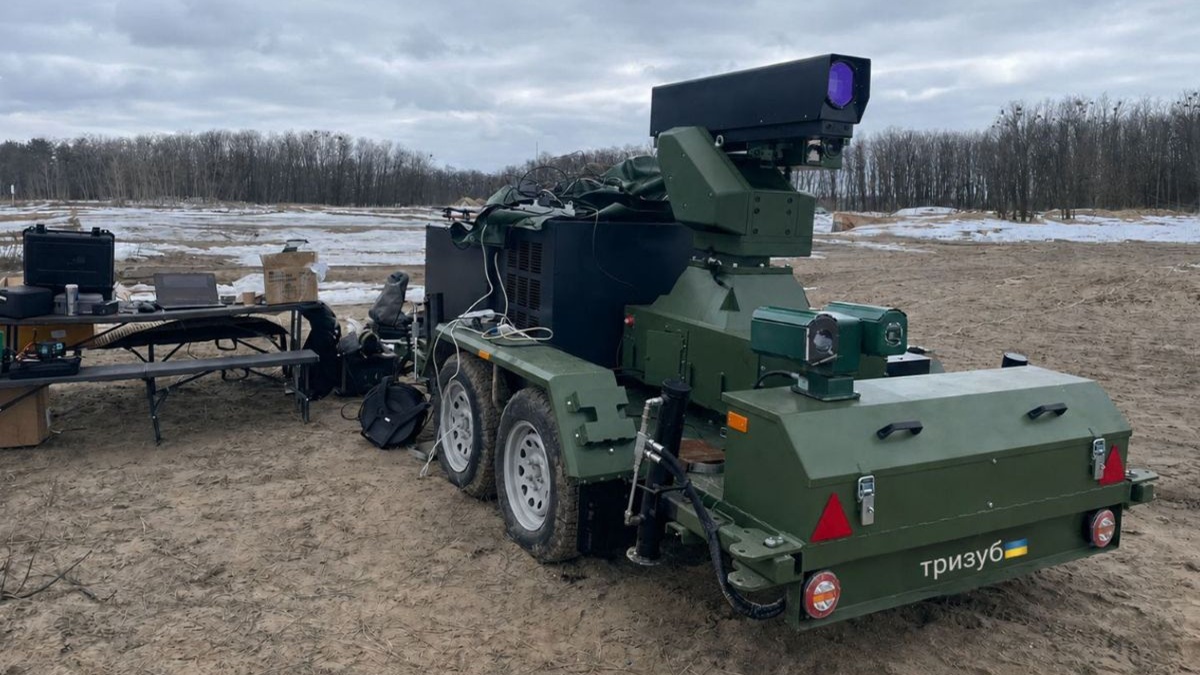
Ukraine Air Force and the Unmanned Systems Forces of the Armed Forces of Ukraine are already using the combat laser system “Tryzub” in limited, targeted deployments to protect command posts and critical infrastructure from hostile UAVs.
On May 7, 2026, the developer, Ukrainian company Celebra Tech, officially presented an updated towed version of the system and announced its transition to final state trials. According to the company, this is not an announcement of a concept, but a system for which approximately five to eight prototype units were already on duty at that time.

Outside the official presentation, the key development was not publicly highlighted. In the second half of 2025, the developers effectively reworked the system’s core software, replacing traditional computer vision with a full neural-network-based guidance model. According to them, this change – rather than the new chassis or towed configuration – represents the real technological advancement achieved over the year.
Let’s take a closer look.
Read also: Weapons of Ukraine’s Victory: The Hornet UAV, Also Known as “Martian-2”
TABLE OF CONTENT:
How the system was developed: from testing range to operational use
The “Tryzub” project began in 2023–2024 as a response to a clearly defined operational need. Ukraine required a means of countering large numbers of low-cost aerial threats without expending expensive surface-to-air missiles. The daily use of “Shahed” drones and FPV drones turned this requirement from a theoretical concept into an immediate practical problem.
At the end of 2024, the “Tryzub” laser system first appeared publicly as an experimental prototype conducting live-fire tests against aerial targets at a training range. At that stage, the configuration was typical for many early domestic defense developments: a collection of separate subsystems assembled primarily for demonstration purposes rather than operational deployment.
February 2025 marked a turning point, when command structures announced the beginning of deployment of the “Tryzub” laser system within military units. In April of the same year, the Unmanned Systems Forces of Ukraine published footage of field trials. The laser was used against both a ground target and an FPV drone. At that stage, the system was officially described as an experimental countermeasure primarily intended for reconnaissance UAVs.
The second half of 2025 was no longer about testing, but about a substantial redesign. At that stage, Celebra Tech reportedly moved away from classical computer vision in favor of a neural-network-based model, while also refining the emitter and the cooling system.
As a result, by February 2026, reports in Western media, including The Atlantic, described cases of real-world engagement where drone targets were reportedly burned through in a matter of seconds, affecting both structural components and optical systems. These were no longer simulated range targets, but operational UAVs in realistic conditions.
By May 2026, the transition from a system of assembled prototype subsystems to a towed configuration undergoing state trials took less than a year and a half.
Read also: Weapons of Ukraine’s Victory: The “Shvidun” Interceptor Drone
Towed platform: a mobility-focused compromise
If the early version of “Tryzub” resembled a laboratory test rig moved into the field, the May 2026 configuration is already a single integrated system with a clearly defined logistical concept.
The base platform is a dual-axle vehicle trailer. In the front section, an enclosed power unit is installed under a protective housing. The central section houses the laser emitter mounted on a rotating and elevation control system, enabling targeting across a wide angular range in both axes. Auxiliary subsystems are located at the rear. Hydraulic stabilizers are used to level the platform during operation.
The emitter itself, unlike the early prototype, is enclosed in a metal protective housing. This design addresses two issues at once: protection of the optics during transport and a reduction in visual signature in the visible spectrum.
At the core of the system is a fiber laser. This choice is not accidental. Solid-state architectures are vulnerable to vibration on rough operational roads. Chemical lasers, due to their toxic components, are not suitable for mobile deployment. A fiber laser provides beam quality of M² < 1.1 and an efficiency of around 30–35%, which allows the system to be powered by battery packs rather than relying exclusively on a stationary generator.
The power supply is implemented as a hybrid system: an integrated LiFePO₄ battery block is designed for approximately 40–50 engagement cycles before requiring recharging from the grid or a generator. Cooling is provided by a closed-loop liquid system with active air cooling.
For comparison, 2025 prototypes relied on passive cooling, which limited operation to three or four shots before overheating. The new version can sustain up to 30 seconds of continuous emission and requires about 60 seconds for cooling. In short-pulse mode against FPV-type targets, the system can engage approximately 15–20 targets in succession before reaching thermal limits.
Read also: Everything About Ukrainian Interceptor Drone JEDI Shahed Hunter
Range and power: where reality ends and marketing begins
The nominal output power of the emitter is 5 kW, with peak values reaching up to 7 kW. Compared to systems such as the British DragonFire or the U.S. HELIOS, this is modest. However, “Tryzub” is not positioned in the same operational category.
The confirmed performance characteristics appear realistic and consistent with the underlying physics of laser engagement:
-
FPV drones: effective engagement range of 800–900 meters. At this distance, the laser can burn through a plastic airframe or disable the camera sensor within 1.5–2 seconds without active cooling.
- Reconnaissance UAVs: up to 1,500 meters. This requires maintaining the beam on a critical component such as a fuel tank or control unit for 3–5 seconds.
-
Optical suppression: up to 10 km under ideal conditions. In typical field environments, this range is significantly reduced, but even then the system can degrade or blind enemy reconnaissance optics from a relatively safe stand-off distance.
Separately, the stated 5 km range against “Shahed”-type drones and heavier targets should be treated as a theoretical figure rather than an immediately achievable operational capability. In practical terms, it is closer to a marketing estimate. The “Geran-2” platform has a metal airframe and a reinforced propulsion section. At a 5 kW power level, reliably engaging such a target would require either sustained beam dwell times of tens of seconds – which is incompatible with the system’s energy balance and cooling constraints – or a laser emitter that is 4–10 times more powerful. Without a significant upgrade in hardware, this range figure is likely to remain theoretical, regardless of how many official announcements accompany it.
Read also: Weapons of Ukraine’s Victory: TRIDON Mk2 Mobile Air Defence Systems from BAE Systems Bofors
The major leap: neural networks instead of classical computer vision
If the “Tryzub” laser system is evaluated solely through the characteristics of its emitter, the picture remains incomplete. The real differentiating factor lies in the software layer.
The AI-based targeting architecture is built on a cascade of neural networks. A lightweight model continuously scans a 120° sector for motion. When a potential object is detected, a heavier model is activated, performing target classification into categories such as “bird,” “civilian drone,” “military UAV,” or “projectile.” The time from detection to laser engagement is approximately 0.2 seconds. For intercepting FPV drones at speeds exceeding 100 km/h, this is a critical parameter.
The tracking algorithm calculates the target’s motion vector and directs the beam with lead compensation toward a predicted intercept point. This approach addresses a key limitation of earlier versions: beam jitter during abrupt drone maneuvers, which caused energy dispersion across the airframe instead of concentration on a single critical area.
A key detail that distinguishes the 2026 version from earlier iterations is that the AI does not aim the beam at the geometric center of the target. Instead, it identifies a vulnerable area – such as the optical module or plastic propeller mounts – and locks the beam onto that point. This reduces the time required to neutralize small drones to about one second and improves energy efficiency. For FPV interception, this difference translates into roughly 20 targets per cycle versus about seven in earlier configurations.
A swarm mode is also implemented: after one target is neutralized, the optical system is immediately redirected to the next object without operator input.
Another important tactical aspect, rarely emphasized in official materials, is that the “Tryzub” system operates via passive optical and thermal channels and does not emit any radio-frequency signals until the moment of firing. This makes it effectively “silent” to enemy electronic intelligence systems. In contrast to traditional air-defense systems equipped with active radar, which are detectable as soon as they are switched on, this significantly improves the system’s survivability in modern reconnaissance-strike environments.
Read also: Mission Control: How Ukraine Is Building a Unified Digital Brain for Drone Warfare
Engagement economics: why lasers matter at all
The main argument in favor of the “Tryzub” system is not technical sophistication, but simple arithmetic.
A single laser “shot” – meaning the energy drawn from batteries and wear on the optical system – costs only a few dollars. Comparable foreign systems estimate the cost per engagement at roughly $1–13. In comparison, a FIM-92 Stinger costs around $120,000, an IRIS-T SLM exceeds $400,000 per missile, and a MIM-104 Patriot PAC-3 interceptor can cost around $4 million. Even the more affordable 9K35 Strela-10 still involves tens of thousands of dollars per launch.
Against this background, the economics become clear: using high-end interceptor missiles against “Shahed”-type drones or FPV drones is structurally unsustainable in a cost-exchange war.
The “Geran-2” drone is estimated at $35,000–50,000, while FPV drones range from roughly $400 to $1,000. Even a relatively modest 5 kW laser system like “Tryzub” therefore has practical value – provided it can physically neutralize its target.
The cost of the system itself has not been disclosed. Based on indirect estimates, it may be in the range of $1–2 million per unit. In the context of sustained missile expenditure during mass attacks, the payback period is measured in months rather than years.
Where “Tryzub” is limited – and it should be stated clearly
The “Tryzub” laser system is not a universal solution, nor a system capable of “covering the sky.” It has clear limitations – some are deliberate trade-offs, others are inherent weaknesses of the technology.
Weather conditions. According to the developer, in dense fog or heavy rain the effectiveness of the 5 kW beam drops by 60–70%. In the Ukrainian theater of operations, this means that a significant portion of autumn and early spring operations will see reduced performance. This is a limitation common to all laser systems in this class, but with “Tryzub” the impact is more pronounced due to its relatively modest power compared to systems like DragonFire.
Detection during operation. A laser “shot” is visible in the infrared spectrum, meaning enemy reconnaissance assets can potentially detect the firing position. The trailer-based platform requires several minutes to redeploy after setup. In a battlefield environment where counter-battery strikes and loitering munitions such as “Lancet”-type systems are actively used, this is a significant vulnerability. The mitigation options are either operating deeper within defensive lines or frequently changing positions – both of which reduce coverage density.
Energy capacity and cooling. The limit of 40–50 engagement cycles before recharging becomes meaningful during mass drone attacks. “Tryzub” is well suited for selective interception of high-priority targets, but not for continuous defense against large-scale drone swarms.
Scale of deployment. With only five to eight prototypes as of May 2026, the system is still in validation rather than operational saturation. Planned production capacity is estimated at 10–15 units per month under stable funding conditions. The main bottleneck remains the cost and complexity of emitter components, meaning the path to mass deployment at the level of tens or hundreds of systems is still ahead.
Read also: Зброя української перемоги: FP-1 – дрон, що долітає до Москви
Where “Tryzub” fits in
In terms of emitter power, the “Tryzub” laser system belongs to the light class of combat lasers. It effectively occupies a similar niche to the Turkish Gökberk. However, a direct comparison based on raw power can be misleading. Both systems are deliberately designed to address the most common category of threats rather than ballistic missiles or high-end strategic targets.
The realistic operational niche for “Tryzub” is the protection of command posts, headquarters, and critical infrastructure from FPV drones and tactical reconnaissance UAVs. This is where three conditions align: the target is valuable enough to justify engagement, the cost of a missile interceptor is disproportionate, and the laser is physically capable of neutralizing the threat.
The system does not replace systems such as the FIM-92 Stinger or IRIS-T SLM. Instead, it occupies the gap between missile-based air defense and gun-based point defense. It fills the space where missiles are excessive and kinetic weapons are insufficient. In this middle layer, the “Tryzub” system can be both effective and operationally justified.
Read also: Weapons of Ukraine’s Victory: FP-1 – A Drone Capable of Reaching Moscow
Air defense that calculates costs
“Tryzub” is not a technological breakthrough in the traditional sense. It is a practical response to a practical problem: how to destroy large numbers of low-cost aerial targets without expending expensive interceptor missiles.
Notably, the developers present their main competitive advantage not as emitter power, but as the software layer – neural-network-based targeting and passive operation modes. In a battlefield environment where any active radar system becomes a potential target, the ability to remain undetected until the moment of engagement is not an optional feature, but a matter of survivability.
The real combat value of the “Tryzub” system will not be determined on a testing range or at a press briefing. It will be defined by the first statistically significant data from large-scale deployment: how many FPV drones are intercepted, how many engagement cycles are completed under real conditions, and how the system performs in rain and under active enemy countermeasures. Until then, any final assessment remains premature.
However, the very existence of “Tryzub” – from a prototype demonstrator in 2024 to a towed system undergoing state trials in 2026 – is already a meaningful result. In the coming years, systems of this type will help determine how costly it becomes for an adversary to send each drone across the front line.
Read also: