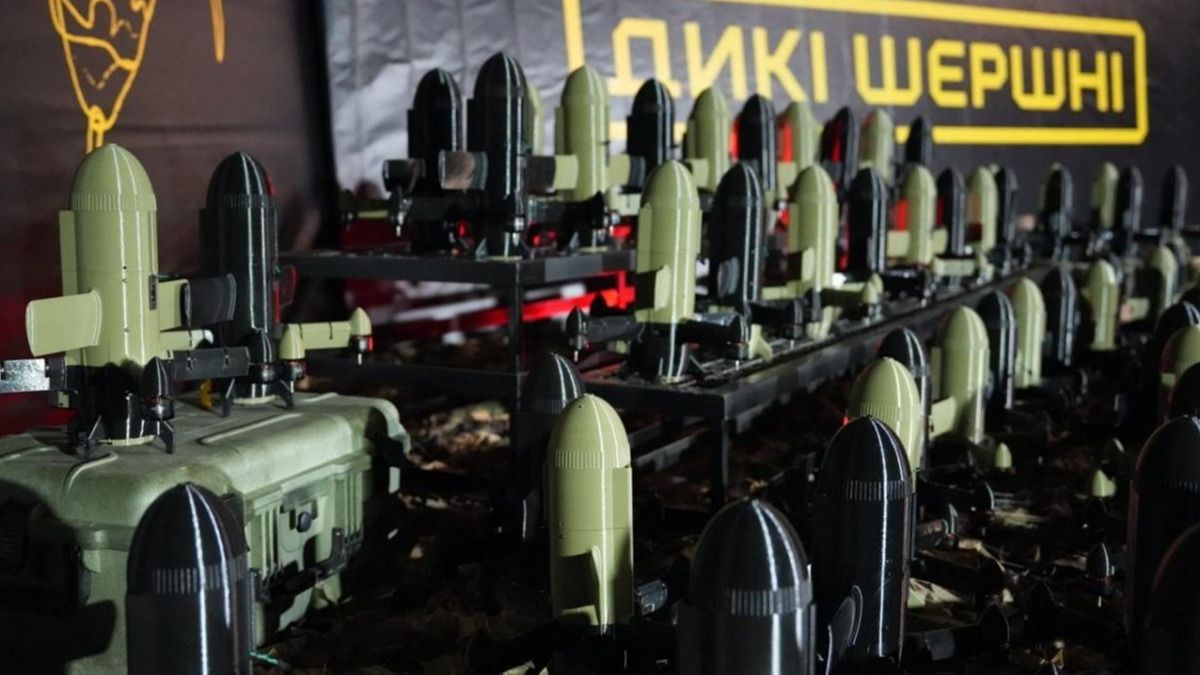
Today we will discuss an interesting interceptor UAV, the Sting, developed by the Ukrainian company Diki Shershni (Wild Hornets). In recent years Ukraine has faced a systemic shortage of conventional air-defence weapons – from man-portable air-defence systems to multi-channel medium-range systems. This shortfall has become particularly acute amid a rise in aerial threats, notably massed kamikaze drone attacks and guided aerial bombs. Under these conditions, seeking unconventional solutions has become a matter not only of efficiency but of the defence system’s survival.
It was in this context that the idea of specialised interceptor unmanned aerial vehicles emerged: cheaper, more mobile platforms capable of operating where the deployment of classical SAM systems would be prohibitively expensive or technically impractical. One of the most recent developments in this area is the Sting UAV, which was formally adopted by the Armed Forces of Ukraine several months ago.
Sting exemplifies an adaptation of the “asymmetric air‑defence” concept – using maneuverable drones instead of conventional missile systems to respond rapidly to threats in the short‑ and medium‑range envelope. This approach helps offset shortages of expensive air‑defence assets and increases the operational flexibility of Ukrainian units when confronting next‑generation aerial threats.
TABLE OF CONTENT:
The history of the development of the Sting UAV interceptor
In the autumn of 2022, Russian forces began mass employment of heavy strike UAVs against critical infrastructure and military targets in Ukraine. It quickly became apparent that existing air‑defence systems – both in numbers and technical capability – were unable to cope effectively with this new class of threats. The drones were launched in large waves, exhibited varying radar signatures and stealth characteristics, and sometimes operated in contested electronic environments. This exposed gaps in zonal defence and created an urgent need for rapid, innovative solutions.
By 2022–2023, a number of Ukrainian and international organisations initiated development of new air‑defence systems specifically aimed at countering Shahed‑type platforms and their analogues. Among several approaches, the concept of a compact interceptor UAV attracted particular attention: a platform combining high manoeuvrability, autonomy and relatively low operating cost to plug gaps in short‑range and tactical‑operational air‑defence.

In 2023, a newly formed company with the telling name “Diki Shershni” (Wild Hornets) began development of such a UAV. The project was designated Sting. Over the year it proceeded through conceptual design, fabrication of prototypes and initial flight test programs. According to official statements from the manufacturer and related sources, the UAV confirmed its projected performance during testing – manoeuvrability, time on station, interception accuracy and compatibility with existing command systems.
The project exhibits several strengths and weaknesses. Advantages include rapid deployability, a comparatively low unit production cost versus missile systems, and the potential for mass employment to block attack corridors. Remaining concerns relate to reliability under electronic‑warfare conditions, effectiveness against targets with differing signatures and profiles, and logistics support at the front. In addition, a large deployed fleet of such interceptors requires clear integration into the overall air‑defence architecture to avoid resource dispersion and conflicts with existing air‑defence assets.
Thus, Sting and similar projects are not a universal replacement for conventional air‑defence systems but may form a valuable component of a hybrid air‑defence layer. Their real value will depend on the outcomes of further testing, timely operational integration into tactical schemes, and the manufacturer’s ability to secure serial production and provide technical support in combat conditions.
Read also: Weapons of Ukraine’s victory: Zozulya Deep Strike Drone
What is already known
At that time the manufacturer was actively promoting and praising the new product. The developers promised a rapid start of serial production and deliveries to air‑defence units. However, actual commissioning and entry into service were delayed: for various reasons the first confirmed reports of combat use of the Sting interceptor UAV did not appear until March 2025. At that time several Ukrainian sources released a number of low‑quality videos – recorded by the onboard cameras of strike kamikaze UAVs – that purported to show the interception of Russian attack drones.
According to official or semi‑official statements, during four months of operation the Sting reportedly engaged around one thousand aerial contacts. That figure, however, requires critical verification: the video evidence is of low quality, and public reports frequently lack the detailed tactical and technical information needed to confidently assess the system’s true effectiveness (interception conditions, proportion of targets damaged, selection criteria for “intercepted” contacts, etc.).
Ukrainian air defence continues to experiment with employing the Sting interceptor UAV within schemes for repelling combined aerial attacks – with mixed results. At the same time, the manufacturer and affiliated organisations are attempting to promote the platform on international markets. In early October 2025 a delegation from the developer visited Denmark to take part in counter‑UAV exercises and brought Sting units for demonstration to local units.
Analysis of the current situation yields several key conclusions. First, marketing claims and actual combat results often diverge – therefore it is necessary to establish a transparent methodology for validating combat effectiveness. Second, mass employment of interceptors will require well‑organised logistics, spare‑parts provisioning and maintenance systems; without these even tactical advantages will be rapidly lost. Third, international interest can accelerate refinement and standardisation, but it also highlights the need for certification, interoperability with other systems and realistic long‑term trials across diverse operational conditions.
Read also: Weapons of Ukraine’s Victory: AIM-132 Missile
Features of the Sting UAV interceptor
The Sting interceptor UAV is a compact, lightweight electric drone equipped with a remote‑control unit and a combat payload. The design was driven by strict cost and mass‑production constraints, and the developers accepted a number of structural compromises intended to strike a balance between flight performance, combat capability and production economy.
The airframe is made entirely of plastic – likely employing additive manufacturing (3D printing) to reduce unit cost and accelerate prototype production. The fuselage is cylindrical with a pronounced nose fairing and a conical tail; a straight, medium‑aspect‑ratio wing is mounted mid‑fuselage. Behind the wing there is an X‑shaped pylon carrying four motor‑propeller units, and small stabilizers are fitted at the tail. Based on published illustrations, overall length is approximately 300–350 mm with a proportional wingspan; mass is reported as several kilograms, a significant portion of which is occupied by the combat payload.
The Sting’s propulsion consists of four electric motors driving tractor‑type propellers. Exact motor models and performance data have not been disclosed, but test reports indicate they provide high speeds conducive to effective interception dynamics. The platform is capable of vertical take‑offs and can also be launched from inclined or horizontal rails. Demonstrations have shown both ground‑based launches and deployments from standard carrier platforms.
According to the published test data, in 2023 an un‑laden Sting reportedly reached about 325 km/h in level flight, and roughly 315 km/h when carrying a combat‑payload simulator. Further improvements to top speed have been claimed, although no specific figures were released. Declared operational range is up to 25 km and interception altitude up to 3 km. These parameters make the Sting suitable for responding to short‑ and low‑to‑medium‑altitude aerial threats, while leaving open questions about on‑board energy reserves during sustained manoeuvring and profile changes in combat.
Guidance is based on an FPV concept. A seeker camera for visual acquisition and target tracking is mounted beneath the nose fairing; control is entirely remote. The operator uses FPV goggles and a standard radio controller, which emphasises dependence on human factors in interception – reaction time, pilot skill and communication‑channel conditions directly affect system combat performance.
The warhead is high‑explosive, weighing slightly over 100 g. A contact fuze that detonates on direct impact is the likely initiation method. This configuration orients the Sting toward kinetic/contact engagements, which simplifies terminal effect but imposes stringent requirements on guidance accuracy.
Integration and tactical employment reveal several strengths and vulnerabilities. Advantages include low per‑unit cost, the potential for mass employment to deny attack corridors, and flexibility in launch methods (vertical take‑off or carriage under a host aircraft). Drawbacks include dependence on video‑link quality and operator skill, limited battery endurance during intensive manoeuvring, and questionable effectiveness in high‑intensity electronic‑warfare environments. It is also important to note risks associated with a contact fuze: given the relatively small warhead mass, little energy is available to damage well‑protected targets, so effectiveness against hardened or large‑scale UAVs remains uncertain.
Operational configurations have also demonstrated the carriage of multiple Sting units under the wing of a medium‑sized carrier aircraft – a scheme that can substantially extend the system’s combat radius and reduce the energy burden on interceptors launched already at altitude with near‑combat charge. This approach increases operational flexibility but requires reliable compatibility with the carrier and well‑practised launch procedures in field conditions.
The Sting UAV represents a pragmatic example of a compromise design for mass interception under conditions of conventional air‑defence shortfall. Its strengths lie in deployment speed and cost; its weaknesses are dependence on stable communications channels, limited onboard energy, and open questions regarding the real combat effectiveness of the warhead against diverse threat types.
Read also: All about the “passenger attack” Cessna AC-208 Combat Caravan: an air‑defense variant?
Technical characteristics of the Sting UAV interceptor
- Technical characteristics of the UAV Type: FPV drone interceptor (quadcopter)
- Maximum speed: approximately 315 km/h
- Maximum altitude: up to 3,000 m (10,000 ft)
- Range: up to 25 km
- Control: via VR goggles for real-time flight
- Guidance system: artificial intelligence target guidance system
- Electronic warfare protection: compatible with analogue and digital FPV stations, equipped with Hornet Vision system
- Design: spherical quadcopter with a dome at the top, where the camera and combat charge are located.
Read also: Tomahawk Cruise Missiles – What You Need to Know
Such interceptors are important for Ukraine
The Sting interceptor UAV, like a number of other domestic and foreign projects, was developed with a single clear objective – to counter Shahed strike drones and similar attack UAVs. The company Diki Shershni asserts that this objective has been met: serial units are claimed to have destroyed hundreds, and in some statements even thousands, of aerial contacts. Such numerical claims should be treated with caution, however: manufacturer announcements, short video clips offered as evidence, and limited tactical transparency raise doubts about the system’s actual combat potential.
At the same time, the Sting does have several practical advantages. A simple design and the use of inexpensive materials and manufacturing technologies make the platform low‑cost and rapidly scalable. Those characteristics are critically important for Ukraine, where industrial capacity is constrained and the demand for mass air‑defence assets is high. Under a “quantity‑over‑individual‑effectiveness” employment logic, a large deployed fleet could offset the limited effectiveness of single units.
Declared flight‑performance figures (speed >300 km/h, high manoeuvrability) theoretically enable the Sting to catch typical strike UAVs and defeat them by direct impact. In practice, however, realising this advantage is constrained by key technical and procedural limitations. First, the guidance concept – FPV with a two‑way radio link – makes the platform vulnerable to modern EW systems: jamming of the video feed or disruption of the command link effectively prevents the operator from completing an intercept. Second, strike UAVs may carry their own jamming systems or operate with escorts, further reducing the probability of a successful hit.
A separate constraint is onboard energy and operational radius. Even at the claimed speeds, range and endurance remain modest: in many scenarios an interceptor may simply be unable to reach the target or will have only one or two realistic impact attempts. This increases the need for timely reconnaissance and coordinated operation of detection and target‑designation systems.
Therefore, to realise the Sting’s potential requires not only the platform itself but an appropriate organisation of air‑defence: timely detection assets, data‑transmission channels for coordination, integration with other air‑defence means and clear fire‑control procedures. Absent these elements the interceptor risks remaining a local experiment of questionable combat value; with proper integration it can become a useful component of a hybrid air‑defence layer.
Read also: