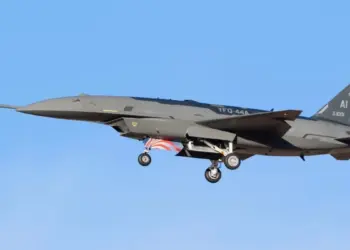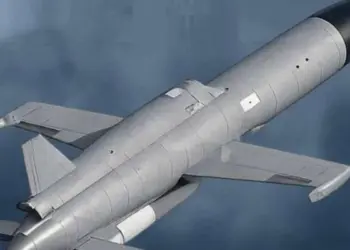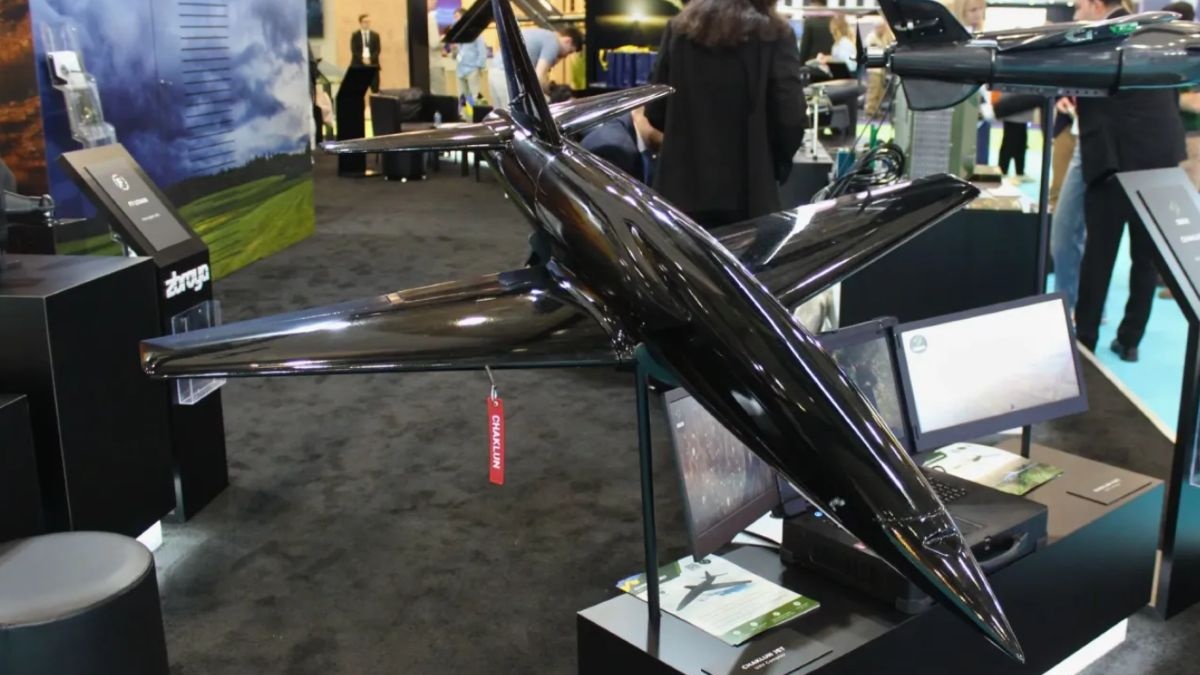
The Ukrainian Air Force publicly presented the Chaklun Jet jet-powered interceptor drone for the first time at the SAHA EXPO 2026 international exhibition in Istanbul. The appearance of a turbojet-powered platform in the lightweight interceptor class is a notable development, although the high-profile debut also leaves a considerable number of open questions.
Let’s take a closer look.
Read also: Weapons of Ukraine’s Victory: The “Shvidun” Interceptor Drone
TABLE OF CONTENT:
Why the Chaklun Jet Appeared
To understand the logic behind the Chaklun Jet, it is necessary to first understand the problem it is intended to solve.
During 2024–2025, Ukraine significantly expanded production of lightweight interceptor drones, including platforms such as P1-SUN, Sting, STRILA, and Octopus. These systems became an effective and comparatively low-cost tool against “Geran” drones – Russian-produced analogues of the Iranian Shahed-136 – which typically fly at speeds of around 180–200 km/h at low altitude.
Electric interceptor drones with propeller-driven propulsion are generally capable of catching such targets, positioning for interception, and destroying them either through direct impact or with a warhead.
However, the situation changed. In early 2026, Russia began deploying the “Geran-3,” a modernized derivative of the Iranian Shahed-238 equipped with a PBS TJ150 turbojet engine. This platform reportedly reaches cruising speeds of approximately 550–600 km/h and can approach 700 km/h during a dive. Its operational ceiling is estimated at around 9 km, and it is said to be capable of carrying a warhead weighing up to 300 kg.
Against this type of target, conventional propeller-driven interceptors become largely ineffective. The available engagement window shrinks to only a few seconds, while matching the target’s cruising speed is physically unrealistic for most electric interceptor designs.
The Chaklun Jet appears intended to address precisely this capability gap.
Read also: Weapons of Ukraine’s Victory: FP-1 – A Drone Capable of Reaching Moscow
A Debut Surrounded by Questions
The Chaklun Jet was presented under the Chaklun brand during SAHA EXPO 2026, held in Istanbul from May 5 to 9. Even the timing of the exhibition is somewhat unusual, as SAHA events have traditionally followed an autumn schedule rather than taking place in May.
More importantly, the legal identity of the manufacturer has not been clearly established in open sources. At different times, various organizations in Ukraine have operated under the “Chaklun” name. For example, Spets Techno Export previously presented the “Chaklun-B 2.0” at IDEF 2025, while the broader Chaklun ecosystem has been described as a consortium of UAV developers and manufacturers. It remains unclear which specific organization is responsible for the jet-powered variant.
This level of anonymity is not especially surprising. It is relatively common either for projects that are still in an early development stage or for programs where publicly identifying the manufacturer could increase the risk of targeted strikes or other security threats.
An equally important question is what exactly was shown at the exhibition. It has not been officially clarified whether the display item was a full-scale mock-up, a conceptual prototype, or a pre-production sample. At the time of publication, there is also no publicly available information regarding field testing, serial production, or operational combat use. For now, the Chaklun Jet should be viewed as an announced project rather than a fully operational system.
Read also: Everything About Ukrainian Interceptor Drone JEDI Shahed Hunter
What the Aircraft Looks Like
The Chaklun Jet is a compact jet-powered unmanned aircraft built around a conventional aerodynamic layout. It features a streamlined fuselage with a pointed nose section, low-mounted swept wings, and a traditional tail assembly. Based on its external appearance, the airframe also appears to be constructed primarily from composite materials.

Specifications:
- Length: 1.65 m
- Wingspan: 1.5 m
- Maximum take-off weight: 10.4 kg
- Payload: 1.6 kg
- Maximum speed: 320 km/h
- Cruising speed: 220 km/h
- Service ceiling: 6,000 m
- Flight duration: 40 minutes
- Operational range: 30 km
A compact single-spool turbojet engine of an undisclosed model is mounted in the rear section of the fuselage. Since the engine does not appear to provide sufficient thrust for an independent takeoff, the drone is launched via catapult.
Control is handled through the ChaklunLRS hardware and software suite, which includes the autopilot, remote-control systems, navigation equipment, and a forward-facing video camera. Communications are reportedly maintained through protected digital and analog channels.
Partial autonomy has also been claimed. According to available statements, the system may be capable of independently searching for and locking onto targets. However, these capabilities have not been independently confirmed in open sources.
Read also: Mission Control: How Ukraine Is Building a Unified Digital Brain for Drone Warfare
The Main Question: The Engine
The most unusual aspect of the Chaklun Jet is the combination of a turbojet engine with a claimed maximum speed of only 320 km/h.
For comparison, the Ukrainian electric interceptor P1-SUN has reportedly reached up to 450 km/h during testing, while the STRILA interceptor developed by WIY Drones is said to achieve around 400 km/h. In other words, conventional propeller-driven electric interceptors are already demonstrating similar or even higher speeds without requiring a jet engine, launch catapult, or the additional complexity and cost associated with such systems.
There are two likely explanations for this discrepancy. Either the stated 320 km/h refers to an economical cruising speed while the true maximum speed remains undisclosed for security reasons, or the figure represents a projected characteristic of a conceptual prototype that has not yet been validated through full-scale testing.
The exact engine model has not been identified. Technically, the most plausible candidates could include:
- PBS TJ150 (Czech Republic, 1500 N thrust, 18.9 kg mass) – the same engine reportedly used in the “Geran-3” and the Iranian Shahed-238. It is capable of supporting speeds in the range of 500–520 km/h, but for an aircraft reportedly weighing only 10.4 kg, it would appear excessively heavy.
- Smaller-class micro turbojet engines, such as the PBS TS100 or comparable Chinese-produced alternatives. Engines in this category would align more closely with the size and mass of the Chaklun Jet, although no confirmation exists in open sources.
Without reliable information about the propulsion system, it is difficult to evaluate the drone’s actual performance, thermal signature, or projected production cost. At the moment, the engine remains the central unknown within the entire concept.
Read also: Weapons of Ukraine’s Victory: Tempest Air Defense System with AGM-114L Longbow Hellfire Missiles
Warhead: Unknown
The type of payload carried by the Chaklun Jet has not been officially disclosed.
Both approaches are already present among Ukrainian interceptor drones. For example, Sting carries a 500 g high-explosive fragmentation warhead, Tenebris Bagnet reportedly uses a 1 kg payload, while Octopus is equipped with a 1.2 kg warhead. By contrast, the Flamingo VB140 is designed primarily for kinetic interception without the use of explosive payloads.
A payload capacity of approximately 1.6 kg would theoretically allow either approach to be implemented. However, it remains unclear which configuration has actually been selected for the Chaklun Jet.
Read also: Everything About the P1-Sun – SkyFall’s Ukrainian Interceptor Drone
“Geran-3”: The Threat the Chaklun Jet Was Designed to Counter
To properly evaluate the Chaklun Jet, it is important to understand the type of target it is intended to engage.
The “Geran-3” is considered a heavily modernized derivative of the Iranian Shahed-238 equipped with a PBS TJ150 turbojet engine. Unlike the piston-powered “Geran-2,” the newer version reportedly reaches cruising speeds of 550–600 km/h and can accelerate to around 700 km/h during a dive. Its claimed range is up to 2,000 km, although more conservative estimates place the realistic figure closer to 1,000–1,200 km. The operational ceiling is estimated at approximately 9 km, with a warhead reportedly weighing up to 300 kg.
The original Iranian Shahed-238 was examined by Ukrainian specialists after being shot down. According to available reports, the aircraft contained not only the PBS TJ150 engine, but also commercially available components including Tallysman antennas, Analog Devices chips, NXP controllers, and Intel processors. This suggests that the platform relies heavily on commercially accessible electronics, which likely simplifies large-scale production.
It was the appearance of the “Geran-3” in operational use that made the concept of a jet-powered interceptor increasingly relevant. Earlier solutions based on propeller-driven or fully electric interceptors are far less effective against targets operating at these speed and altitude ranges.
Read also: Weapons of Ukraine’s Victory: Sting UAV Interceptor
Position within the Ukrainian Interceptor Drone Ecosystem
As of May 2026, Ukraine has developed a structured ecosystem of interceptor drones, divided into several performance classes.
Light class (approximately $1,000–3,000):
- P1-SUN (SkyFall) – 300–450 km/h, 5 km range, 5,000 m ceiling
- Sting (Wild Hornets) – 280–343 km/h, 25 km range, 500 g warhead
- STRILA (WIY Drones) – 350–400 km/h, 14–28 km range
Medium class ($5,000–15,000):
- VB140 Flamingo – kinetic interceptor, 50 km range, 4,500 m ceiling
- Merops (Project Eagle) – ~280 km/h
Autonomous targeting class:
- Octopus – 300 km/h, 30 km range, 1.2 kg warhead, AI-based target recognition; planned joint production with the UK at up to ~1,000 units/month
- Angel Spire – 150–290 km/h, 20 km range, day/night optical tracking
Within this structure, the Chaklun Jet is positioned as a separate niche category: a high-speed jet-powered interceptor intended to engage jet-powered aerial threats.
However, based on the publicly stated maximum speed of 320 km/h, it does not currently demonstrate a clear performance advantage over systems such as STRILA, which are significantly cheaper and do not require catapult-assisted launch systems.
If the actual maximum speed of the Chaklun Jet is substantially higher than what has been publicly disclosed, then the underlying design logic becomes more coherent. If not, its operational advantage over existing interceptor platforms remains unclear.
Interception Economics
The primary argument in favor of the entire interceptor drone category is not technical sophistication, but cost efficiency.
A “Shahed” / “Geran-2” class drone is typically estimated to cost around $10,000–15,000, while the newer “Geran-3” variant is believed to be in the range of $20,000–30,000. In contrast, a single launch of a Patriot missile system interceptor is reported to cost over $3 million. Light electric interceptor drones, by comparison, are generally priced in the range of $1,000–5,000 per unit. This creates a cost exchange ratio of approximately 1:5 to 1:10 in favor of defense when using drone interceptors. With systems like Patriot, the ratio is reversed, reaching roughly 85:1 in favor of the attacker.
The Chaklun Jet, due to its jet engine and catapult launch system, is expected to be more expensive than propeller-based alternatives. Preliminary estimates place its unit cost in the range of $8,000–20,000.
Even at this price level, it would remain significantly cheaper than heavy air defense missile systems and still below the estimated cost of a target in the “Geran-3” class.
Read also: All About the NEO Hunter Mission: How an Ion Beam System Could Protect Earth
Global Context
On a global scale, the Chaklun Jet is closest in concept to systems
- Raytheon Coyote Block ⅔. This is a U.S. interceptor integrated into the LIDS (Low, Slow, Small Unmanned Aircraft Integrated Defeat System) and paired with the KuRFS radar. The unit cost is typically estimated at around $100,000–300,000 depending on configuration.
- Anduril Roadrunner, a jet-powered VTOL interceptor with dual turbojet engines, AI-based control via the Lattice platform, and the ability to return to base if no target is engaged.
Against this backdrop, the Chaklun Jet appears to be a significantly simpler system and potentially an order of magnitude cheaper. This simplicity may represent its main competitive advantage in an international context, particularly for countries seeking an affordable response to jet-powered loitering munitions and similar aerial threats.
Read also: Boeing CST-100 Starliner: Mission That Nearly Ended in Disaster
Limitations That Should Be Stated Clearly
The Chaklun Jet comes with several important limitations that should not be overlooked.
First, its speed is not particularly high in comparative terms. The stated 320 km/h is lower than the cruising speed of the “Geran-3,” which it is reportedly intended to intercept. If this figure is accurate and not intentionally understated, it implies that successful engagements would be limited to specific geometries and intercept scenarios rather than direct head-on pursuit.
Second, the effective operational range is constrained. The reported 30 km refers to communication or control range rather than a physical flight ceiling or endurance limit. In practice, in environments with dense electronic warfare interference, the usable range could be even lower.
Third, the catapult launch system introduces additional logistical complexity. Unlike drones that can be launched by hand or from simple ground setups, the Chaklun Jet requires dedicated launch infrastructure. In field conditions, this reduces deployment flexibility and increases setup requirements.
Fourth, both the manufacturer and the current development stage remain unclear. Without verified production status or publicly available test data, it is not possible to confirm whether this is an operational system or an early-stage concept that has not yet reached serial production.
Finally, the type of warhead or interception method has not been defined. Without clarity on how the system achieves target neutralization, its effectiveness against specific classes of threats cannot be reliably assessed.
Read also: All About Starship V3: Technological Platform for the Next Spaceflight Era
What This Actually Means
The Chaklun Jet can be understood as a direct response to a very specific operational problem. The introduction of “Geran-3” class drones with jet propulsion has pushed Ukrainian defense development toward solutions that operate in a similar speed regime. In that sense, the use of a turbojet engine in a lightweight interceptor is conceptually straightforward: it is an attempt to match the performance envelope of faster aerial threats that are no longer realistically addressable with propeller-driven systems. The underlying idea is technically reasonable and aligned with the physics of the problem.
However, there is still a significant gap between concept and a fully operational system. Without confirmed details on the engine, verified real-world speed, defined warhead configuration, identified manufacturer, or published test results, the Chaklun Jet should currently be regarded as a forward-looking announcement rather than an established platform.
If the publicly stated 320 km/h figure is intentionally understated and the true maximum performance is significantly higher, then the system could indeed fill a capability gap that is not yet addressed within Ukraine’s current interceptor ecosystem. If not, its advantages over existing solutions are less clear, while the higher cost becomes an additional drawback.
In a broader context, the idea of a mass-producible, relatively low-cost jet-powered interceptor for countering high-speed strike UAVs is a well-aligned direction of development. Similar approaches are already being pursued internationally, including systems such as the Raytheon Coyote Block 2/3 in the United States, the Anduril Roadrunner program, as well as initiatives in the United Kingdom (LEAP program) and Turkey. Demand for such systems is likely to grow beyond Ukraine alone.
Whether the Chaklun Jet ultimately proves competitive in this segment will depend on test results and interest from international buyers. Until then, it is more accurately described as a promising concept rather than a finalized weapon system.
Read also: