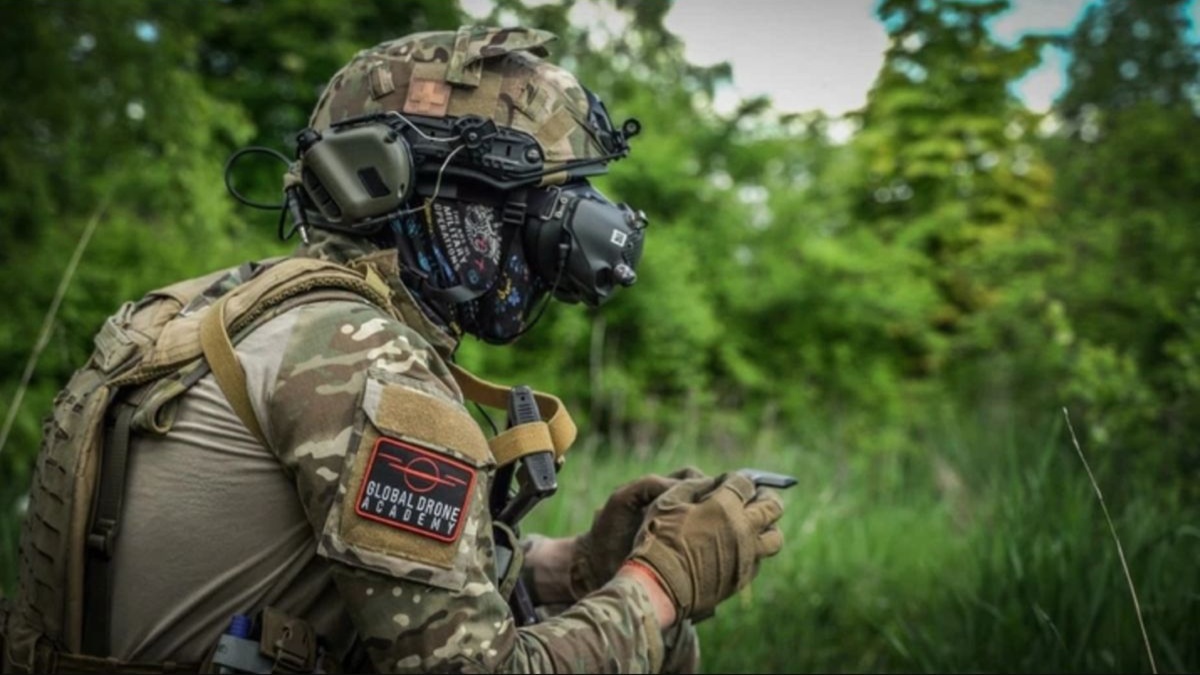
Global Drone Academy represents an approach to modern warfare that emphasizes decision-making, accountability, and operator mindset. We spoke with its founders and present their responses below.
The full-scale war has not only altered the front line but has also significantly reshaped the underlying logic of contemporary combat. Where numerical strength and conventional tactics once played a dominant role, increasing importance is now placed on adaptability, technological flexibility, and the training of personnel capable of operating under conditions of persistent uncertainty. Unmanned systems have evolved from auxiliary tools into core components of an emerging military ecosystem.

It is within this context that initiatives emerge which not only respond to current challenges but also contribute to setting new operational standards. The development of Global Drone Academy reflects more than a training effort for operators; it points to a broader shift toward a distinct operational culture. In this framework, the determining factor is not the technology itself, but the people who employ it – their decision-making, accountability, and capacity to adapt at a pace that matches changes on the battlefield.
We spoke with the founders of Global Drone Academy, Roman Korzh and Anton Veklenko, and asked them a series of questions. The following section presents their responses.
Read also: Weapons of Ukraine’s Victory: The “Shvidun” Interceptor Drone
Aeronaut: How did the idea to create Global Drone Academy originate – was it a spontaneous decision driven by wartime conditions, or a continuation of your prior experience?
Global Drone Academy: It was a deliberate response to the challenges that emerged after the start of the full-scale invasion. Initially, I trained volunteers on a volunteer basis, but the demand continued to grow. By combining efforts and experience with colleagues and partners, we established a dedicated training center.
AN: What underlying philosophy informs your training approach – is it primarily focused on technology, responsibility, or a shift in how individuals think in a combat environment?
GDA: These elements are interconnected. Contemporary UAV operator training extends well beyond basic piloting skills. Technology evolves rapidly. If a person learns only specific controls and procedural instructions, that knowledge can become outdated within months. For this reason, the core principle embedded in our training is adaptive thinking – the ability to learn quickly, adjust to changing conditions, and make decisions in unfamiliar or evolving environments.
Equally important is accountability. Today, drones are a high-impact tool that can influence both operational outcomes and the safety of personnel. There is little room for error – mistakes can carry significant consequences. The third layer is the technology itself. Operators must understand the hardware, tactics of use, and system-specific characteristics. However, without the right mindset and a sense of responsibility, technology remains just equipment. Our approach is therefore based on a simple principle: we do not train “operators with a controller,” but individuals capable of functioning effectively in a rapidly changing operational environment, where conditions evolve continuously.
AN: What strategic objective do you set for the academy – training the maximum number of operators or shaping a new culture of drone use within the military?
GDA: Our objective is the second option: establishing a culture of unmanned systems usage within the military. Drones are an element of the broader military ecosystem. They are integrated into combat operations, reconnaissance, strike missions, logistics, interception, and information management. The number of trained operators is important – there is clearly a need for personnel. However, even more critical is the quality of thinking and the standardization of operational practices.
In short, our aim is to contribute to changing the operational model of modern warfare.
AN: You both came into drones from completely different fields – cinematography and transport modelling. At what point did you realize that civilian skills had to be fully restructured for military requirements?
GDA: The turning point came quickly – when it became clear that the usual logic no longer applied. In the civilian sector, the focus is on image quality, efficiency, flight safety. The priority is to produce something stable, controlled, and visually consistent. In a military context, those priorities shift significantly: speed, adaptability, performance under pressure, and decision-making in uncertain conditions become central. Many civilian drone-related skills remained valuable – technical reasoning, spatial awareness, data handling, and process discipline. However, they had to be fundamentally re-evaluated and adapted to a different set of operational requirements.
For example, in the civilian context, the priority is to avoid risk. In the military context, the focus shifts to managing it. Civilian operations typically rely on structured planning, whereas in combat conditions plans can change within minutes, requiring continued execution under new circumstances.
AN: In April 2022, you launched Global Drone Academy. Why did you choose to establish a training center rather than, for example, focus on drone manufacturing or direct volunteer supply of equipment to the front line?
GDA: At that time, the country needed everything – production, logistics, volunteer support, and new technologies. However, we approached the situation pragmatically. Equipment can be purchased, delivered, or assembled, but trained personnel cannot be sourced quickly.
At the beginning of the full-scale invasion, it became clear that a drone without an operator is essentially just a piece of hardware. Even a high-quality system is often used at only 20–30% of its potential without proper training, and in some cases is lost due to basic operational errors. We therefore identified the primary bottleneck not in equipment, but in people and knowledge.
A training center creates a multiplicative effect. A single delivered drone operates in one location, while a trained operator can work over time, transfer knowledge to others, train teams, and strengthen an entire unit. A capable instructor can already influence hundreds of people. This is why we chose the training direction.
In addition, at that time the hardware market was developing rapidly on its own. Manufacturers, volunteer initiatives, and suppliers were emerging quickly. However, structured training remained comparatively limited. We decided to focus where we could provide the most impact.
In retrospect, this approach proved effective. Today, competition is often less about the hardware itself and more about who trains personnel more effectively and adapts them faster to the evolving realities of warfare.
Read also: Weapons of Ukraine’s Victory: TRIDON Mk2 Mobile Air Defence Systems from BAE Systems Bofors
AN: You have developed four main courses, ranging from civilian quadcopters to FPV “kamikaze” systems and instructor training. Which of these courses is currently the most in demand, and why?
GDA: Today, the highest demand is for FPV training and all areas related to strike drones and the interception of hostile aerial targets. These systems are currently among the most operationally impactful on the battlefield. FPV platforms have provided armed forces with a relatively low-cost, scalable method of precision engagement. Interceptor systems, in turn, have emerged as a response to new threats – from reconnaissance UAVs to strike drones such as Shahed 136. The demand for these capabilities is therefore a direct reflection of current operational needs.
However, at a deeper level, the most scarce resource today is not operators, but instructors. Personnel can be recruited and trained, but individuals capable of effectively training others, transferring practical experience, and maintaining consistent training standards are significantly harder to find. For this reason, our instructor training program is strategically one of the most important. A strong instructor can, over time, influence dozens or even hundreds of new operators. This is a multiplier effect that is often underestimated.
AN: Initially, everything started with your own funding, and later you moved to a mixed model (free for military personnel, paid for civilians). How difficult is it today to maintain the academy, and do you still have to contribute personal funds?
GDA: In the early stage, we launched the academy using our own resources. It was a deliberate decision not to wait for external support, but to begin operating at a time when training personnel was needed immediately. Later, we transitioned to a mixed model: free training for military personnel and commercial programs for civilians and corporate clients. This approach made the system more sustainable and financially independent.
It is important to emphasize that we do not rely on large-scale public donation drives. While we respect the volunteer movement, we chose a different development model focused on systematic cooperation with businesses and investors interested in scaling operations, developing new programs, building infrastructure, and achieving long-term outcomes. In our view, this is a more structured approach. When it comes to training, quality, and scale, what is required is not episodic or emotionally driven support, but predictable resources and long-term partnerships.
Do we still invest personal funds today? Occasionally, yes, but we would frame this more as investment into new initiatives rather than operational necessity. In this field, the main asset is not equipment itself. It is the team, expertise, and the ability to efficiently convert resources into trained personnel and measurable outcomes.
Read also: All About the NEO Hunter Mission: How an Ion Beam System Could Protect Earth
AN: At the beginning, you trained volunteers completely free of charge. Which stories of your graduates inspire you the most and motivate you to continue?
GDA: What is most inspiring is seeing someone arrive with no experience, sometimes with significant self-doubt, and gradually become a specialist who is able to make a real operational difference. There are graduates who, after completing training, have taken on key roles within their units, built drone capabilities from scratch, become instructors themselves, and are now training others. This is likely the most valuable outcome – when knowledge begins to scale independently of us. We are also strongly motivated by cases of people who now represent Ukrainian experience internationally. For example, one of our graduates currently holds a key position within a military contingent deployed by Ukraine to the Middle East, where they are involved in sharing operational experience related to air defence systems and countering threats such as Shahed 136.
For me, this is highly symbolic. Ukraine has moved from a country that was rapidly learning to a country that is now capable of training others. There are also less public – but equally important – stories. People sometimes write months or years later saying, “What you gave us back then actually worked.” For us, this is a strong indication that the work has real value.
However, motivation does not come only from success stories. It also comes from responsibility. When you understand that your work can help someone prepare better, preserve lives, or make the right decision in a critical moment, it changes how you approach it. That is the main reason to keep going.
AN: Who typically comes to your courses – what kinds of people and with what motivation? And are there cases where you refuse training or certification not for technical reasons, but for personal or behavioral ones?
GDA: A wide range of people attend our courses. These include military personnel from combat units, individuals preparing for deployment to operational areas, civilians transitioning into service or seeking a new profession, engineers and technical specialists, and sometimes entrepreneurs or business representatives who view the field strategically.
Motivations also vary. Some come because they will be operating on the front line the next day. Others want to contribute to national efforts. Some are looking for a new career path. Others understand that drone technologies already represent a distinct and rapidly growing sector in both defence and security. Yes, there are cases where we may refuse training or deny certification for non-technical reasons. For example, if a person consistently ignores safety rules, demonstrates irresponsible behavior, shows aggression, is unable to work in a team, or treats the training environment as a game. In this field, such attitudes are not acceptable.
For us, a certificate is not merely a document confirming course completion. It represents a level of trust in a person as a qualified specialist. For that reason, it can sometimes be more appropriate not to issue a certificate than to do so as a formality. In this field, the consequences of mistakes are fundamentally different from those in many civilian professions.
Read also: Mission Control: How Ukraine Is Building a Unified Digital Brain for Drone Warfare
AN: The course lasts 5 days of highly intensive practical training: trenches, camouflage, and flights over 4–5 km. What are the most common mistakes beginners make at the start, and how do you address them?
GDA: First, a clarification: the basic course lasts 6 days, not 5. This is important for us because in such an intensive program, an additional day is not a formality – it provides an opportunity to properly consolidate practical skills. Regarding beginners, the most common initial mistake is treating the drone as standalone equipment rather than as part of a broader operational process. People often focus exclusively on flight control: how to take off, how to operate, how to land. However, real effectiveness begins earlier – with position preparation, situational assessment, communications, route planning, coordination with the team, and understanding operational risks.
The second common mistake is rushing. Many participants want to immediately “fly far and smoothly” without first developing stable basic control. This often leads to unnecessary control inputs, loss of orientation, and errors under pressure. The third issue is tunnel vision. Operators focus exclusively on the screen and lose awareness of the broader environment: team activity, changes in conditions, potential threats, battery status, and link quality.
Another frequently underestimated factor is attention to detail. This includes unverified batteries, skipped checklists, insufficient preparation of the launch site, and underestimating weather conditions. In practice, such small oversights often lead to significant operational problems. As for how these issues are addressed, the approach is based on continuous practice in conditions that closely replicate real operational environments. Core procedures are repeated until they become automatic. Training scenarios are designed to introduce workload and stress, rather than relying on controlled or “clean” conditions.
We deliberately include not only ideal flight situations but also scenarios where participants must correct mistakes, adapt, and maintain composure. The primary objective of the course is not simply to teach drone operation. It is to train individuals to act correctly when events do not go according to plan. This is where the most operational value is developed.
AN: The adversary is also actively developing drones and electronic warfare systems. How quickly do you have to update your training program so that what you teach today does not become outdated on the front line within a month?
GDA: Today, this is a continuously evolving process. What was relevant a few months ago may now only be partially effective, and some approaches may no longer work at all. This is driven not only by the adversary, who constantly adapts tactics, but also by the fact that warfare itself has become a highly dynamic environment. As a result, we continuously update our programs. Sometimes this involves incremental weekly adjustments – such as configurations, operational scenarios, flight methodologies, and procedures for operating under electronic warfare interference. In other cases, it requires more fundamental revisions when the underlying logic of system employment changes.
In practice, we operate closer to an IT product model than to traditional education. There is continuous feedback from units, new operational cases from the front line, and ongoing developments in the market – all of which must be rapidly integrated into training. If a training center operates on the principle of “we wrote the curriculum once and use it for two years,” it quickly begins teaching outdated practices. In this field, that approach is a risk.
For this reason, we focus not only on specific skills, but also on the ability to adapt. It is not possible to train someone once for every possible scenario. Instead, the goal is to teach them how to continue learning efficiently. In our view, this is one of the key competencies of a modern UAV operator today – the speed of retraining and adaptation.
AN: The “Army of Drones” program recognizes your certificates. Do you receive real state support, or only formal recognition – and what do you actually need from the state?
GDA: It is important for us that state initiatives recognize the certificates issued by Global Drone Academy. This indicates that a private training system can be integrated into the country’s broader defence ecosystem, and that quality training receives official validation. However, for us, more important than formal recognition itself is effective cooperation. The drone sector and training requirements evolve rapidly, while traditional bureaucratic processes often move at a significantly slower pace. The key challenge, therefore, is not status or documentation, but the speed of decision-making and operational coordination.
What we actually need from the state is, first of all, clear and transparent rules of engagement. Private training providers must understand how to operate systematically, how to integrate into state programs, what quality standards are required, and how to plan long-term investments. Second, a partnership-based approach. The state is not required to do everything independently. In many areas, the private sector can move faster, more flexibly, and often at lower cost. The role of the state should be to leverage that speed and expertise rather than compete with it.
Third, support for scaling proven models. If certain training centers have demonstrated results, they should be enabled to expand their capacity. Another important element is continuous feedback from the front line. Training must be regularly updated based on real operational needs. In our view, the most effective role of the state is to act as a strong client, partner, and standards moderator, rather than attempting to centrally control every process.
Read also: Weapons of Ukraine’s Victory: Tempest Air Defense System with AGM-114L Longbow Hellfire Missiles
AN: Is it possible to scale your training model to the level of a state training system, and what would be required to achieve this?
GDA: Yes, I am convinced that such a model can be scaled to a state-level training system. In fact, it would be difficult to meet the real demand for personnel training in modern warfare without it. The primary requirement is a strong instructor corps. Today, instructors represent the main bottleneck. Operators can be trained in large numbers through standardized processes, but experienced instructors with both operational background and structured teaching methodology are significantly fewer in number.
Second, unified quality standards, but without unnecessary bureaucracy. It is important to clearly define what outcome a course should deliver, which competencies a trainee must acquire, and how the level of preparation is assessed.
Third, the speed of curriculum updates. If a state system teaches material that was relevant six months ago, it is already lagging behind. This requires a continuous update model, closer to a technology-sector approach than to traditional education.
Fourth, partnership between the state and the private sector. In our view, the most effective model is one where the state defines standards, formulates demand, and scales solutions, while the market provides flexibility, speed, and practical expertise.
In short, scaling is possible. However, replicating the structure alone is not sufficient. What needs to be scaled is the substance – the culture of quality and the pace of adaptation.
Read also: Everything About the P1-Sun – SkyFall’s Ukrainian Interceptor Drone
AN: How do you see the role of drones in future warfare, and will basic UAV operation become as essential a skill as driving a car is today?
GDA: I believe the role of drones in future warfare will become so fundamental that we will stop perceiving them as a separate “new technology.” Drones already cover reconnaissance, strike missions, fire correction, logistics, interception, communications relay, and engineering tasks. This is only the beginning. Going forward, we will see increased autonomy, deeper integration with ground robotic platforms, and more complex command-and-control systems. In practice, the battlefield will be saturated with unmanned systems operating across multiple domains – in the air, on the ground, and at sea.
Regarding the second part of the question, I am convinced that basic UAV operation will become a widespread skill. It may not become literally universal in the same way as driving a car, but it will be essential across a wide range of professions. For military personnel, it will be standard. The same applies to emergency services, law enforcement, logistics, agriculture, and engineering roles.
A person who does not understand the basic logic of unmanned systems will, over time, find themselves in a position similar to someone who could not use a computer when digital tools became standard. The key skill will be the ability to work alongside these systems: defining tasks, monitoring processes, making decisions based on data, and integrating them into existing workflows.
In other words, the future is not about humans replacing drones, or drones replacing humans. It is about humans learning to extend their capabilities through these systems. Those who adapt earlier will have a significant advantage.
AN: You have set the goal of training as many pilots as possible to support victory and save the lives of defenders. How do you see Global Drone Academy in one to two years? Do you plan to expand into additional areas, such as maritime drones or other domains?
GDA: Today, our ambition is to build a full ecosystem for training, certification, and the transfer of modern Ukrainian expertise. This includes improving personnel quality, developing instructor training, introducing new educational standards, and rapidly scaling operational knowledge.
We do plan to expand into additional areas. Airborne systems will remain the core focus, but modern warfare has long extended beyond the air domain alone. We see significant potential in training for ground-based robotic platforms, interception of hostile drones, and integrated use of multiple types of unmanned systems within a single operation. A key strategic direction for us is instructor development. As mentioned earlier, a strong instructor can ultimately produce dozens of new operators, making it the most efficient way to scale a high-quality training system.
We are also looking at international development. Ukraine now possesses unique practical experience in drone technologies and their application in modern tactics. There is significant interest in this expertise from other countries.
In one to two years, I see Global Drone Academy evolving into a platform operating across several parallel directions: personnel training for Ukraine, new technology-focused programs, international educational products, and the export of Ukrainian expertise. The goal is not only to grow in scale, but also in impact. The primary objective is to contribute to the development of a new security framework in which Ukrainian operational experience carries tangible relevance.
Global Drone Academy is an example of how war reshapes not only technology, but also approaches to human training. The focus is not on drones as hardware, but on mindset, accountability, and the ability to adapt quickly. These systemic approaches increasingly define effectiveness on the battlefield and are shaping the emerging model of modern warfare.
Read also: