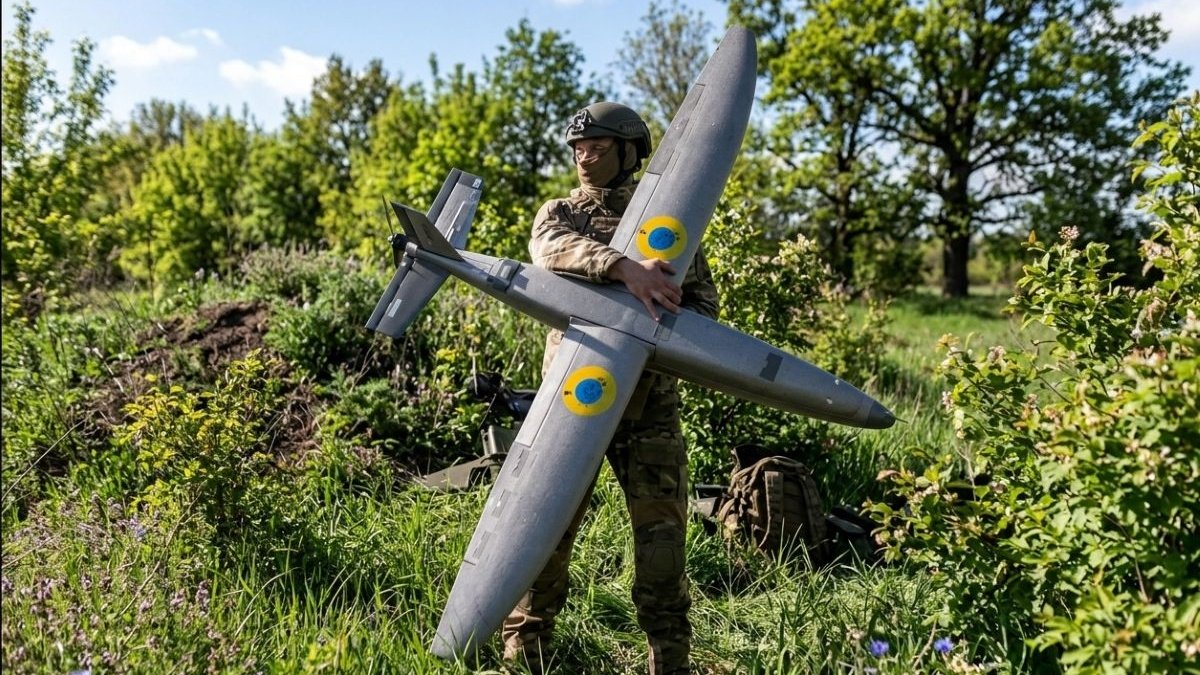
Today we will look at the Hornet drone, also referred to as “Martian-2” – a system reportedly difficult to detect acoustically and electronically, and one that has already been used against rear positions of Russian forces.
In March 2026, a previously unknown weapon system appeared on the battlefield in the Donetsk region. There were no official announcements or press releases. Initial reports emerged through images of unidentified drone wreckage and growing concern among rear-line units on the opposing side.
According to available reports, the project is linked to several technology companies operating through a network of affiliated structures, as well as individuals associated with the U.S. technology sector, including former Google CEO Eric Schmidt. The underlying technologies were originally developed for civilian applications but were later adapted for military use.
There are several ways the appearance of a new weapon on the battlefield becomes known: official statements from defense ministries, frontline reporting, or indirect evidence from operational channels. In the case of the Hornet system, early information spread through Russian Telegram channels associated with electronic warfare operators, who reported that standard detection systems failed to identify the drone before impact.
This was how the world first learned about the Hornet loitering munition, referred to by Russian sources as “Martian-2.” The first documented combat use reportedly took place near Donetsk in March 2026. Fragments of the drone were later examined by representatives of the Russian defense industry, who noted that the system did not clearly match previously known categories of UAVs or loitering munitions.
Let’s take a closer look.
Read also: Weapons of Ukraine’s Victory: FP-1 – A Drone Capable of Reaching Moscow
TABLE OF CONTENT:
The Origins of Hornet
To understand the Hornet system, it is important to examine who developed it and for what purpose. The project is associated with Eric Schmidt, who led Google for a decade and later chaired both the Pentagon’s Defense Innovation Advisory Board and the U.S. National Security Commission on Artificial Intelligence. His background combines experience in large-scale technology development with involvement in defense and AI policy.
According to publicly available information, Schmidt began work on the defense initiative in September 2022 following meetings with Ukrainian officials. The project initially operated under the name White Stork before evolving into what became known as Project Eagle.
Development and organizational management reportedly involve several interconnected entities, including Swift Beat LLC, Volya Robotics OÜ, and Perennial Autonomy. Perennial Autonomy is considered by observers to be the consolidated corporate identity behind the Hornet platform. Some reports also mention the involvement of engineers and specialists with backgrounds connected to Qualcomm.

This is fundamentally not a state-developed system. Hornet is a commercially driven project financed through private capital and designed from the outset with real combat conditions as its primary testing environment. In this context, Ukraine has simultaneously acted as a customer, an operational testing partner, and, from a more pragmatic perspective, a live deployment environment.
In July 2025, the Ministry of Defense of Ukraine signed a memorandum on long-term strategic cooperation with Swift Beat LLC. The agreement was concluded in Denmark in the presence of Volodymyr Zelenskyy. According to reported details, the deal included deliveries of “hundreds of thousands of drones” within the same year – a figure indicating planned large-scale industrial production rather than limited experimental batches.
Overall, Hornet can be described not as a conventional Pentagon procurement program, but as a project emerging from the intersection of private investment, Silicon Valley technology expertise, and the operational demands of the war in Ukraine.
Design: What Sets Hornet Apart
The first notable aspect of the Hornet platform is its airframe configuration. The drone uses a fixed-wing aircraft layout with an estimated wingspan of around two meters. It features a vertical tail stabilizer, control surfaces, and a rear-mounted pusher propeller. The use of a pusher configuration is a deliberate engineering choice, as it leaves the front section available for sensors and payload systems without obstructing cameras or targeting equipment.
The airframe is reportedly constructed from a combination of nylon-based polymers, duralumin, and carbon fiber composites. This material mix provides several practical advantages, including low weight, sufficient structural rigidity, and reduced acoustic and radar signatures. According to available reports, the drone remains difficult to detect acoustically until the final phase of approach, a characteristic that has been repeatedly highlighted in discussions of its battlefield use.
The propulsion system consists of electric motor equipped with two-blade propeller. Compared to internal combustion engines, electric motors generate lower noise levels, produce a reduced infrared signature, and generally require less maintenance. The reported cruising speed is approximately 100–120 km/h, while terminal attack dives may reach speeds of 200–300 km/h. In practical terms, this significantly reduces the available reaction time once the drone is detected near the target area.
The optical system includes two high-resolution cameras with 10× optical zoom. These are used both for navigation during flight and for target identification during the terminal phase of an attack. The standard operating altitude is reported to be between 300 and 500 meters, although the platform is also said to be capable of reaching altitudes of up to 5,000 meters. At such heights, it operates beyond the effective range of many short-range anti-aircraft artillery systems.
Technical specifications of the Hornet (“Marsian-2”)
- Wingspan: ~2 m
- Range: 100–150 km
- Cruising speed: 100–120 km/h
- Dive speed: 200–300 km/h
- Flight time: up to 2 hours
- Payload: ~5 kg (MMW)
- Flight altitude: 300–500 m
- Maximum altitude: up to 5,000 m
- Communications: Starlink + Wi-Fi MIMO
- Estimated cost: < €5,000
The Brain of the System: Artificial Intelligence as the Core Capability
If the Hornet’s hardware design represents an evolution of established solutions, its software stack marks a more substantial advance. The AI component is what shifts the drone’s role from that of an expensive guided munition to a comparatively autonomous strike platform.
The Hornet AI system addresses several functions.
First, it handles target recognition and classification. The onboard computing module operates with a library of visual reference profiles that includes different categories of trucks, armored vehicles, artillery systems, personnel, and radar stations. Targets can be acquired automatically, although the operator still confirms the selection before engagement. This is not a fully autonomous weapon operating entirely without human involvement, but the level of manual control is significantly reduced.
Second, the system is designed to operate in contested electronic warfare environments. This also explains why many conventional drone detectors fail to identify it. Hornet uses a Wi-Fi modem capable of switching to non-standard frequency ranges – from 2000 to 2300 MHz and from 3300 to 3800 MHz. Most existing FPV detection systems are configured for standard drone frequencies and therefore do not reliably detect the platform. Tracking drones of this type requires specialized equipment, such as Shadow detectors, whose developers have acknowledged the limitation and announced corresponding software updates.
Third – and likely most significant – is its GPS-independent navigation capability. Hornet employs a vision-based positioning system conceptually similar to technology previously developed by Vermeer for cinematic camera tracking applications. The module weighs less than one pound and integrates two cameras with a compact onboard computer. It can maintain target positioning at speeds of up to 350 km/h and, critically, does not rely on transmitting or receiving external navigation signals. As a result, electronic warfare systems designed to disrupt satellite navigation are inherently ineffective against this type of guidance architecture.
External communication with the operator is provided via Starlink terminals. This enables a control range comparable to that of a cruise missile system, while operating at a significantly lower cost. During the terminal phase, the drone neither emits nor receives navigation signals. As a result, electronic warfare systems designed to disrupt GPS-based navigation have little or no effect on its guidance, since there are no satellite navigation signals to interfere with.
Read also: Everything About Ukrainian Interceptor Drone JEDI Shahed Hunter
Warhead: configurable options
The Hornet carries a 5-kilogram multi-mode warhead (MMW). Depending on configuration, it can function either as a high-explosive fragmentation charge intended for engaging personnel and lightly armored vehicles, or as a shaped charge for targeted disabling of armored equipment. This allows the same drone platform to be reconfigured for different target types without changing the airframe or payload carrier.
In addition to the standard MMW payload, the use of a thermobaric MOA-400 warhead has also been observed. In urban combat scenarios or when targeting personnel in fortified positions, this represents a particularly destructive option. Thermobaric effects are produced not by fragmentation, but by overpressure and high temperature, meaning that conventional cover and structural barriers offer limited protection.
The terminal-phase attack sequence has been reconstructed from analysis of recorded strikes. The drone descends to approximately 20–30 meters, approaches the target area at a speed of 50–90 km/h, and then the onboard AI performs final target acquisition, triggering detonation at an altitude of roughly 2–3 meters above the object. This type of detonation profile significantly reduces the available reaction window and makes suppression with small-arms fire less effective in practice, leaving only limited opportunities to physically disrupt the drone or its critical components such as the warhead, flight controller, or battery.
Read also: Weapons of Ukraine’s Victory: TRIDON Mk2 Mobile Air Defence Systems from BAE Systems Bofors
How Hornet is used in combat: logistics as the primary target
Hornet’s selection of priority targets is a key operational aspect. It is not intended for direct engagement with frontline positions or for dueling armored vehicles in close combat. Instead, it is primarily used against logistical assets: cargo trucks such as KamAZ and Ural vehicles, mobile fire support units, radar systems on the move, depots, and rotation points.
This target selection reflects a broader operational logic. A modern army depends first and foremost on its supply network. If logistics are disrupted, front-line units degrade over time: ammunition delivery slows or stops, wounded personnel cannot be evacuated efficiently, and unit rotations become difficult to sustain. Hornet conducts strikes at depths of approximately 50–65 km behind the line of contact, targeting areas where opposing forces typically consider themselves relatively secure and where the concentration of vehicles and support assets is higher.
The first documented combat use reportedly took place in March 2026 in the Donetsk region. Azov Brigade confirmed the systematic use of Hornet for strikes on supply routes, including Vuhledar, Andriivka, Starobesheve, Horlivka, Lysychansk, as well as the Donetsk ring road. Video recordings showed drones operating directly over occupied Donetsk, at distances exceeding 50 km from the front line. The drone’s camera also captured the Donbas Arena stadium in the city center. Donbas Arena
In parallel, Hornet has been reported as effective against mobile fire teams with personnel. The onboard AI-based recognition system is involved in target identification, allowing the drone to classify objects and distinguish civilian vehicles from military ones prior to engagement.
Operators from the opposing side working with electronic warfare systems described Hornet in the following terms: “This is a highly dangerous UAV: it is difficult to hear, not detected by standard systems, it operates deep in the rear, and is resistant to electronic warfare.”
Read also: Mission Control: How Ukraine Is Building a Unified Digital Brain for Drone Warfare
Adversary response: nets, detectors, and interception
The emergence of Hornet has triggered a non-trivial response. Along key rear supply routes, protective netted “corridors” have begun to be installed. These are essentially physical barriers intended to prevent drones from conducting low-altitude terminal approaches to targets. The approach is costly and labour-intensive, and only partially effective: it complicates the terminal attack phase but does not eliminate the threat at a fundamental level. The Shadow detector produced by the eponymous company has received updates enabling it to detect Hornet’s Wi-Fi signal in non-standard frequency ranges. However, the situation remains structurally asymmetric: the drone developer can shift operating frequencies in subsequent production batches, restarting the adaptation cycle for detection systems.
At present, the most effective countermeasure against Hornet appears to be interceptor drones. Drone-on-drone interception is more expensive, technically complex, and requires strong situational awareness, but it is currently the only method that can reliably stop Hornet before it enters its terminal attack phase.
The Russian unit “Burevestnik” reportedly confirmed the destruction of several Hornet drones using this method in May 2026. Notably, the intercepted drones were neutralized before initiating their attack sequence. This suggests that interception can work, but so far remains an exception rather than a consistent capability.
Read also: Weapons of Ukraine’s Victory: The “Shvidun” Interceptor Drone
Production scale and U.S. integration
In an early 2025 promotional brochure, Swift Beat stated a planned monthly production rate of over 6,000 units. For comparison, this figure exceeds Russia’s monthly production of “Geran”-type drones. Whether this production level has been achieved remains unclear, as official statistics have not been published.
More notably, the U.S. military has already begun integrating Hornet into its training activities. In March 2026, demonstration launches were conducted at the Grafenwöhr training area in Germany. In May 2026, units of the U.S. 2nd Cavalry Regiment trained with the system at the Pabradė training area in Lithuania as part of Exercise Saber Strike 26, with additional exercises conducted in Poland at Bemowo Piskie. Across three countries and multiple exercises, the same platform was used, suggesting a shift beyond isolated testing toward routine operational integration.
The broader implication is that Hornet, developed in the context of the Ukrainian battlefield, is being incorporated into NATO training frameworks. Operational experience accumulated in Ukraine is being translated into alliance-level doctrine.
Read also: Everything About the P1-Sun – SkyFall’s Ukrainian Interceptor Drone
Limitations and vulnerabilities: a balanced view
A realistic assessment of Hornet requires acknowledging its limitations. Some of them are structural rather than situational.
First, weather-related constraints. The airframe is not fully sealed, which makes operation in rain or high humidity problematic. In the context of Ukraine’s climate, this reduces its year-round operational reliability. The cooling system has also been criticised, with overheating under certain conditions described as a known early-stage technical issue.
Second, limited payload utility per platform. Hornet is a single-use system. Each launch results in the loss of the airframe. At an estimated cost of under €5,000, it is still significantly cheaper than most missile systems, but more expensive than mass-produced FPV kamikaze drones. Against large waves of very low-cost drones, Hornet is not always an economically efficient response.
Third, supply chain dependency. The system is assembled from a combination of foreign components and Ukrainian-made parts. This creates a structural vulnerability in the event of disrupted logistics, export restrictions, or sustained sanctions pressure affecting key components.
Finally, the AI system, regardless of its level of sophistication, is not infallible. Countermeasures such as vehicle camouflage, netting, thermal shielding, and deliberate alteration of thermal signatures can complicate automated target acquisition. The adversary is adapting, and future iterations of the system are likely to be adjusted in response to these evolving conditions.
Each limitation of Hornet should not be interpreted as a failure of the concept, but rather as a constraint that defines its appropriate use. Hornet is not a system based on mass employment, but on precision and operational depth.
Read also: Weapons of Ukraine’s Victory: Sting UAV Interceptor
What Hornet means for the future of drone warfare
Hornet represents a broader shift rather than an isolated system. Historically, loitering munitions have fallen into two main categories: expensive, high-end systems such as Israeli or U.S. platforms (e.g., Harop, Switchblade 600), or low-cost but relatively crude FPV drones. Hornet appears to occupy a middle tier between these extremes – comparatively affordable, with extended range, AI-assisted navigation, and reduced dependence on signals that can be jammed.
It is one of the first platforms of this class to undergo sustained combat use in a heavily contested electronic warfare environment, demonstrating operational effectiveness under real conditions. Not in controlled demonstrations or marketing presentations, but in live strikes against documented targets with observable outcomes.
Also significant is the funding model: private venture capital rather than state defense procurement. This enables shorter development cycles, fewer bureaucratic constraints, and greater flexibility in iteration. If this model proves sustainable, it may influence defense industry dynamics more broadly than any single technical feature of the system itself.
The name “Martian-2”, given to the drone by the opposing side, turned out to be unexpectedly fitting. From a certain perspective, the system does resemble something unfamiliar or “non-terrestrial” – at least for those who do not yet understand how to counter it and lack a rapid response. However, this is not a case of advanced or exotic technology in isolation, but rather a convergence of Silicon Valley-style engineering and modern battlefield requirements.
It is important to understand that the Hornet UAV is neither a revolution nor a “wunderwaffe.” It is an incremental but significant step within a specific niche: an autonomous loitering munition with AI-based targeting, designed to operate in contested electronic warfare environments. It is more resilient to jamming than traditional systems, less expensive than missile-based solutions, and more capable than typical FPV drones in certain roles.
At present, it represents one of the more effective tools for striking rear-area logistics under conditions of dense electronic warfare. The remaining question is not its current performance, but whether production can be sustained at scale, and whether opposing forces will develop a systematic countermeasure.
Read also: