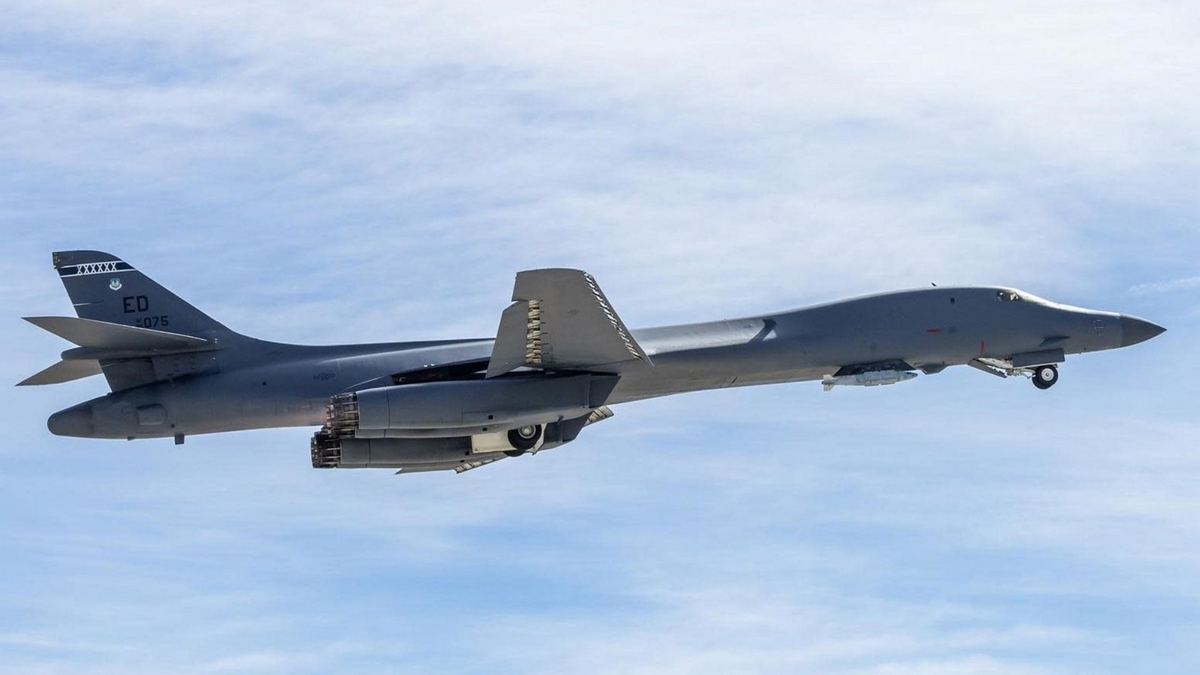
The American supersonic strategic bomber B-1B Lancer, known in military circles by the nickname “Bone,” has been operating within the U.S. Air Force since 1985. At present, the U.S. Department of Defense, in cooperation with the aerospace corporation Boeing, is carrying out a program aimed at integrating hypersonic missile systems and other long-range strike capabilities into the aircraft.

Representatives of Boeing have officially announced the successful completion of the Preliminary Design Review (PDR) phase, which focused on adapting the Load-Adaptive Modular (LAM) pylon for the B-1B Lancer aircraft. This milestone is significant in the modernization effort, as it will substantially expand the bomber’s tactical capabilities by enabling additional external payloads, including advanced precision-guided munitions. Such developments are considered critical to ensuring that the B-1 remains an effective and relevant combat platform amid the ongoing modernization of the United States’ strategic bomber fleet.
The B-1 program manager at Boeing, Lindsay Brenock, emphasized that the current progress was achieved thanks to the engineering team’s innovative approach. She noted that without the development of the LAM pylon, it would not have been possible to reach this stage or to develop new methods for employing the aircraft across a wider range of missions.
To maintain combat readiness and meet modern requirements, U.S. command plans to carry out a large-scale modernization of its bomber fleet over the next five years. According to Boeing’s official statement, the financial investments allocated for upgrading the B-1 and B-2 platforms over this period confirm that enhancing existing systems remains the primary approach to preserving the high speed, long range, and significant firepower of U.S. strategic aviation.
According to the preliminary design review technical documentation, the installation of the new LAM pylons on the B-1B Lancer airframe will utilize six existing external hardpoints. These attachment points were originally designed for carrying air-launched cruise missiles with nuclear warheads. During the Cold War, the aircraft was developed specifically as a nuclear-capable platform, but it was later fully reconfigured for conventional strike missions only. Following the aircraft’s removal from nuclear roles under the Strategic Arms Reduction Treaty framework, these external hardpoints have largely remained unused.
The core idea of the new engineering solution is to repurpose these stations for carrying new types of payloads, including hypersonic missile systems and future standoff weapons designed to engage targets without entering enemy air defense coverage. According to Lindsay Brenock, this represents only the initial phase of a broader effort to expand the aircraft’s capabilities. She stated that the engineering team continues to explore additional technological solutions for the platform in order to provide military leadership with a wider range of operational options and to maintain the B-1’s status as a core component of the U.S. Air Force bomber fleet.
The preliminary design review involved participation from the U.S. Air Force Materiel Command leadership, as well as key industry partners and suppliers. This joint effort is intended to accelerate progress toward the critical design review phase, after which direct aircraft modifications will begin, followed by ground and flight testing required for operational deployment of the new capability.
The B-1B Lancer is a supersonic long-range multirole bomber designed for conventional munitions. Current maintenance and sustainment programs are intended to keep it in intensive operational service at least through 2040 and potentially beyond. The aircraft retains its status as the fastest bomber in the U.S. inventory, capable of speeds exceeding 1,448 km/h, or approximately Mach 1.2. Equipped with in-flight refueling capability, it has effectively unlimited range for operations anywhere in the world.
The aircraft’s geometric parameters are 44.5 m in length, with a wingspan of 41.8 m and a height of 10.4 m. The empty weight of the aircraft is approximately 86.2 tonnes, while the maximum takeoff weight is listed at 216.4 tonnes. As of today, the United States Air Force operates a fleet of 45 B-1B Lancer bombers, based at two main military installations within the country.
Read also:
- New life for a legend: US Warthogs receive a unique refueling system
- Sweden to Provide Ukraine with Several Gripen Fighter Jets
Source: interestingengineering