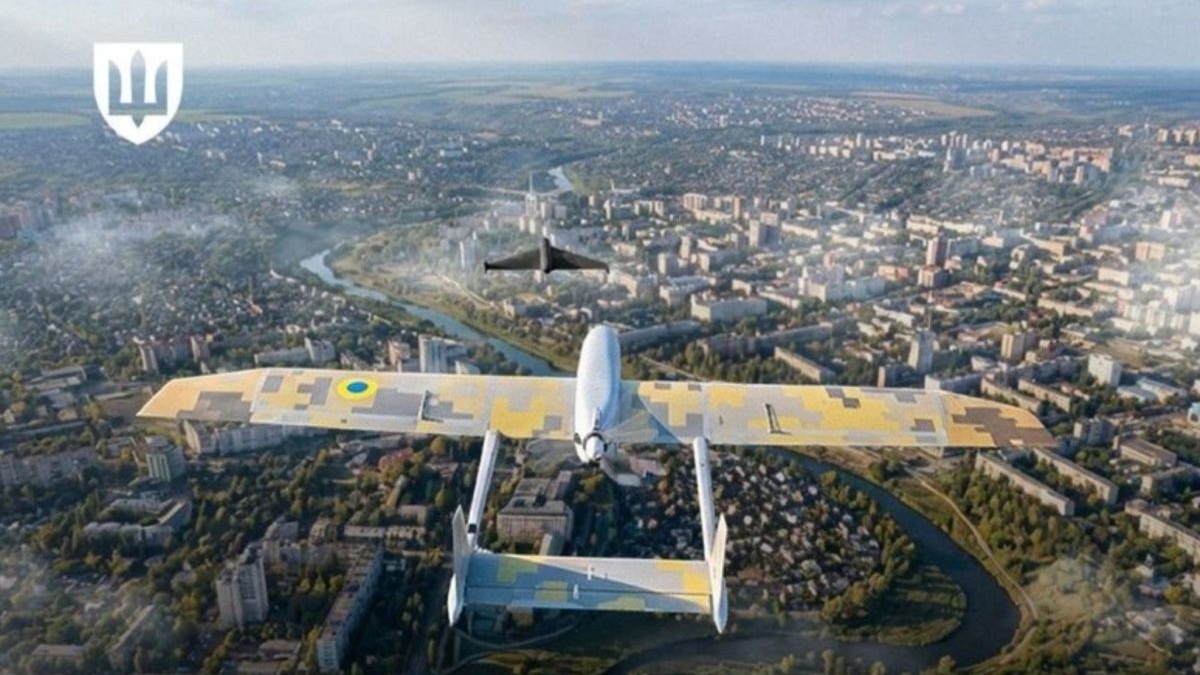
Today’s focus is on the Ukrainian interceptor drone “Shvidun,” which has been officially codified and approved for service within the Armed Forces of Ukraine.
In March 2026, the Ministry of Defense of Ukraine formally codified and authorized the deployment of a new domestically developed unmanned aerial system (UAS), “Shvidun” (also referred to as Vidun or ShVIdun). This system represents a specialized platform rather than a general-purpose drone, designed specifically as an interceptor to counter mass aerial threats.
Read also: Everything About Ukrainian Interceptor Drone JEDI Shahed Hunter
TABLE OF CONTENT:
“Shvidun”: An Operational Response to Mass Drone Attacks
“Shvidun” has demonstrated effectiveness as a countermeasure against Russian strike and reconnaissance UAVs, including Shahed-136 (referred to in Russian nomenclature as “Geran”), as well as systems such as Gerbera, Zala, Supercam, and Skat. Owing to a relatively high interception rate and an application concept tailored for this role, the system has reportedly neutralized approximately one hundred targets and continues to contribute to strengthening air defense, particularly in urban areas.

A key advantage of “Shvidun” lies in cost efficiency. In a context where the adversary relies on the large-scale use of relatively inexpensive loitering munitions, employing high-cost surface-to-air missiles becomes resource-intensive. The Ukrainian approach offers an asymmetric response: a lower-cost interceptor that can effectively engage targets within its class without overburdening air defense systems.
More broadly, the “Shvidun” UAS reflects an emerging operational logic in modern warfare – rapid engineering adaptation, scalability in production, and reliance on technologically simpler but numerous systems. Such approaches contribute to sustaining defensive capacity under conditions of prolonged conflict and continuous pressure on critical infrastructure.
Read also: Weapons of Ukraine’s Victory: High-precision APKWS II Missile
Development and Adoption
The development of “Shvidun” took place under conditions of full-scale war, as part of a broader effort to scale interceptor drone capabilities. Ukraine has already fielded a range of similar systems, including P1-Sun and JEDI Shahed Hunter; however, “Shvidun” stands out in terms of operational stability, potential for reuse, and effectiveness during mass nighttime attacks.
From the outset, the system was designed as a response to adversary tactics involving the extensive use of Shahed-136 for strikes against critical infrastructure and for exhausting air defense resources. In this context, the need for cost-effective, scalable, and efficient interceptors became critical. “Shvidun” addresses this requirement by enabling engagement of comparable targets without reliance on more expensive missile-based systems.
According to the Ministry of Defense of Ukraine, scaling such systems is a key element of the current defense strategy. This approach focuses on building a multi-layered air defense architecture capable of near real-time identification of aerial threats and achieving interception rates close to the maximum feasible level.
On March 31, 2026, the ministry officially announced the codification of the system. Initial “Shvidun” UAS units are already on combat duty, integrated into the broader air defense network and contributing to the protection of Ukrainian cities. According to sector assessments, it is among the more effective domestically developed interceptor drones in engaging targets such as the Shahed-136, supporting the viability of the chosen technological and operational approach.
Read also: Mission Control: How Ukraine Is Building a Unified Digital Brain for Drone Warfare
Design Features, Advantages, and Technical Characteristics
The “Shvidun” UAS is a compact yet technically balanced fixed-wing interceptor drone, optimized for sustained operation under combat conditions. Its airframe is based on modern composite materials that combine structural strength with low weight. This balance is a critical factor in achieving maneuverability, speed, and energy efficiency.
Key Technical Parameters:
- Weight: approximately 8 kg
- Wingspan: nearly 2 meters
- Operational altitude: up to 6 km
- Maximum speed: over 250 km/h
- Operational range: more than 70 km
- Endurance: over 2 hours
These characteristics enable the system to effectively cover airspace over large urban areas and engage targets at considerable distances from the launch point.
Particular attention should be given to its flight and operational properties. The “Shvidun” UAS features relatively low takeoff and landing speeds, which simplifies deployment in field conditions and allows for reuse even after an unsuccessful interception attempt. This capability has a direct impact on overall cost efficiency and operational sustainability.
From an engineering perspective, the airframe is designed to minimize flutter – an aeroelastic phenomenon that typically occurs at higher speeds. Reducing this effect improves platform stability during maneuvering and, importantly, ensures clearer and more stable video output from onboard sensors. For the operator, this translates into improved target identification and greater accuracy during the terminal phase of interception.
Overall, the “Shvidun” UAS can be characterized as a balanced system in which aerodynamics, materials, and onboard electronics are integrated to support consistent performance under contemporary operational conditions.
Read also: Weapons of Ukraine’s Victory: Magic 2 Air-to-Air Missile
How the “Shvidun” Operates
The “Shvidun” belongs to the class of specialized interceptor drones designed for kinetic target engagement, either through ramming or controlled contact detonation. A typical operational scenario involves detecting an aerial target (either by an operator or through integration with surveillance systems), tracking it, approaching, and neutralizing it at an optimal interception point.
By combining speed, altitude capability, and flight stability, the “Shvidun” is capable of engaging a range of targets, particularly Shahed-136 drones, which travel at speeds of 150–180 km/h, as well as faster reconnaissance UAVs. Interception can be conducted in both manual mode and with automated assistance, particularly during the terminal guidance phase, where precision and reaction speed are critical.
One of the main advantages of the system is the reusability of the interceptor. In the event of a lost target or a change in the tactical situation, the drone can safely return to base, undergo maintenance, and be redeployed for subsequent missions. This distinguishes it from single-use FPV solutions, which operate under a “one sortie – one target” logic.
From an operational perspective, this creates a different cost and efficiency dynamic. A single unit can carry out multiple interceptions, reducing the cost per neutralized target and enhancing the overall resilience of the air defense system during prolonged or concentrated attacks. Essentially, the “Shvidun” combines the capabilities of an interception tool with those of a reusable standby platform, a feature particularly relevant during night-time wave attacks.
Read also: Everything About the P1-Sun – SkyFall’s Ukrainian Interceptor Drone
Combat Deployment and Effectiveness
During a relatively short period of operational use, the “Shvidun” has shown measurable results. According to confirmed reports from Ukrainian Armed Forces units, approximately one hundred enemy UAVs have been neutralized with its assistance, with numbers expected to increase as the system is further deployed.
The system is effective not only against slower targets such as the Shahed-136, but also against faster and more maneuverable reconnaissance platforms, particularly at medium and high altitudes. In these airspace layers, traditional air defense assets sometimes demonstrate lower cost-effectiveness or limited fire density, whereas interceptor drones allow for increased coverage and control.
The operational range of the “Shvidun” enables the creation of localized aerial “shields” over major cities and critical infrastructure. When integrated with other systems, such as platforms like the JEDI Shahed Hunter, it functions as part of a multi-layered defense network, where each component addresses specific niches in altitude, range, and target type.
Subject matter experts note that the “Shvidun”’s competitive advantage does not rely on a single characteristic, but rather on the combination of features: a stable video platform, sufficient operational range, a high probability of target engagement, and reusability. Collectively, these factors position the system as one of the most balanced and effective Ukrainian interceptor drone solutions, particularly in the context of countering massed aerial attacks.
Read also: Weapons of Ukraine’s Victory: Sting UAV Interceptor
Significance for Ukraine’s Defense
The introduction of the “Shvidun” represents more than an additional weapon system; it reflects a broader evolution in Ukrainian defense capabilities. In a context where the adversary relies on attrition tactics against air defense through mass UAV attacks, systems like this allow for a more efficient allocation of resources. Expensive surface-to-air missiles can be reserved for higher-value or more complex targets, while interceptor drones handle large-scale threats, such as Shahed-136-class UAVs.
The “Shvidun” integrates into a multi-layered air defense architecture, complementing mobile fire units, radar assets, and conventional missile systems. This approach creates a denser and more flexible interception environment, where each component performs its role with optimized efficiency.
This development illustrates how engineering innovation and rapid adaptation to adversary tactics enable Ukraine not only to maintain defense but also to impose its own technological logic on the conflict. Essentially, it represents a shift toward a model in which scalable, relatively low-cost, and quickly updatable solutions play a decisive role.
In the near term, an increase in serial production of the system is expected, along with further evolution in both electronics and guidance algorithms, as well as integration with other air defense elements. Each new “Shvidun” unit represents not only an additional piece of equipment but also a tangible contribution to the protection of critical infrastructure, civilian safety, and overall national resilience.
Ukraine’s airspace is gradually becoming a complex, multi-layered defensive environment, with systems like the “Shvidun” forming a central component of this transformation.
Read also: