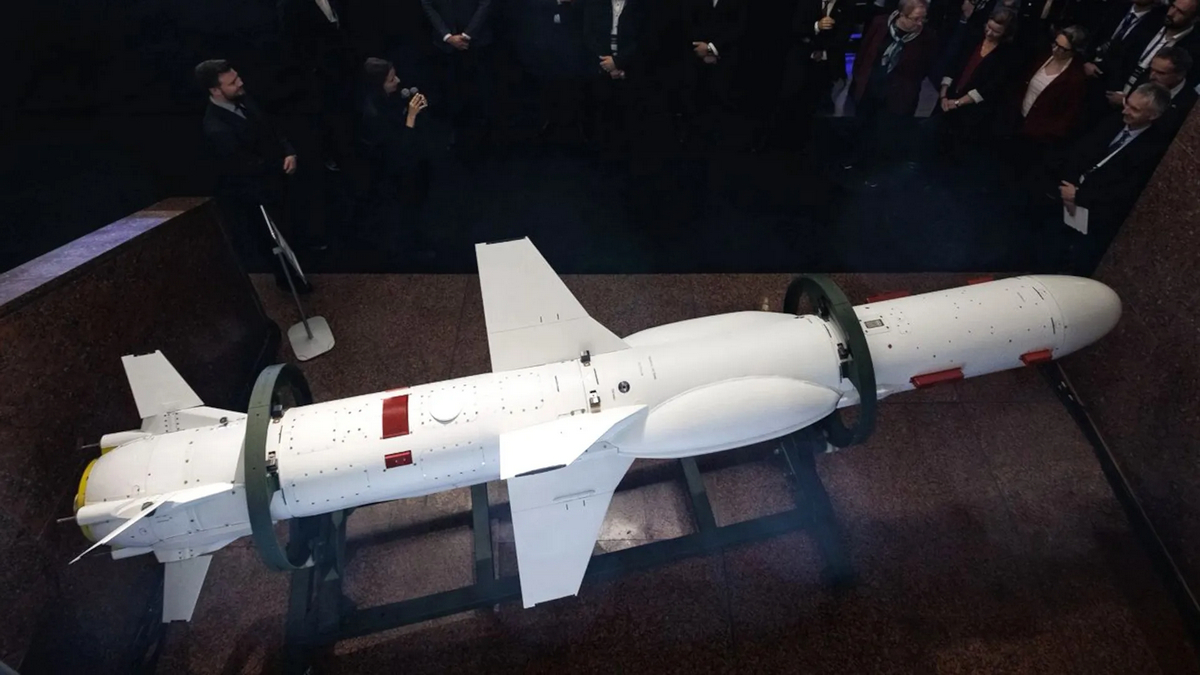
A new modification of the “Neptune” cruise missile has been unveiled in Ukraine. Based on available photos, the missile features additional bulged elements on its fuselage – likely external fuel tanks designed to extend its operational range. Judging by its appearance, this variant appears to occupy an intermediate position in range and capability between existing versions and the more extensively upgraded “Long Neptune” model.
Ukrainian Defense Minister Denys Shmyhal shared a photo of the new “Neptune” today on social media. The image was taken during a visit by Lithuanian Prime Minister Inga Rušinienė and other Western delegates. During the visit, guests were also shown several previously known examples of Ukrainian weaponry, including the “Peklo” missile drone and the “Magura-7” unmanned surface vessel equipped with R-73 air-to-air missiles.
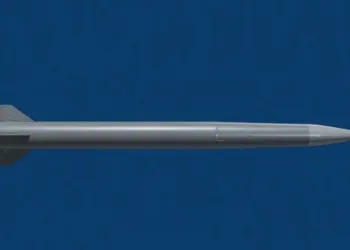
The baseline Neptune, designated R-360, was designed primarily as an anti-ship missile but can also be employed against land targets. Its design is an evolution of the Soviet Kh-35, which remains in service with Russian and other armed forces. Modern Neptunes differ from the Kh-35 not only in subsystem characteristics but also in external shape – most notably the main control surfaces, which feature a stepped or “curved” profile. The missile is powered by a small turbojet engine and, according to its developer, the Promin design bureau, has a reported maximum range of up to 300 km.

Since 2023, a Neptune variant adapted specifically for strikes against land targets has also been in service. Reportedly, this version combines an inertial navigation system with GPS support and an infrared imaging sensor in place of the original active radar seeker. A Ukrainian military representative speaking to TWZ previously stated that the flight range of this variant is at least 360 km.
The new modification shown to Prime Minister Rušinienė and other Western officials features two noticeable bulges on either side of the forward fuselage, located immediately ahead of the main stabilizers. Although their purpose has not been officially confirmed, the most likely explanation is auxiliary fuel tanks. Adding fuel is a relatively straightforward and practical way to increase range without a major redesign of the basic airframe. Such an addition could also offset an increase in mass if a heavier warhead were fitted, although that explanation appears less likely given known design choices for the Neptune.
Of course, other functions for these fairings cannot be ruled out, but at present there is no more plausible explanation than additional fuel tanks. Based on what is known about the internal layout of the Kh-35 family, the zone in question typically houses navigation equipment and avionics. The warhead is usually located immediately forward of that section, while the primary seeker is fitted in the nose.
Extending the range of the baseline Neptune would create an intermediate capability between the standard R-360 and the more heavily upgraded RK-360L. That would allow RK-360L to be reserved for missions requiring maximum range, while the modified R-360 could serve as a lower-cost or simpler production option. It is also possible that the increased range could be achieved by upgrading existing missiles rather than only through new production.
Such a range extension would have operational implications for both maritime and land strikes. On the maritime side, it would increase the threat envelope against surface vessels; for strikes against land targets, it would expand the set of targets reachable without resorting to the longest-range variant.
Existing versions of Neptune have already demonstrated their significance in combat operations: according to Ukrainian Navy spokesman Dmytro Pletenchuk, interviewed by Dzerkalo Tyzhnia, over the past year the Ukrainian Navy has successfully hit more than 50 Russian targets with Neptune missiles.
The expansion of the Neptune family also reflects Ukraine’s broader strategy of increasing and localising arms production. Ukrainian President Volodymyr Zelensky has emphasised the goal of bringing the share of domestically produced ammunition used on the front lines to 50% by the end of the year. According to him, partnerships with foreign countries are an important part of the plan to achieve this goal. Perhaps the current work on various modifications of Neptune and the process of their production are already benefiting from cooperation with partners and allies.
Source: TWZ