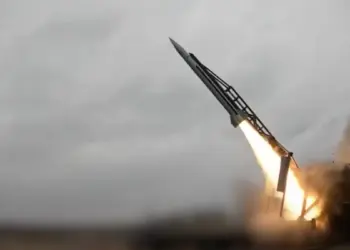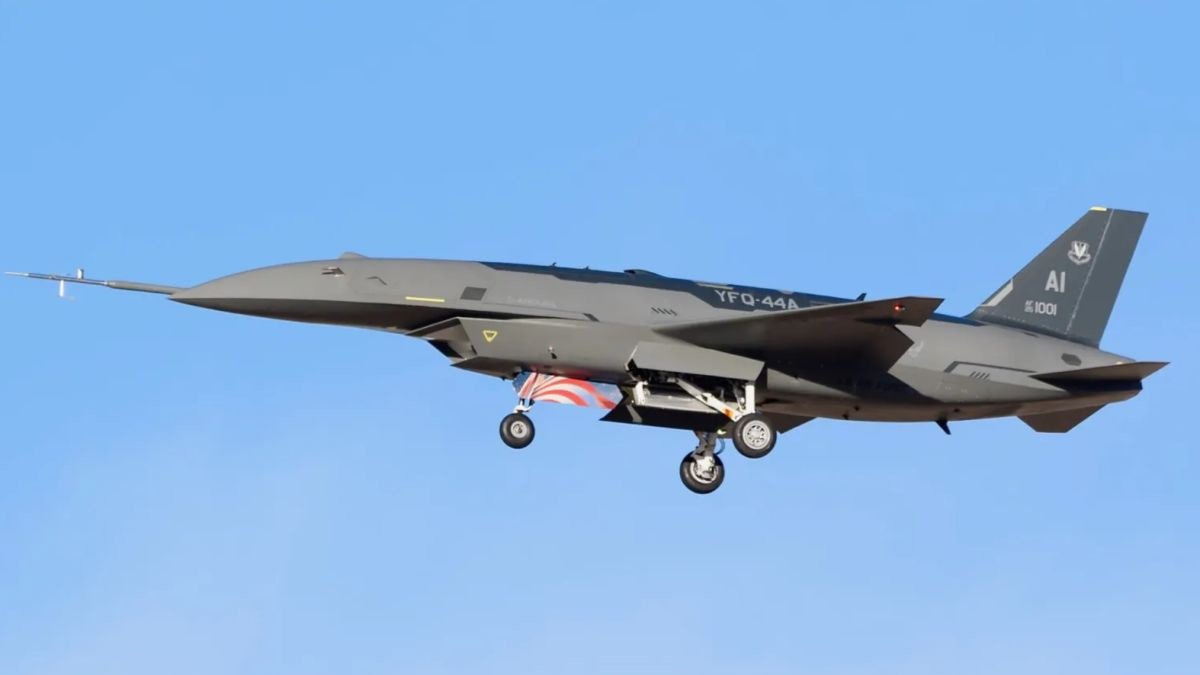
Today, we’ll take a closer look at the combat trials of the YFQ-44A unmanned fighter, developed by Anduril Industries.
Over the Mojave Desert, the aircraft accomplished something no operational U.S. Air Force drone had done before: it launched a live air-to-air missile at a target under the command of a remote operator who was not physically present at the launch site. On the surface, the event appears technically straightforward – one aircraft, one missile, one target. Yet behind that simplicity lies a milestone the U.S. Air Force has been working toward for years, one that is now beginning to take tangible shape.
TABLE OF CONTENT:
From Concept to Reality: What Is Collaborative Combat Aircraft?
The Collaborative Combat Aircraft (CCA) program was born out of a simple realization: the number of crewed fighter aircraft the United States can keep in the air at any given time is constrained not only by budget, but also by the limited pool of trained pilots and the cost of every additional cockpit. Rather than replacing crewed aircraft, CCA is designed to multiply their effectiveness. A single F-35 or F-22 pilot can operate alongside a group of unmanned wingmen, each equipped with its own sensors, electronic warfare systems, or weapons, and capable of assuming missions that would otherwise expose the human pilot to greater risk. This is no longer a futuristic concept. It has evolved into a fully fledged engineering program, with two competing prototype aircraft now under development.
The YFQ-44A, developed by Anduril Industries under the internal designation Fury, is one of two aircraft selected for the first phase of the program, known as Increment 1. The other is the YFQ-42A Dark Merlin, developed by General Atomics.

The competition between these two approaches, rather than reliance on a single prime contractor, is what defines both the pace and the direction of the program. The two aircraft are progressing through parallel test campaigns, with the Fury becoming the first to reach the milestone of launching a live air-to-air weapon.
Read also: Project Freyja: How Fire Point Aims to Close a Gap in Ukraine’s Air Defense
Test Methodology: Why This Was More Than Just a Missile Launch
Equally significant is the way the U.S. Air Force reached the point of conducting the launch itself. The process follows the same methodology that has been used for decades to certify crewed fighter aircraft. This is no coincidence, but rather a deliberate decision to apply a conservative, incremental testing approach to an aircraft that, until recently, existed only as a prototype. The first step saw the YFQ-44A fly with an inert, non-explosive version of the AIM-120 AMRAAM. The purpose of this flight was simply to verify that carrying the missile did not adversely affect the aircraft’s aerodynamic characteristics or flight handling.
Only after that did the engineering team move on to validating the data link between the aircraft and the missile itself, ensuring that the operator’s commands could be transmitted reliably and without distortion under conditions designed to simulate a combat environment. Only once both of these stages had been successfully completed did the program proceed to a live missile launch. This step-by-step approach minimizes the risk of a catastrophic failure at the most critical stage of testing, when the future of the entire program could be affected. A serious failure during weapons testing on an experimental aircraft has the potential to delay development by months – a risk the U.S. Air Force is clearly intent on avoiding.
Read also: Middle Strike: How Ukraine Is Building a New Class of Medium-Range Strike Systems
A Human Pulls the Trigger: The Architecture of Lethal Force Control
Perhaps the most important aspect of these trials – and the one most consistently emphasized by U.S. officials – has little to do with the drone’s technical capabilities. Instead, it concerns the division of authority between the machine and its human operator. Although the YFQ-44A is capable of flying and maneuvering with a high degree of autonomy, the decision to employ weapons is never delegated to the onboard systems. A human operator retains full command and control of the platform, and the aircraft is designed so that every weapons release requires explicit human authorization. This is not merely a technical implementation detail. It is a deliberate architectural principle that reflects the legal and ethical responsibilities associated with any system capable of employing lethal force.
It is worth noting that the phrase “a human always pulls the trigger” serves both as a technical statement and as a carefully crafted public message. The U.S. Air Force is well aware of the sensitivity surrounding autonomous weapons systems in both public and international debate, and has consistently emphasized the distinction between autonomy in flight operations – where the aircraft can genuinely operate on its own – and autonomy in the use of lethal force, where the final decision always rests with a human operator. Whether this distinction will remain unchanged as combat scenarios become more complex and decision-making timelines continue to shrink is a question that analysts are likely to keep asking. Official statements from either the manufacturer or the Air Force, while important, should not be viewed as definitive proof of how such systems will ultimately perform under the pressures of real-world combat.
Read also: Weapons of Ukraine’s Victory: FP-1 – A Drone Capable of Reaching Moscow
The Manufacturer’s Position: Between Technical Achievement and Marketing Narrative
Unsurprisingly, Anduril presents the test as evidence that its platform has reached a significant level of maturity. Mark Shushnar, the company’s Senior Vice President for Autonomous Air Systems, described the event as an end-to-end beyond-visual-range engagement against a simulated target. According to his account, the sequence covered the entire operational chain – from takeoff at Edwards Air Force Base, through target-track acquisition via Anduril’s Lattice software platform, to the actual missile launch following a formal engagement authorization from the human operator. The wording is deliberately chosen to distinguish the event from a scripted technology demonstration. Anduril’s position is that this was not a staged proof of concept, but a realistic operational scenario executed under representative conditions.
It is important, however, to maintain an analytical perspective. Any trial organized and overseen by both the manufacturer and the customer is, by definition, conducted in a controlled environment: the target is known, the airspace is restricted, and the support team is fully prepared. None of this diminishes the technical significance of the achievement. It does, however, mean that claims such as “demonstrates the maturity of the program” should be viewed as part of a marketing narrative supported by a genuine – yet still isolated – technical milestone, rather than as conclusive evidence of combat readiness in a contested operational environment against an actively capable adversary.
Read also: Everything About the P1-Sun – SkyFall’s Ukrainian Interceptor Drone
The View from the Top: Military Leadership’s Messaging and Its Limits
The differences in emphasis among senior officials are equally revealing. Air Force Chief of Staff General Ken Wilsbach described the test as a significant step forward for the Collaborative Combat Aircraft program, bringing the point closer at which these capabilities will be delivered to operational fighter forces. His wording highlights the program’s operational objective rather than its purely experimental nature. Lieutenant General Dale White, who oversees the Air Force’s portfolio of critical weapon systems, focused instead on the transition from carrying an inert missile to actually employing a live weapon. In his view, this milestone demonstrates that the program has progressed beyond the earliest prototype stage while also providing an opportunity to validate digital integration models using real flight-test data rather than simulations alone.
Both statements are consistent and, in essence, convey the same message in different terms: the program is progressing faster than the pace traditionally associated with major Pentagon acquisitions and is approaching the point where the CCA will transition from an experimental aircraft into an operational combat capability. At the same time, the consistency and carefully polished language of these remarks – typical of public statements about programs receiving active funding – should remind readers that they are part of an official communications strategy rather than independent assessments of the program’s progress.
Read also: Weapons of Ukraine’s Victory: FP-1 – A Drone Capable of Reaching Moscow
Tactical Context: Why a Fighter Needs an Unmanned Wingman
To appreciate the significance of this test, it is important to understand the tactical logic behind the CCA concept. Modern air combat increasingly depends not on the maneuverability of a single aircraft, but on the number of sensors, communication links, and weapons that can be distributed across the battlespace. A crewed fighter operating alongside several unmanned wingmen effectively gains an extended sensor envelope, additional options for deceiving enemy radar systems, and – perhaps most importantly – the ability to project both firepower and risk away from the cockpit. In a scenario involving advanced enemy air defenses or interceptor aircraft, it is the unmanned platform, rather than the crewed fighter, that can be sent into the highest-risk area first.
The decision to use the AIM-120 AMRAAM – a missile that has served as the standard air-to-air weapon for U.S. fighter aircraft for decades – rather than developing a dedicated weapon specifically for unmanned platforms is equally significant. It reflects a deliberate emphasis on integrating the CCA into the existing logistics, maintenance, and training ecosystem instead of creating a separate, more costly weapons infrastructure. This approach has the potential to accelerate the fielding of CCA aircraft with operational units, as it avoids the need to establish an entirely new production and sustainment pipeline for munitions.
Read also: Weapons of Ukraine’s Victory: Tempest Air Defense System with AGM-114L Longbow Hellfire Missiles
What This Means for the Balance of Power and Other Loyal Wingman Programs
The YFQ-44A trials are taking place against the backdrop of a broader global effort to develop unmanned loyal wingman aircraft – a concept that several other nations are also pursuing, albeit at varying levels of technological maturity. The fact that the U.S. program has become the first to progress beyond flights with inert weapons to an actual live missile launch gives the United States a meaningful advantage in accumulating operational data on integrating autonomous aircraft into the complete kill chain – from target detection and tracking to weapons employment.
At the same time, the competition between the YFQ-44A and the YFQ-42A within the Increment 1 program means that the final production platform has yet to be selected. Even if the Fury continues to perform well, the U.S. Air Force has deliberately chosen to keep both development paths active for as long as practical, reducing the strategic and industrial risks associated with relying on a single contractor.
Limitations and Open Questions
Despite the significance of the milestone, it is important to recognize what the test does – and does not – demonstrate. This was a single live missile launch conducted in a controlled test environment over a restricted range, not a combat engagement against an adversary capable of electronic warfare, communications jamming, or cyber-physical interference with the command-and-control network. Key questions therefore remain unanswered. It is still unclear how resilient the data link between the operator and the weapon would be under sustained electronic attack, or how effectively the system would enable a human operator to make timely engagement decisions during a fast-moving battle involving multiple simultaneous targets. A single successful test cannot resolve these uncertainties.
The economics of the CCA concept also remain an open issue. Whether the costs of procuring and operating these aircraft will ultimately justify the promised savings achieved by distributing the missions of a crewed fighter across several lower-cost autonomous platforms is still unknown. This argument is frequently highlighted in public messaging, but it will ultimately have to be validated by the actual procurement and lifecycle costs of the program.
Read also: Weapons of Ukraine’s Victory: The “Shvidun” Interceptor Drone
A Small Step with Far-Reaching Consequences
The YFQ-44A weapons trial should be viewed not as the culmination of the CCA concept, but as the beginning of a new phase in its validation. For the first time, the previously abstract idea of distributed combat capability has been substantiated through a successful live missile launch. The significance of the event lies not merely in the missile striking its target, but in demonstrating that the entire operational chain – from autonomous flight, through the digital command-and-control architecture, to the human operator authorizing the use of force – can function as a single, integrated system under conditions intended to approximate real-world combat.
At the same time, the messaging surrounding the event from both the manufacturer and the U.S. Air Force deserves to be viewed with a critical eye. A single successful trial conducted under controlled conditions does not, by itself, demonstrate operational combat readiness. Fundamental questions about the resilience of autonomous systems in real, contested environments – as opposed to carefully managed test scenarios – remain unresolved. Ultimately, the pace at which these questions are answered through future, less controlled testing will determine whether the CCA program becomes a genuine transformation in air warfare or joins the long list of ambitious Pentagon initiatives whose promise has outpaced their operational deployment.