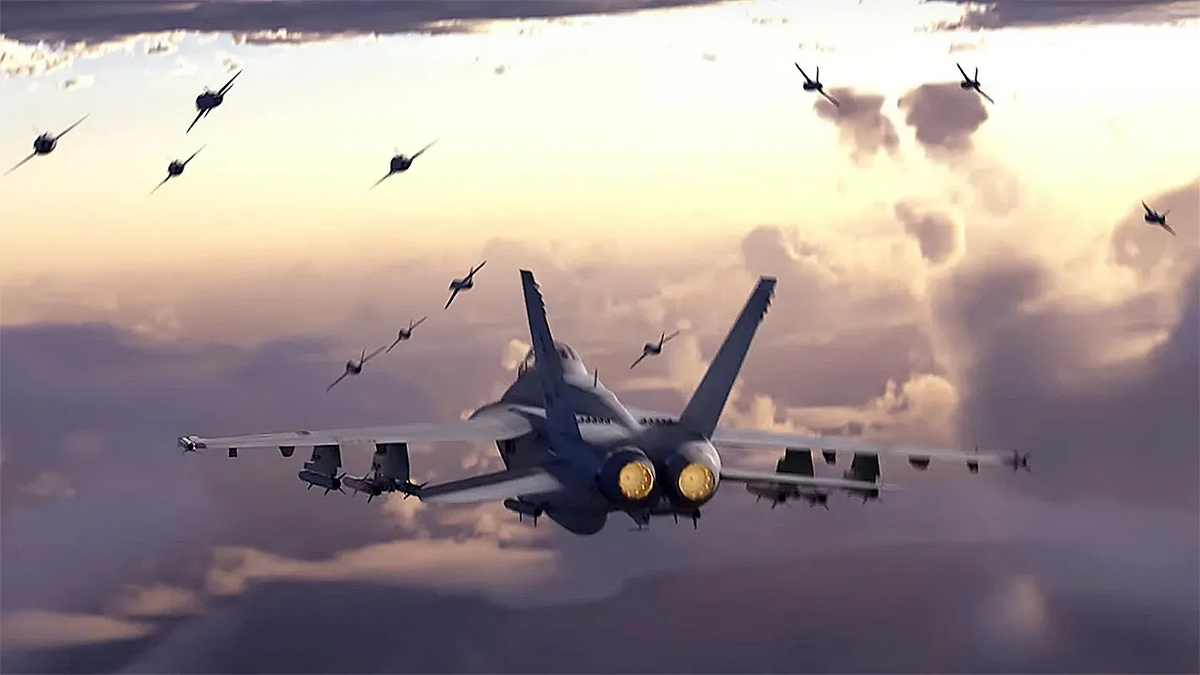
The U.S. Air Force has successfully carried out the first-ever missile launch from an uncrewed collaborative combat aircraft developed under the Collaborative Combat Aircraft (CCA) program. The test was conducted in partnership with defense company Anduril Industries, with the YFQ-44A unmanned aircraft serving as the test platform. During the exercise, the aircraft launched an AIM-120 guided missile that successfully engaged a virtual target.

The development of autonomous combat aircraft designed to patrol and fight alongside conventional crewed fighter jets was always expected to reach the stage of live weapons employment. Previous missions involving drones such as the YFQ-44A were limited to carrying weapons as passive payloads, without actually engaging targets.
That milestone has now been reached during a test conducted in restricted airspace over California’s Mojave Desert, where Anduril’s YFQ-44A launched an AIM-120 medium-range air-to-air missile. However, the engagement was not fully autonomous. While the aircraft independently detected, tracked, and maneuvered into a suitable firing position, the final authorization to launch the missile was given by a human operator on the ground. This approach reflects current U.S. military policy, which requires a human to make the final decision on the use of lethal force rather than allowing an autonomous system to engage targets entirely on its own.
The military has previously launched missiles from uncrewed aircraft, but those operations involved remotely piloted platforms, with every maneuver controlled by a human operator from the ground. The latest test, conducted with support from the U.S. Air Force’s 412th Test Wing and the Joint Integrated Test Force for Air Dominance, represented a far more advanced demonstration than simply releasing a weapon at pre-programmed coordinates.
This time, the aircraft executed a dynamic air combat scenario largely controlled by onboard software. Using Anduril’s proprietary Lattice software platform, the system scanned the airspace, identified and tracked the target, and calculated the optimal interception trajectory. Human involvement was limited to a single step – authorizing the missile launch. Once approval was given, the autonomous system resumed control and carried out the launch sequence.
Major General Dale White, who oversees the U.S. Air Force’s portfolio of critical weapons programs, said that the transition from carrying inert missile mock-ups earlier this year to executing a live missile launch demonstrates the project’s growing maturity. According to him, the successful test validates the accuracy of the digital integration models using real-world operational data.
He also noted that the demonstration confirms the ability of collaborative uncrewed aircraft to autonomously perform the entire weapons employment sequence within parameters defined by a human pilot. This capability, he added, is expected to accelerate the introduction of next-generation defense technologies into operational service.
Read also:
- 50,000 Attack Drones: Germany to Finance One of the Largest UAV Procurements for Ukraine
- Foundation of the FREYJA System: Ukraine Unveils the FP-7.X Interceptor Missile for Countering Russian Ballistic Threats
Source: newatlas