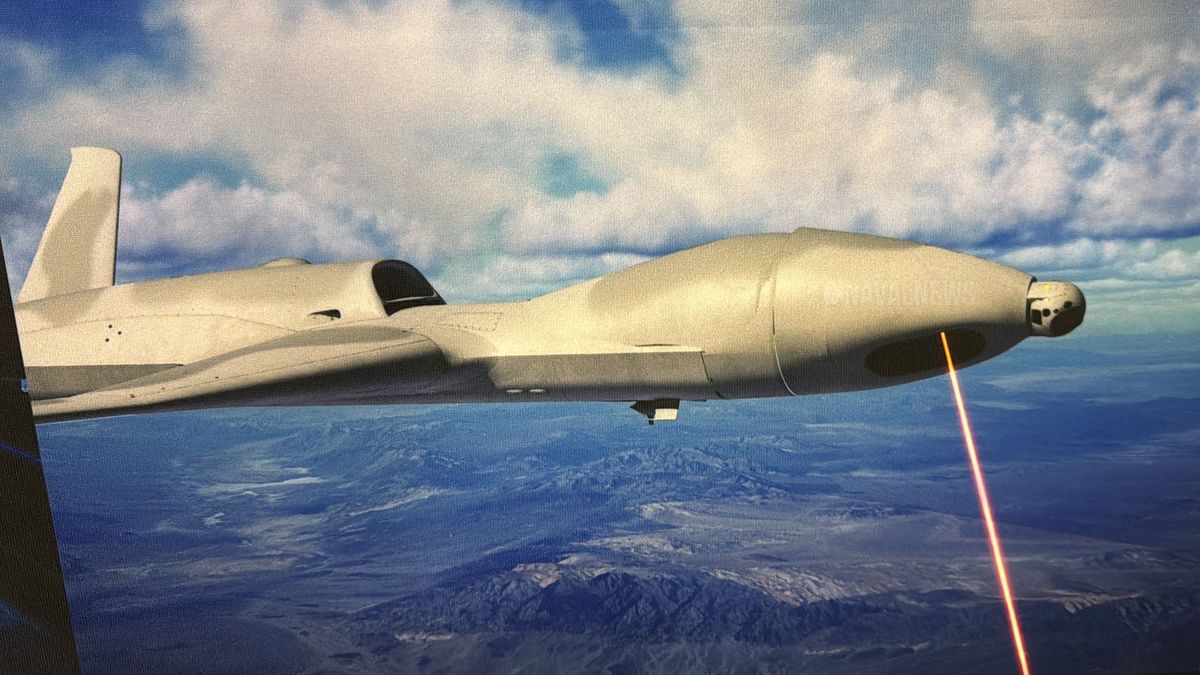
General Atomics has released a conceptual rendering of the MQ-20 Avenger combat drone equipped with a directed-energy laser weapon. The image depicts a laser beam emerging from a rotating turret mounted in place of the aircraft’s conventional nose section. While the company emphasizes that the illustration represents a concept, it reflects ongoing research into the potential integration of laser systems on unmanned aerial vehicles, particularly within the Gambit family. This suggests that the technology may be closer to practical implementation than it appears.

The MQ-20 Avenger with a laser was first shown at the AUSA 2025 exhibition. This is not a real photo, but it demonstrates General Atomics’ vision for the future of unmanned combat aircraft. Laser systems have the potential to deliver high-speed, high-precision targeting, an almost unlimited ammunition supply with sufficient power and cooling, and the ability to conduct silent and stealthy attacks. At the same time, they have weaknesses due to power limitations and environmental factors.
The image shows the MQ-20 Avenger featuring a redesigned nose section that rotates and emits a beam through a dedicated aperture. At the front, a sensor turret houses optical and infrared cameras, along with laser rangefinders and target designators – equipment similar to that previously integrated into Avenger drones. The primary operator of these unmanned aircraft is believed to be the U.S. Central Intelligence Agency, although officially the MQ-20 series is described as serving primarily as an experimental, low-observable test platform.
‘Visitors to AUSA saw a rendering and a short video about the MQ-20 Avenger with a high-energy laser (HEL) system. Both of these products exist at General Atomics, and we are using them to describe a concept, not a specific programme or contract,’ said General Atomics spokesman Mark Brinkley. ‘The purpose of the demonstration was to show that General Atomics continues to lead the way in the research and development of both combat laser systems and unmanned combat aircraft.’ He noted that the images of the Avenger and the laser should not be given too much importance, as the final version could take many forms. For example, as a system on the MQ-9B or Gray Eagle, or as an integrated weapon on the Gambit family of aircraft.
The Gambit family, introduced in 2022, is built around a modular architecture: a common chassis and control suite that can accept interchangeable airframes tailored to different mission sets. The XQ-67A prototype, developed under the U.S. Air Force’s Off-Board Sensing Station effort, demonstrated the practical benefits of that modular approach. Subsequent work has transitioned into the YFQ-42A effort, now being pursued as part of the Collaborative Combat Aircraft (CCA) program.
General Atomics has extensive experience in developing laser weapons. Its GA-EMS division worked on the High Energy Liquid Laser Area Defense System (HELLADS), designed to intercept rockets, mines, and artillery shells. It remains unknown whether this system has undergone real testing on the Avenger platform. At the same time, Lockheed Martin was developing similar technologies for the U.S. Missile Defense Agency, but the program was halted in 2020 due to technical difficulties.
In April, General Atomics unveiled another concept: a laser module for the MQ-9 Reaper family intended to defeat hostile loitering munitions. Similar technologies are being explored by Raytheon, Northrop Grumman and Boeing. Laser weapons are also being considered as part of the Next Generation Air Dominance (NGAD) initiative, which encompasses development of the sixth‑generation F‑47 fighter and the Collaborative Combat Aircraft (CCA) unmanned systems. Advances in solid‑state lasers and component miniaturization are pushing these systems out of the laboratory and toward practical deployment.
Read also:
- Ukraine and Sweden Sign Memorandum of Intent to Acquire Up to 150 Gripen Fighter Jets
- Sikorsky Unveils Nomad Drone Series for Maritime and Land Missions
Source: twz