• • CONTACTS
  • • PRIVACY POLICY
  • • GADGETS & TECHNOLOGIES
AERONAUT.media
  • NEWS:
  • • Aviation
  • • UAVs & drones
  • • Flying weapon
  • • Space
  • ARTICLES
  • Language:
  • EN
  • UA
No Result
View All Result
  • NEWS:
  • • Aviation
  • • UAVs & drones
  • • Flying weapon
  • • Space
  • ARTICLES
  • Language:
  • EN
  • UA
No Result
View All Result
AERONAUT.media
No Result
View All Result
Home Articles

Weapons of Ukraine’s Victory: Windracers Ultra Mk 2 heavy logistics UAV

Yuri Svitlyk by Yuri Svitlyk
22/12/2025
in Articles
0
blank
16
SHARES
294
VIEWS

Ukraine has recently received several dozen Windracers Ultra Mk 2 heavy logistics UAVs, which are capable of delivering payloads of up to 150 kg to frontline areas. This development warranted closer examination, as it provides an opportunity to assess the characteristics and potential applications of these British-made heavy logistics drones. The following sections review the system in a structured manner.

Read also: Everything About the P1-Sun – SkyFall’s Ukrainian Interceptor Drone

TABLE OF CONTENT:

  • British Contribution to Ukraine’s Unmanned Logistics Capability
  • Development Milestones
  • Design and Capabilities of the Ultra Mk 2
  • Autonomy and Control: Foundations for Safe and Scalable Operation
  • Specifications of the Ultra Mk 2 UAV (short version)
  • Applications in Ukraine: From Frontline Logistics to Humanitarian Missions
  • Impact of the Ultra Mk 2 on Ukrainian Logistics and Defense

British Contribution to Ukraine’s Unmanned Logistics Capability

Since 2022, the United Kingdom has been one of Ukraine’s key partners in the development and scaling of unmanned systems, including aerial platforms across multiple categories. This cooperation has not been limited to the delivery of finished systems; it has also included the transfer of components, technical assistance, and support for establishing local production capacity. According to official information from the UK Ministry of Defence, approximately £600 million has been allocated to these programs during the current year alone. These investments have resulted in the delivery to Ukraine of around 85,000 unmanned systems and related equipment, ranging from reconnaissance and strike platforms to logistics-oriented solutions.

An important element of this cooperation was an exhibition held in November at the UK Parliament, focused on supporting the development of Ukrainian unmanned technologies. The event served not only a demonstrative function but also a political and economic one, as it helped identify the companies directly involved in assistance programs for Ukraine. Among the participants, Windracers Ltd. stood out as a relatively young market entrant, founded only a few years ago, yet one that has already demonstrated measurable practical outcomes.

Ultra Mk 2

Windracers’ participation in the parliamentary exhibition itself indicated the company’s involvement in defence-related programs connected to Ukraine. However, at the time, no details were disclosed regarding the scope or nature of this involvement. Greater clarity emerged later. On 12 December, BFBS Forces News – part of the UK Ministry of Defence media network – published a report on Windracers’ current activities, technological developments, initial results, and future plans. As previously assumed, the company is indeed involved in the production of unmanned systems for Ukraine and has already reached a stage where tangible outcomes can be observed.

Earlier this year, Windracers introduced its new development, the Ultra Mk 2 heavy transport unmanned aerial vehicle. As of now, the platform has completed the required testing cycle and entered serial production. A substantial portion of the manufactured systems is intended for Ukraine. Available information indicates that several dozen of these drones have already been delivered, with additional shipments expected in the near term. At the same time, specific production volumes, delivery schedules, and the total number of Ultra Mk 2 units produced have not been disclosed for security reasons. The same applies to details related to manufacturing arrangements, funding, and logistics.

Windracers’ management states that the new UAVs have already been deployed in combat zones and are being used for operational logistics tasks. The company maintains ongoing communication with operators in the field and regularly receives feedback on system performance under combat conditions. This operational experience has informed further development of the project, with iterative improvements to the airframe, software, and overall performance implemented in short development cycles. According to company representatives, certain updates and design changes are introduced on an almost weekly basis, reflecting a contemporary approach to military-technical development under conditions of active conflict.

Ultra Mk 2

For Ukraine, this platform has become a significant asset in both military support and humanitarian logistics. In the context of a prolonged conflict, the demand for autonomous, secure, and reliable systems capable of delivering critical supplies has become a strategic priority, and the Ultra Mk 2 addresses this requirement in a practical manner.

The Windracers case and the development of the Ultra Mk 2 illustrate how Western defence companies are adapting their technologies to Ukrainian operational experience and battlefield requirements. At the same time, Ukraine increasingly functions as a real-world testing environment for the accelerated development of unmanned technologies, particularly in the field of military logistics.

Read also: Rafale for Ukraine: What Kind of Aircraft Is It and What Could It Mean?

Development Milestones

Windracers is a British aviation technology company specializing in the design and production of autonomous cargo unmanned aerial vehicles. Founded in 2017 and headquartered in Southampton, the company focuses on making long-range autonomous air transport more accessible and cost-effective for both civilian and military applications.

The first iteration of the Ultra unmanned aircraft was developed in the previous decade as an experimental platform intended to validate the concept of a heavy cargo UAV. At that stage, the primary objective was to assess whether a relatively simple, low-cost, fixed-wing unmanned aircraft could be produced and operated efficiently while performing regular long-distance logistics missions. The experience gained during this early phase formed the basis for the subsequent evolution of the program.

Ultra Mk 2

The company’s aircraft underwent their first operational trials in late 2020, when the Ultra UAV successfully delivered medical supplies to remote islands in the United Kingdom. Subsequently, the project became one of the key components of UK trials focused on autonomous logistics solutions, including applications for the Royal Navy.

In 2023–2024, the developer moved on to creating a substantially upgraded version, designated Ultra Mk 2. This effort went beyond a minor update and involved a comprehensive redesign to address new requirements, primarily of a military nature. The completed prototype was publicly presented for the first time in January 2025. It then completed a full cycle of flight and ground testing, confirming its stated performance characteristics. Notably, the Ultra Mk 2 did not remain a purely demonstrative platform: it attracted the interest of military customers, leading to procurement decisions and the launch of serial production.

Read also: Weapons of Ukraine’s Victory: Sting UAV Interceptor

Design and Capabilities of the Ultra Mk 2

The Ultra Mk 2 belongs to the class of fixed-wing transport UAVs intended for carrying a wide range of payloads over extended distances. During the design process, particular emphasis was placed on simplifying the structure and reducing production costs without introducing critical performance trade-offs. One of the key engineering choices was the use of an all-aluminium airframe, which provides adequate structural strength and ease of repair while allowing the use of standard manufacturing methods and materials commonly available on the civilian market.
Ultra Mk 2

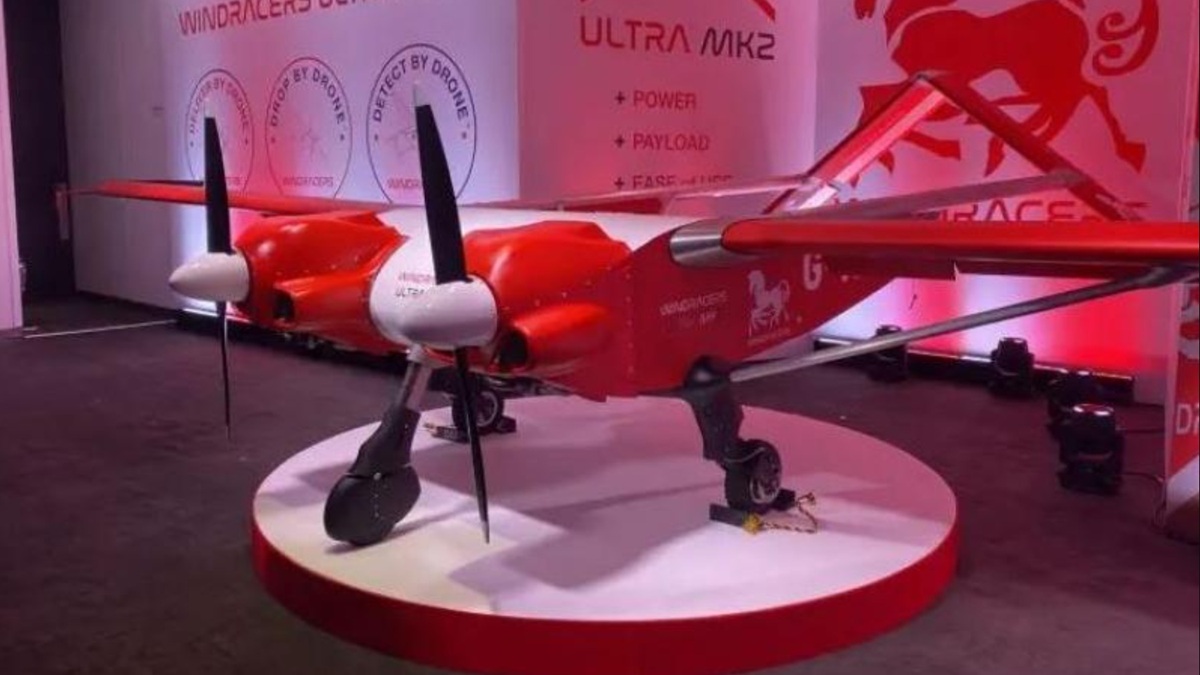
From a structural standpoint, the UAV is built around a twin-boom configuration. It features a relatively short but wide fuselage optimized for payload accommodation. A high-mounted straight wing is attached to the sides of the fuselage, a layout that improves aerodynamic efficiency and facilitates operation from unprepared or temporary airstrips. The rear section consists of two tubular booms supporting an L-shaped tail assembly. The landing gear is a conventional fixed tricycle configuration, which further reduces mechanical complexity and enhances survivability in field conditions.

The Ultra Mk 2 has a wingspan of approximately 9.3–10 meters, while the overall length is significantly shorter, underscoring its role as a cargo-focused platform. The exact maximum takeoff weight has not been disclosed; however, based on the stated payload capacity and overall dimensions, the system can be classified within the heavy tactical UAV category.

The propulsion system consists of two commercially available piston engines of civilian origin, each rated at approximately 50 horsepower. This configuration provides several practical advantages, including thrust redundancy, improved reliability, and the ability to repair or replace powerplant components relatively quickly. In its current configuration, the Ultra Mk 2 achieves a cruise speed of around 140–150 km/h, with a maximum speed of up to 200 km/h. The stated operational range is up to 1,000 km, and the developer is already working on upgrades intended to roughly double this figure.

Ultra Mk 2

The control system aligns with current standards for UAVs in this class. It includes an onboard autopilot, satellite navigation systems, and remote control links. Particular emphasis is placed on the use of jam-resistant antennas and solutions designed to maintain controllability and navigation under conditions of active electronic warfare. For military applications, this capability is critical, as logistics UAVs often operate within the effective range of adversary electronic countermeasures.

The primary role of the Ultra Mk 2 remains cargo transport. Payloads are accommodated within the internal fuselage volume near the wing center section. The rear fuselage incorporates a large hinged door, providing direct access to the cargo bay and simplifying loading and unloading procedures. Smaller payloads can be delivered by parachute, enabling resupply without landing. In addition, the airframe allows for the installation of mission-specific equipment to support other roles, ranging from reconnaissance to communications relay.

Ultra Mk 2

In its current configuration, the Ultra Mk 2 is capable of carrying a payload of up to 150 kg. The dimensions of the cargo compartment allow for the transport of a broad range of supplies required by military units, including ammunition, food, medical supplies, spare parts, and specialized equipment. The developer indicates that an increase in payload capacity to 200 kg is planned in the near term, which would further expand the platform’s potential use cases.

The combination of these characteristics contributes to the Ultra Mk 2’s relevance for Ukrainian units. A payload capacity of up to 150 kg enables targeted logistics missions without relying on larger and more vulnerable transport assets. An operational range of up to 1,000 km allows missions to be conducted at considerable depth, bypassing areas exposed to heavy fire or minefields. An endurance of 7–10 hours supports deliveries to remote locations without intermediate landings, while a cruise speed of approximately 143 km/h supports timely resupply under active combat conditions.

In summary, the Ultra Mk 2 can be viewed not merely as another unmanned aircraft, but as a purpose-built military logistics tool adapted to the conditions of contemporary warfare. It combines relative structural simplicity, suitability for serial production, and sufficiently strong performance characteristics, making it a representative example of how unmanned systems are increasingly assuming roles that were previously handled exclusively by crewed transport platforms.

Read also: Weapons of Ukrainian Victory: Multi-Purpose Helicopter UH-60 / S-70A Black Hawk

Autonomy and Control: Foundations for Safe and Scalable Operation

A key advantage of the Ultra Mk 2 is its high level of autonomy, which directly impacts the safety and efficiency of its operations. The UAV is equipped with Windracers’ proprietary autopilot system, capable of managing a fully autonomous flight cycle – from takeoff and climb, through route navigation, to landing at a designated point. This reduces the need for constant operator involvement and lessens personnel workload, a factor of particular importance in high-intensity combat environments with limited human resources.

Complementing the autopilot is the Mission Control software suite, which functions as a centralized digital management system for the UAV. It enables detailed route planning that accounts for terrain, range, fuel reserves, and potential hazards, while also providing real-time monitoring of the aircraft’s status. Operators have access to key telemetry data and can adjust the flight plan mid-mission or alter the route in response to changing operational conditions.

Ultra Mk 2

It is also noteworthy that the Ultra Mk 2 is capable of operating beyond the visual line of sight (BVLOS) of its operator, a feature of critical importance in military contexts. This capability allows the UAV to cover long distances, traverse frontline and near-frontline areas, and operate in regions where conventional ground transport or manned aircraft would face excessive risk. In practical terms, this enables the creation of an autonomous aerial logistics corridor that is less vulnerable to enemy fire and human error.

For Ukraine, this functionality is particularly significant. The ability to conduct long-range autonomous flights allows the delivery of supplies to challenging and hazardous areas where other methods of transport are either impractical or too risky. The combination of autonomy, flexible control, and BVLOS operation positions the Ultra Mk 2 not merely as a transport UAV, but as a tool for resilient, systematic logistics in the context of modern warfare.

Read also: Everything About the Bell AH-1Z Viper and UH-1Y Venom Helicopters: History, Specifications, and Prospects in Ukraine

Specifications of the Ultra Mk 2 UAV (short version)

  • Class: heavy tactical transport UAV
  • Aerodynamics: twin-boom configuration, high-wing
  • Wingspan: 9.3-10.0 m
  • Length: less than wingspan
  • Powerplant: 2 piston engines, 50 hp each
  • Speed: cruising ~140-150 km/h, max. up to 200 km/h
  • Range: up to 1000 km (possible upgrade to 2000 km)
  • Flight duration: 7-10 hours
  • Payload: 150 kg (with the prospect of up to 200 kg)
  • Cargo compartment: hinged tail cover, parachute drop capability
  • Control: Windracers Autopilot autonomous autopilot, satellite navigation, BVLOS
  • Landing gear: three-point, non-retractable
  • Features: interference-protected antennas, high maintainability, low production cost.

The Ultra Mk 2 is designed for cargo delivery to remote or high-risk areas, as well as for reconnaissance and logistics support in modern combat environments.

Read also: Weapons of Ukraine’s victory: Zozulya Deep Strike Drone

Applications in Ukraine: From Frontline Logistics to Humanitarian Missions

In the context of the full-scale conflict, the Ultra Mk 2 has found practical use across several areas critical to Ukraine. It is not a narrowly specialized platform, but rather a versatile tool capable of addressing a wide range of tasks, from purely military operations to humanitarian and infrastructure-related missions.

First and foremost, the Ultra Mk 2 is employed in military logistics. The UAV is used to deliver ammunition, reconnaissance equipment components, spare parts, and other supplies directly to areas of active combat. This is particularly relevant for sections of the front where ground transport is either unsafe or physically impractical due to shelling, minefields, or persistent aerial threats. Under such conditions, UAV-based aerial logistics enables sustained support to frontline units while reducing risk to personnel.

Ultra Mk 2

A second important area of use is reconnaissance and surveillance. Although the Ultra Mk 2 was primarily designed as a transport platform, its high level of autonomy, extended endurance, and ability to carry additional equipment make it suitable for information-gathering tasks. Autonomous flights enable the collection of up-to-date data on enemy movements, as well as the condition of roads, bridges, and surrounding terrain, without requiring an operator to be present in hazardous areas. This reduces operational risk and broadens planning options.

The humanitarian dimension also plays a distinct role. The Ultra Mk 2 is used to deliver medical supplies, food, essential goods, and medical equipment to frontline and hard-to-reach settlements. In many cases, traditional supply routes are either damaged or remain under constant enemy fire. The use of an unmanned platform allows support to reach civilian populations in situations where other delivery methods would be too slow or pose excessive risk.

Ultra Mk 2

Another significant application is support for critical infrastructure. The Ultra Mk 2 can deliver equipment and components for emergency repairs to power grids, water supply systems, communications networks, and municipal facilities in areas affected by shelling. This capability allows rapid response to damage and reduces downtime for essential services, even under challenging security conditions.

This multifunctionality positions the Ultra Mk 2 not simply as another UAV, but as a strategic asset for a nation engaged in active defense operations. Its ability to simultaneously support military logistics, reconnaissance, humanitarian needs, and infrastructure restoration highlights the role of autonomous aerial systems as a key element of modern warfare and national resilience.

Read also: Weapons of Ukraine’s Victory: The Heavy Cruise Missile “Flamingo”

Impact of the Ultra Mk 2 on Ukrainian Logistics and Defense

The deployment of Ultra Mk 2 UAVs in Ukraine has acted as a catalyst for integrating foreign technologies into both military and civilian logistics. Widespread use of these systems significantly reduces dependence on ground transport, shortens delivery times, and enhances the mobility of units even in challenging and high-risk frontline and near-frontline areas.

Operational experience with the Ultra Mk 2 provides a strong foundation for potential future localization of production in Ukraine and for integrating these technologies into the capacities of national defense enterprises. This opens the possibility of developing indigenous transport and reconnaissance UAVs based on the acquired knowledge, thereby strengthening the country’s strategic autonomy in military technology.

Ultra Mk 2

The Windracers Ultra Mk 2 illustrates how modern unmanned platforms can fundamentally change approaches to warfare and logistics management. For Ukraine, the UAV has become a critical tool, enabling the safe delivery of supplies to combat zones, operational reconnaissance and surveillance, support for critical infrastructure, and the execution of humanitarian missions in hard-to-reach areas.

The Ultra Mk 2 not only enhances the operational capabilities of Ukrainian units but also lays the groundwork for the development of autonomous logistics, which is likely to remain important beyond the current conflict. The platform serves as a clear example of how advanced technologies can become strategic assets in a modern military-humanitarian context, establishing new standards of efficiency and safety in both logistical and combat operations.

Read also: 

  • Inertial Navigation Systems: How It Works
  • Weapons of Ukraine’s Victory: Modern Long-Range ERAM Missiles
  • Weapons of Ukraine’s Victory: AASM/HAMMER Precision-Guided Bombs
Tags: FavoritesMilitary UAVsTOPUkraine
Share6Tweet4ShareShareShareShare1Pin2
Previous Post

Ukrainian drones Strike a Russian “Shadow Fleet” Tanker for First Time in Neutral Waters of Mediterranean Sea

Next Post

Ukraine to Establish Its Own Satellite Communications: First UASAT LEO Satellite Scheduled for Launch in 2026

Yuri Svitlyk

Yuri Svitlyk

RelatedPosts

T625 Gökbey
Articles

T625 Gökbey: Everything about Turkey’s New Helicopter

19/05/2026
228
Все про український лазерний комплекс “Тризуб”: Від полігону до фронту
Articles

The Ukrainian “Tryzub” Laser System: From Testing Grounds to the Front Line

18/05/2026
276
Зброя української перемоги: БпЛА Hornet, він же “Марсіанин-2”
Articles

Weapons of Ukraine’s Victory: The Hornet UAV, Also Known as “Martian-2”

13/05/2026
436
Все про реактивний БпЛА Chaklun Jet, здатний перехоплювати “Герань-3”
Articles

Everything About the Chaklun Jet UAV Designed to Intercept the “Geran-3”

11/05/2026
299
IA-58 Pucará
Articles

Last Torpedo Carrier: Argentina’s IA-58 Pucará Experiment

07/05/2026
764
Зброя української перемоги: FP-1 – дрон, що долітає до Москви
Articles

Weapons of Ukraine’s Victory: FP-1 – A Drone Capable of Reaching Moscow

05/05/2026
1k
Next Post
UASAT

Ukraine to Establish Its Own Satellite Communications: First UASAT LEO Satellite Scheduled for Launch in 2026

Leave a Reply Cancel reply

Your email address will not be published. Required fields are marked *

Subscribe

  • Bluesky
  • Facebook
  • Mastodon
  • RSS
  • Twitter

Recent Comments

  • Haley Knudsen on Month of Silence and Uncertainty: European Space Agency Reestablishes Contact with Proba-3 Spacecraft
  • JoeRonamo on Tomahawk Cruise Missiles – What You Need to Know
  • Richard on Light Fighters: Useful Option or an Unnecessary Substitute?
  • asansör perdesi on Everything About the Bell AH-1Z Viper and UH-1Y Venom Helicopters: History, Specifications, and Prospects in Ukraine
  • Vladyslav Surkov on A-10 Thunderbolt II Attack Aircraft Escort Nuclear Submarine Wyoming During Drills

Recent Posts

  • New Successful SBU Operation: Drones Strike FSB Headquarters in Kherson Region
  • Ukrainian Drones Strike Russian Pilot Training School: Equipment, Ammunition, and Repair Facilities Reportedly Destroyed
  • Dangerous Maneuvers: Russian Fighter Jets Intercept British Air Force Aircraft Over the Black Sea
  • $30 Billion Deal of the Year: China to Purchase 200 Boeing Aircraft Following Xi–Trump Agreement
  • T625 Gökbey: Everything about Turkey’s New Helicopter

Help this site

SWITCH LANGUAGE:

  • EN
  • UA
  • • CONTACTS
  • • PRIVACY POLICY
  • • GADGETS & TECHNOLOGIES

© 2024-2025 AERONAUT.media

No Result
View All Result
  • NEWS:
  • • Aviation
  • • UAVs & drones
  • • Flying weapon
  • • Space
  • ARTICLES
  • Language:
  • EN
  • UA

© 2024-2025 AERONAUT.media