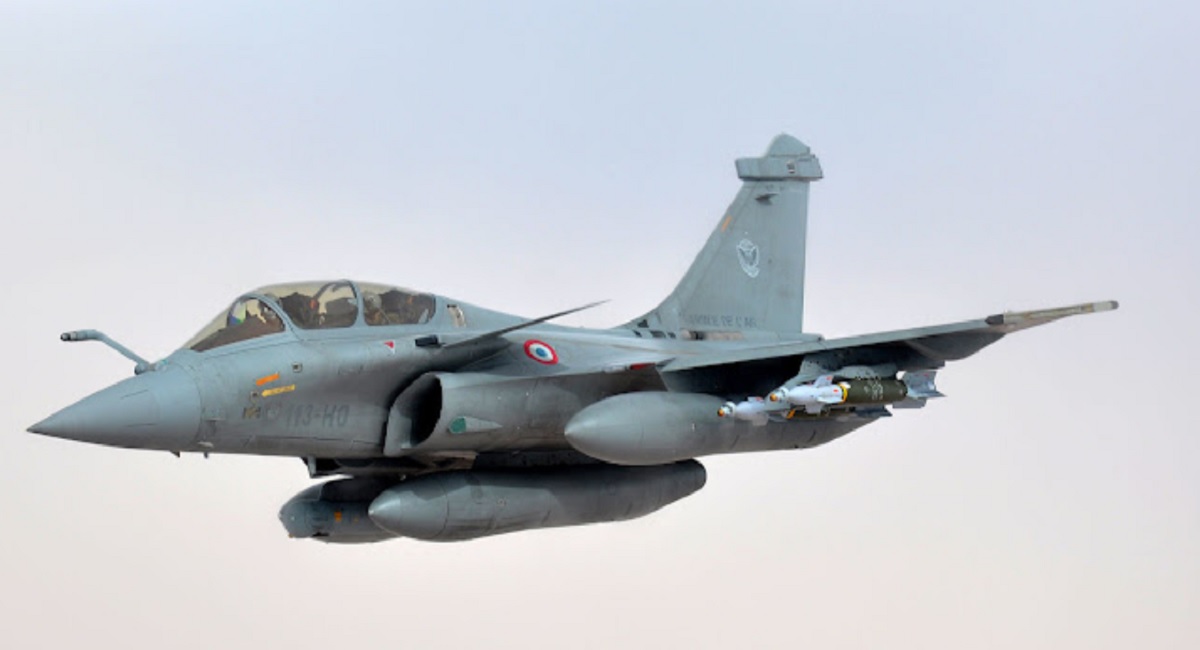
On November 17, the presidents of Ukraine and France signed a declaration of intent on defense cooperation, with one of the key points being the potential acquisition of a large fleet of Rafale multirole fighters – possibly up to 100 aircraft – by 2035. This makes it worthwhile to take a closer look at the aircraft.
TABLE OF CONTENT:
A Brief History
In 1975, France began research aimed at developing a tactical combat aircraft (Avion de Combat Tactique, or ACT). Analysis by French experts indicated that the lightweight Mirage 2000 – which had not yet flown – would remain competitive against emerging Soviet aircraft (future MiG-29 and Su-27, which also had not yet flown) through the late 1990s. At the same time, there was a recognized need to replace the strike aircraft Jaguar.
While the Mirage 2000 was designed primarily as an air-to-air fighter optimized for air defense, the ACT was intended primarily as a strike aircraft – not a pure bomber or attack aircraft, but a true multirole platform. The plan was to create a unified naval version, the Avion de Combat Marine (ACM). France, with only two small aircraft carriers, could not afford the American luxury of separate naval fighters and attack aircraft. The ACM was meant to replace three types of carrier-based aircraft: the F-8E(FN) Crusader fighters, the Super Etendard attack aircraft, and the Etendard IVP reconnaissance planes. As later events showed, prioritizing versatility proved to be the right choice.
In 1978, Dassault Aviation received two contracts from the French government to develop the ACT and ACM aircraft. The design adopted a canard configuration with fully pivoting forward horizontal stabilizers and a delta wing. A digital fly-by-wire control system was planned. The powerplant was to consist of two new SNECMA M88-2 turbofan engines. To test key design solutions, a demonstrator aircraft, the ACX – later called Rafale A – was built. Due to the initial unavailability of the M88-2 engine, Rafale A was equipped with American F404-GE-400 engines producing 7,015 kgf of afterburner thrust for early testing. Only in early 1990 was one M88-2 engine installed to replace the left F404 engine.

Read also:
- Milestone for Aviation Icon: 90 Years Since the First Flight of Hurricane
- Everything About the Bell AH-1Z Viper and UH-1Y Venom Helicopters: History, Specifications, and Prospects in Ukraine
Variants
In 1988, France approved the development of three production versions of the aircraft: the single-seat Rafale C and the two-seat Rafale B for the Air Force, as well as the single-seat Rafale M for the Navy. In April of the same year, the government ordered the Rafale C01 prototype, which took to the skies on 19 May 1991. Compared to the Rafale A demonstrator, it featured reduced dimensions and weight.
On 30 April 1993, the prototype of the two-seat Rafale B01 made its maiden flight. From the outset, it was viewed not so much as a trainer-combat variant but as a fully capable combat aircraft. In the end, the Rafale C/B combination embodied the same idea the Americans implemented with their pairing of the single-seat F/A‑18E and the two-seat F/A‑18F.
The need to modernize the French Navy’s carrier-based aircraft fleet was significantly more urgent than for the Air Force. As a result, development of the naval Rafale M proceeded at an accelerated pace. The Rafale M01 prototype made its first flight on 18 December 1991, and on 19 April 1993, it successfully completed its first carrier landing on the Foch.
The first production Rafale M began flight testing on 7 July 1999. A year later, it was delivered for operational evaluation to Squadron 12F, and in 2002, the carrier-based Rafale M was officially inducted into service. In contrast, the Air Force’s first Rafale squadron, EC 1/7, was formed only in the summer of 2006.
Over the 25 years since the Rafale entered service, the aircraft has undergone continuous evolution. This process has been formalized through the introduction of incremental standards, designated F1 through F4. Understanding the differences between these standards requires at least a general familiarity with the onboard avionics, as upgrades to these systems have been the primary driver of the aircraft’s development.
All Rafale variants are equipped with the Thales RBE2 multimode radar. Early F1-standard aircraft had a radar capable of engaging only aerial targets. In this configuration, the radar can track up to 40 targets and guide missiles against eight simultaneously. Armament was limited to medium-range MICA EM air-to-air missiles with radar guidance. Only 13 aircraft were delivered to this standard – 10 Rafale M, two Rafale B, and one Rafale C. The fleet aircraft were later upgraded to F3 standard.
F2-standard Rafales introduced the capability to detect stationary ground targets. The onboard suite was expanded with the OSF electro-optical system, which includes TV-laser and infrared modules, and the Link 16 data link system – the same system that was removed from F-16s transferred to Ukraine under U.S. requirements. Armament was extended to include MICA IR missiles with infrared guidance and precision-guided bombs. By 2008, the French armed forces had received 48 F2-standard aircraft, which were subsequently upgraded to F3.
F3-standard aircraft feature fully multimode RBE2-AA radars, and since 2013, the passive phased array antenna has been replaced with an active electronically scanned array (AESA). This upgrade increased detection range by at least 50%, to roughly 200 km, although precise radar and electronic warfare specifications remain classified. F3 Rafales can employ a wide array of air-to-surface weapons, including AASM guided bombs, tactical cruise missiles such as Apache and SCALP EG, AM-39 Exocet anti-ship missiles, and even ASMP-A nuclear-capable cruise missiles (excluding export variants). Notably, the Rafale was not initially designed to use unguided air-to-surface weapons; certification for these munitions was conducted only at the request of a foreign customer (Qatar).
The F3R standard introduced long-range Meteor air-to-air missiles to the Rafale’s armament. In 2023, the French Air Force received its first F4-standard aircraft, featuring more powerful M88-4 engines, avionics optimized for network-centric operations, a new electro-optical system, a helmet-mounted display, and new MICA NG missiles.
Read also:
- All about the “passenger attack” Cessna AC-208 Combat Caravan: an air‑defense variant?
- K-MAX Logistics Drone: An American Case Study
In France and Abroad
Around early autumn 2025, Dassault Aviation produced the 300th Rafale aircraft. The French Air Force operates approximately 100 aircraft, while the Navy has 41. In addition, Rafales are in service with five other countries, and three more are awaiting delivery under existing orders.
The first export success occurred in January 2012, when the Rafale won an Indian Air Force tender. The contract signed in January 2016 provided for the delivery of 36 aircraft – 28 single-seat Rafale EN and 8 two-seat DH variants. Deliveries took place between 2019 and 2022. In 2023, the Rafale M was selected as a prospective carrier-based fighter to replace the MiG-29K. In April 2025, an agreement was signed for the delivery of 26 aircraft (22 single-seat carrier-based Rafale MN and 4 two-seat land-based Rafale DH), scheduled for delivery by 2030. The Indian Air Force is also considering an additional purchase of 114 F4.1-standard aircraft. In May 2025, Indian Rafales participated in a conflict with Pakistan, conducting strikes with SCALP missiles and AASM bombs. On the night of May 6–7, one aircraft was reportedly shot down by a Pakistani J-10C fighter, although India officially denies the loss.
In February 2015, a contract was signed for the delivery of 24 aircraft to Egypt – 16 two-seat Rafale DM and 8 single-seat Rafale EM. To expedite delivery, the first six aircraft were converted from Rafale B units originally ordered by the French Air Force and nearing final assembly. The first three Rafale DM aircraft arrived in Egypt in July 2015, and the entire batch was delivered by 2018. In 2021, Egypt ordered an additional 30 F3R-standard Rafales (to compensate for a canceled Su-35S order). Some sources indicate that 31 aircraft may be delivered, with the extra unit intended to replace one lost from the initial order. The first aircraft from the second order was delivered at the end of 2024, and by the end of 2025, six aircraft had been received.
In May 2015, Qatar ordered 24 aircraft (18 single-seat Rafale EQ and 6 two-seat Rafale DQ). Over the next three years, the country purchased an additional 12 aircraft (9 single-seat and 3 two-seat). The full batch was delivered between 2018 and 2023.
Additional Customers:
- In August 2020, Greece ordered 18 F3-standard aircraft from France (12 single-seat Rafale EG and 6 two-seat Rafale DG), including 12 used aircraft. In 2022, Greece placed an additional order for 6 new F4-standard aircraft. The first order was completed by the end of 2023, and the second by January 2025.
- Croatia purchased used F3R-standard Rafales (10 single-seat and 2 two-seat). By the end of 2023, it had received the first three aircraft, and the full contract was completed by April 2025.
- The largest current contract is with the United Arab Emirates for 80 F4-standard aircraft (55 single-seat Rafale EU and 25 two-seat Rafale DU). The first aircraft was delivered on January 29, 2025, and the full order is expected to be completed by 2031.
- Indonesia ordered 42 F4-standard aircraft. The batch includes 26 single-seat and 6 two-seat aircraft (other sources indicate 30 and 12, respectively). The first Indonesian Rafale was completed in July 2025, and the first six aircraft are scheduled to arrive in Indonesia between February and April 2026.
- In August 2024, Serbia ordered 12 F4-standard aircraft (9 single-seat and 3 two-seat). The contract value is €2.7 billion, with the first aircraft expected to arrive in 2028.
For Ukraine
The agreement currently in place is only a memorandum of intent, outlining the potential delivery of up to 100 Rafale aircraft. The final number of French fighters to be delivered to Ukraine is not yet known. It can be assumed that deliveries would begin with a relatively small batch – perhaps a dozen – of used Rafales transferred from the French Air Force inventory. The French military-political leadership has previously authorized such transactions when deemed beneficial for France. This initial batch could arrive as early as next year. New aircraft, however, would require a waiting period of approximately four years, as indicated by the terms of the Serbian contract. Dassault Aviation is currently heavily committed with existing Rafale orders, even though production runs at about three aircraft per month.
The main remaining question is how Ukraine would finance these aircraft, as Rafales are expensive – over €200 million per unit for Serbia, for example. Another consideration is production localization. In practical terms, full assembly of Rafales (or Gripens) in Ukraine is unlikely. The maximum feasible option would be manufacturing certain components locally and supplying them to the assembly line in France, as has been implemented in India.
If all these challenges can be resolved and the Ukrainian Air Force acquires Rafales, combined with Gripens, they would form a capable fleet of 4+ generation combat aircraft – similar to the U.S. approach of pairing two fourth-generation fighters, the heavy F-15 and the lighter F-16.
The multirole capability of the Rafale would be particularly useful for Ukraine. While the aircraft was designed with a focus on strike missions, it retains air-to-air combat qualities. Its ability to employ a wide range of precision air-to-surface weapons – including both French and U.S.-produced guided bombs, as well as SCALP-EG cruise missiles – could allow the Ukrainian Air Force to gradually replace specialized strike aircraft such as Su-24M bombers and Su-25 attack aircraft.
Another important point, given the uncertainty of the current U.S. administration’s stance, is that among the three European fighters currently in production (Rafale, EF2000 Eurofighter, and Gripen), the French aircraft is the least reliant on American components. U.S. content in the Rafale is limited to a few percent – mainly parts of the M88 engine – whereas in the Gripen E/F it exceeds 50%, including the engine itself.
Read also: