The American military command conducted tests of Hornet drones in a strike role against targets simulating Chinese amphibious assault vehicles. The trials took place during the large-scale Balikatan 2026 exercises in the Philippines, held from April 20 to May 8. During the exercises, loitering munitions produced by Perennial Autonomy were used in live-fire scenarios. Their primary objective was to engage targets replicating the characteristics of ZBD-05 amphibious infantry fighting vehicles operated by the Chinese Marine Corps. According to available reports, the systems involved had previously been used in operational environments in Ukraine, and this experience is being evaluated by the United States for potential adaptation to security requirements in the Indo-Pacific region.

This version of the Hornet drones is reportedly capable of covering distances of over 96 km and is equipped with an AI-assisted guidance system, which is intended to improve resistance to electronic warfare measures. The system is launched using a pneumatic catapult, and its estimated unit cost is reported to range between $5,000 and $12,000, depending on configuration. Its deployment during the Balikatan 2026 exercises marked one of the first confirmed uses of this platform in the Indo-Pacific region.
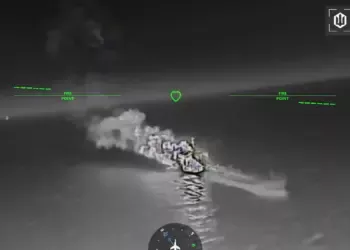
The joint U.S.–Philippines drills focused on modern naval warfare scenarios, including anti-landing operations and multinational force coordination. Released footage shows a strike against a target representing the ZBD-05 amphibious vehicle. The selection of this target is consistent with the exercise objectives, as the ZBD-05 plays a key role in rapid amphibious deployment, enabling forces to transition directly from sea to land combat. This suggests that the training scenarios were designed to reflect potential operational contingencies in the South China Sea region.
The company Perennial Autonomy, which developed the Hornet drones, has positioned itself as a producer of relatively affordable long-range systems whose software is designed to maintain operational effectiveness even in heavily contested electromagnetic environments. Due to its pneumatic launch method, the system does not require runways, enabling deployment from a wide range of locations. Dedicated algorithms are intended to support terminal guidance accuracy in scenarios where GPS signals may be jammed or spoofed by an adversary. The extended operational range is also intended to keep operators at a safer distance from enemy air defense coverage.
The financial aspects of the system remain partially unclear, as Perennial Autonomy does not publicly disclose pricing or detailed specifications. However, expert estimates suggest that a full package – including a ground control station, launch system, and five drones – may cost approximately $160,000. While these figures are not officially confirmed, the economic logic behind the system is generally considered clear: the cost of a single drone is significantly lower than the value of the targets it is designed to destroy, and it is also substantially cheaper than the interceptor missiles that might be used against it.
The deployment of Hornet drones at exercises in the Pacific is presented as a continuation of a broader strategy to field the system in multiple regions. According to available reports, U.S. forces previously tested the platform in Europe, including Poland, Germany, and Lithuania. This phased introduction is described as being enabled by prior operational validation in Ukraine. Open-source accounts suggest that Ukrainian forces used systems developed by Perennial Autonomy for long-range strike and surveillance tasks targeting key logistical routes connecting mainland Russia with occupied Crimea. In those contexts, the drones were reportedly used to engage vehicle columns at extended distances, disrupting supply chains and ammunition transport. Experience gained from long-range operations in Europe is now being evaluated for potential adaptation to coastal defense scenarios in the Asia-Pacific region.
The combination of long-range capability, AI-assisted targeting, communication noise mitigation, and relatively low cost positions the Hornet drones as a system intended to address roles that are difficult to cover with conventional munitions. High-precision missiles remain effective against high-value, discrete targets, but are generally not a cost-efficient solution for countering large-scale amphibious assaults over wide maritime areas. In contrast, a lower-cost autonomous drone capable of independently detecting and engaging amphibious vehicles under electronic warfare conditions represents a different operational approach to coastal defense. This shift is often discussed in analytical circles as a factor that could influence future planning assumptions in maritime security scenarios, including those considered by military analysts in the United States and China.
Read also:
- Everything About the Chaklun Jet UAV Designed to Intercept the “Geran-3”
- Weapons of Ukraine’s Victory: The “Shvidun” Interceptor Drone
Source: defence-blog