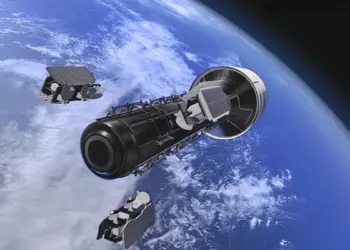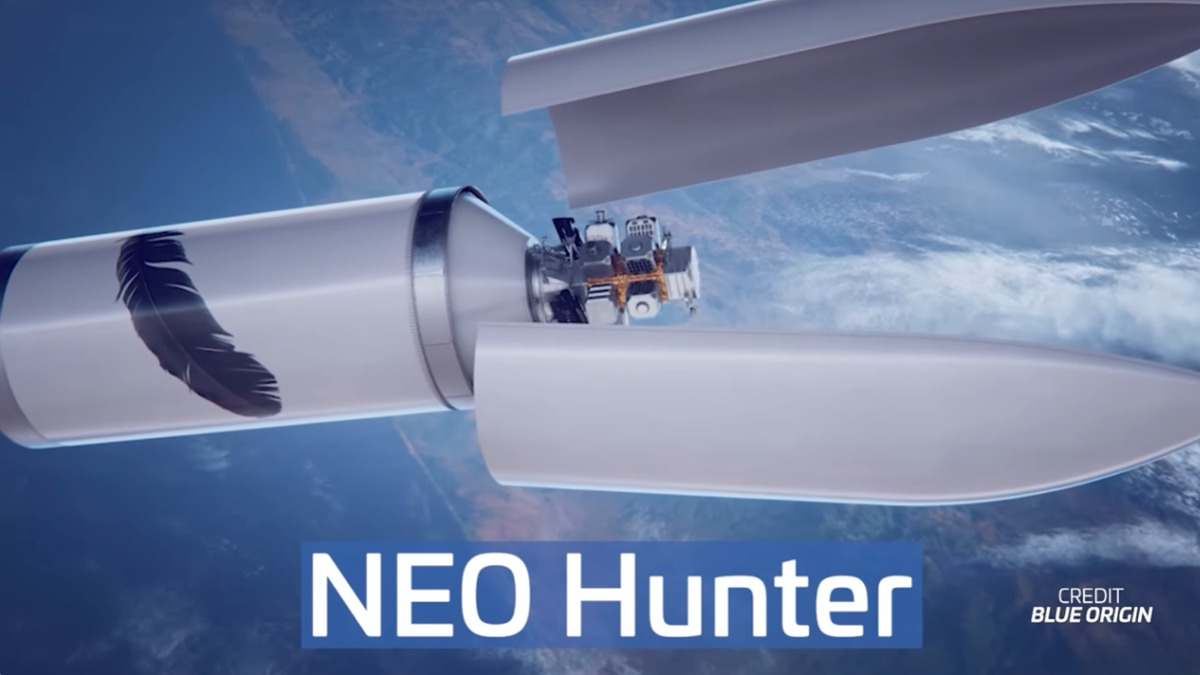
Blue Origin is developing an orbital ion beam system as part of the NEO Hunter project. The initiative is intended to support planetary defense by addressing potential threats such as asteroids and other near-Earth objects.
TABLE OF CONTENT:
Orbital Shield for Earth: How Blue Origin Plans to Track and Intercept Asteroids
While government space agencies continue to test planetary defense technologies cautiously, the private sector is pursuing faster and more ambitious approaches. Blue Origin has partnered with specialists from Jet Propulsion Laboratory and researchers at California Institute of Technology, effectively laying the groundwork for a new approach to space security architecture.
Read also: All About Starship V3: Technological Platform for the Next Spaceflight Era
The concept goes beyond a single mission or experiment, focusing instead on integrating planetary defense elements directly into general-purpose space platforms. At the center of this approach is the Blue Ring system, which is being developed from a “space tug” into a multifunctional node. It is intended to handle reconnaissance and logistics, and potentially serve as a platform for influencing or mitigating space-based threats.
 In this context, the NEO Hunter (Near-Earth Objects Hunter) concept emerges. Unlike simple monitoring of near-Earth objects, it represents a comprehensive approach that includes detailed scanning and early detection of asteroids, high-precision trajectory analysis, active methods for orbit deflection, and, in extreme cases, physical neutralization of the threat. Essentially, the system is designed not only to respond to hazards but also to anticipate and prevent them.
As previously noted, the Blue Ring system plays a central role in this architecture. It is a modular platform that already functions as a versatile tool for operations across various sectors of space. Its payload capacity of several tons, autonomy, and ability to operate across a wide range of orbits – from low Earth to geostationary – make it an ideal base for deploying additional systems.
Effectively, Blue Origin is aiming to create a “rapid-response infrastructure” in space. Currently, it serves as a cargo delivery and mission support platform, but in the future, it could become a potential component of a global planetary defense system.
The strategic implications are significant. If technologies capable of altering asteroid trajectories become integrated into commercial space platforms, the line between scientific missions and geopolitics begins to blur. In other words, humanity is approaching a point where the question shifts from “can we defend against an asteroid?” to “who will control that defense?”
Read also: Boeing CST-100 Starliner: Mission That Nearly Ended in Disaster
NEO Hunter: Precise Intervention in Asteroid Trajectories
What was until recently described as a theoretical model is gradually taking shape as a concrete operational framework within the NEO Hunter concept. According to Blue Origin, the planetary defense system is divided into two main phases: reconnaissance and active intervention. Importantly, despite sometimes sensational descriptions, the focus is not on “cyberweapons” but on physical measures to counter space-based threats.
In the first phase, the orbital platform deploys a swarm of small CubeSat satellites, serving as “forward reconnaissance” units. These satellites approach potentially hazardous asteroids and conduct a detailed analysis of critical characteristics, including mass, density, structure, and mineral composition. This data determines whether the object can be deflected or if more radical measures are required.
This phase addresses the central challenge of such missions: uncertainty. An asteroid is not a uniform body but a complex structure, and errors in assessing its composition could render any intervention ineffective – or even dangerous.
The second phase is more ambitious. If the asteroid’s properties allow, a directed-energy system – a conceptual “ion emitter” – is activated. Its operation is based on the same physical principles as ion propulsion systems used in current missions, such as Dawn.
There is, however, a fundamental difference. While ion engines generate thrust for the spacecraft itself, in NEO Hunter the stream of charged particles is directed at the asteroid’s surface. This produces a microscopic but continuous force that gradually alters its trajectory.
This is neither an impact nor an explosive approach. It is a slow, controlled “nudge” that can last weeks or even months, providing a key advantage: predictability. Instead of the risks associated with breaking an asteroid into uncontrolled fragments, the system allows it to be gently guided into a safe orbit.
NEO Hunter functions less like a weapon in the conventional sense and more as a tool for precise engineering intervention. If realized, it would provide humanity with a mechanism not just for observing space threats, but for methodically changing their course.
Read also: Mission Control: How Ukraine Is Building a Unified Digital Brain for Drone Warfare
Kinetic Strike to Protect Earth
But what if an asteroid is too large, too dense, or moving too fast for the delicate maneuvers of NEO Hunter to be effective? In that case, the system moves to a second, more radical phase: massive kinetic disruption. In simple terms, this involves a direct, high-impact collision with the object posing a threat to Earth.
If the threat is critical, NEO Hunter assumes the role of a space “interceptor.” The spacecraft would engage on a collision course, striking the target at speeds exceeding 36,000 km/h. This rapid, almost self-sacrificial maneuver requires absolute precision. Even here, the technology serves science: just before impact, a small satellite – aptly named Slamcam – would be deployed to capture the moment of contact, formally confirm mission success, and provide scientists with invaluable data for analysis.
NEO Hunter combines two strategies: delicate “nudging” and dramatic kinetic impact. Both operate within a unified planetary defense framework, where engineering precision and a bold demonstration of force complement each other. Humanity finally gains the ability not only to observe space threats but to actively manage them.
However, this project is not the only one being pursued by researchers worldwide.
Read also: Weapons of Ukraine’s Victory: High-precision APKWS II Missile
DART: Humanity’s First Success Against a Space Threat
The most significant breakthrough in planetary defense to date remains NASA’s DART (Double Asteroid Redirection Test) mission. In the fall of 2022, a spacecraft weighing just over half a ton intentionally collided with the asteroid Dimorphos, a small moon orbiting the larger body Didymos.
The mission had a highly pragmatic goal: to test whether a kinetic impact could effectively alter the trajectory of a celestial object. In practice, this meant adjusting the moon’s orbit just enough that even a small change could represent a meaningful step in planetary defense.
The result exceeded all engineering expectations. While a reduction of 73 seconds in Dimorphos’s orbital period was considered a significant achievement, the impact actually shortened it by an astonishing 33 minutes. This demonstrates that even a relatively small object can be influenced deliberately and predictably.
For humanity, this marked the first deliberate alteration of a celestial body’s motion in history. It provided strong evidence that the “kinetic impact” method can work in practice. DART not only confirmed the physical effectiveness of kinetic intervention but also laid the foundation for a new era of planetary defense, where precision, scientific calculation, and controlled force become key tools for protecting Earth.
Read also: Weapons of Ukraine’s Victory: TRIDON Mk2 Mobile Air Defence Systems from BAE Systems Bofors
OSIRIS-REx and Lessons for Planetary Defense
While the OSIRIS-REx mission gained fame for returning asteroid samples to Earth, its significance extends far beyond scientific collection. The project provided a foundation for early warning systems and strategies to defend against near-Earth objects. The probe targeted asteroid Bennu, a large body projected to pass dangerously close to Earth in the coming decades.
When the sample return capsule landed in the Utah desert at the end of 2023, scientists gained a crucial insight: Bennu is not a solid monolithic rock, but rather a loosely bound “rubble pile” held together primarily by its own gravity.
This knowledge provided a vital lesson for planetary defense. If a spacecraft or intervention system were to collide with such a porous object with significant force, the outcome could be unpredictable. The asteroid’s trajectory might remain largely unchanged, while it could fragment into thousands of smaller, equally hazardous pieces. In other words, the impact would be like dropping something into a large, fluffy snowdrift – dramatic but ineffective for planetary safety.
The conclusion is simple yet critical: understanding an asteroid’s internal structure is just as important as having the technology to influence it. Planning future planetary defense missions is impossible without an accurate picture of what these objects are made of. OSIRIS-REx demonstrated that science and planetary defense strategy go hand in hand, and this combination will be the foundation for the success of NEO Hunter and similar initiatives.
Read also: All About Lightweight Patrol and Counter-Drone Aircraft “Draco”: Reincarnation of Iconic “Vilga”
Hayabusa‑2: Japan’s Breakthrough in Asteroid Research
Before NASA’s DART demonstrated the effectiveness of kinetic impact, the Japan Aerospace Exploration Agency (JAXA) made a major leap in understanding asteroids and their response to external forces. As part of the Hayabusa‑2 mission, which targeted the distant asteroid Ryugu, a dramatic and high-risk experiment was conducted in 2019.
The spacecraft deployed a special impactor onto the asteroid’s surface, releasing a copper projectile at an astonishing speed of around 2 km/s. This created an artificial crater, giving researchers unprecedented access to pristine material buried beneath the surface layer.
But the significance of this experiment goes far beyond sample collection. It provided insight into how loose, porous asteroid material responds to sudden high-energy impacts – a critical factor for planetary defense. This knowledge helps predict the outcomes of attempts to alter the trajectory of potentially hazardous objects and avoid unpredictable fragmentations that could pose additional threats to Earth.
Hayabusa‑2 served as a kind of “training ground” for future missions like NEO Hunter, demonstrating that science and precise engineering can turn high-risk experiments into practical tools for planetary protection.
Read also: A-60 Aircraft: Soviet Dream of Laser Weapons in the Sky
Commercial Spacecraft Are Changing Planetary Defense
Representatives of Blue Origin emphasized in a post on X (formerly Twitter) that the NEO Hunter mission demonstrates how commercial space platforms like Blue Ring can carry out high-priority planetary defense tasks efficiently, without relying on large government budgets or extensive bureaucracy.
The topic of near-Earth object defense has increasingly come to the forefront of public discussion in recent years. Awareness has been driven both by real events, such as a meteorite striking a rooftop in Germany, and by regular reports of massive celestial bodies passing between Earth and the Moon. Society is gradually recognizing that space is not just a beautiful night sky, but a domain of real and tangible risks.
For decades, astronomers have been scanning the sky, compiling catalogs of objects that could potentially pose a threat. While no object currently requires immediate intervention, the mere existence of early warning systems and intervention technologies provides a measure of reassurance: when a critical moment arrives, we will not be completely defenseless.
Many people recall films like Armageddon, where the fate of the world depended on a drilling team armed with nuclear warheads. The reality of planetary defense is very different. It is precise, controlled, and – most importantly – already producing tangible results. Massive explosions and chaotic strikes remain in the realm of cinema; in space, it is science, engineering, and computational modeling that determine outcomes.
Reaching the stage of building spacecraft with ion cannons, like the NEO Hunter system, first required proving that we can physically alter an asteroid’s trajectory. Asteroid science is advancing rapidly, and the first successes are already evident – from orbital adjustments in missions like DART to precise modeling of impacts on large celestial bodies.
Today, we stand on the threshold of a new era: private companies are no longer just launching satellites for commercial or scientific purposes – they are creating infrastructure capable of genuinely protecting the planet.
NEO Hunter represents the first steps toward a world in which humanity can actively manage its own space security, rather than passively waiting for a threat to strike.
Read also: