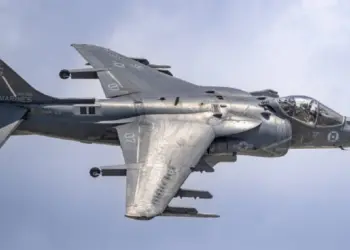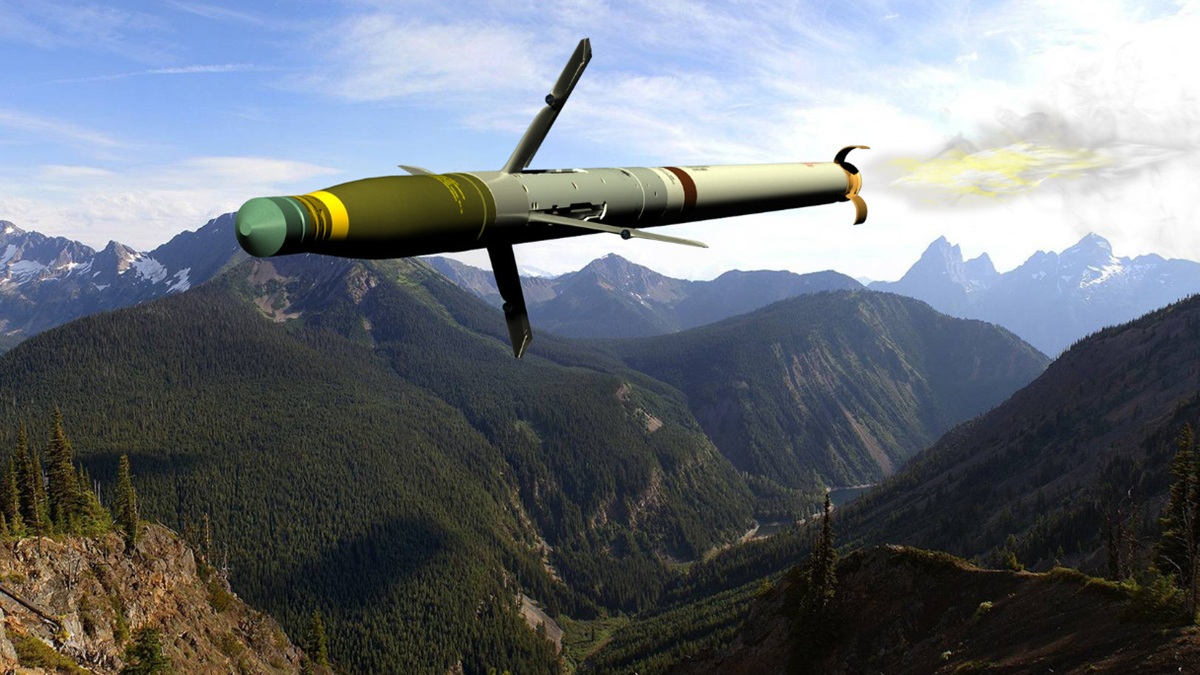
Today, we will discuss the APKWS II precision-guided rockets, which Ukrainian F-16s are employing against Russian drones.
In the context of the ongoing conflict in Ukraine, precision-guided munitions have become not just an advantage but a strategic requirement. One such system is the APKWS II rocket, which Ukrainian F-16 fighters are currently using to target Russian strike drones, such as the Shahed/Geran models.

This system has become a relatively low-cost option for countering large-scale drone attacks. The following analysis examines the system itself, its technical specifications, development history, and its specific operational relevance in the context of Ukraine.
Read also: Weapons of Ukraine’s Victory: TRIDON Mk2 Mobile Air Defence Systems from BAE Systems Bofors
TABLE OF CONTENT:
What APKWS II Is
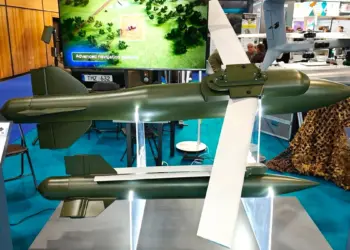
The APKWS (Advanced Precision Kill Weapon System) was developed by BAE Systems in collaboration with the U.S. government to provide a relatively low-cost, precision-guided munition. The system was designed not to create a new missile from scratch, but to upgrade the existing 70-mm unguided rocket with a laser guidance module. Essentially, it is a guidance kit installed between the warhead and the rocket motor, converting a standard munition into a precision weapon.
This approach integrates three primary attributes: affordability, accuracy, and versatility. Instead of deploying expensive, long-range air-to-surface missiles, armed forces gain a compact munition capable of engaging targets accurately at tactical distances. The system quickly demonstrated operational effectiveness and was deployed within U.S. armed forces – initially on helicopters, later on fixed-wing aircraft, and on certain unmanned platforms. Recently, Ukrainian F-16s have also received and successfully employed APKWS II rockets.
APKWS is employed against a wide range of targets, including lightly armored vehicles, various fortifications, fast attack boats, and aerial targets such as drones. The semi-active laser guidance allows the rocket to engage both stationary and moving targets. This capability is particularly relevant in modern conflicts, where operations often occur near civilian infrastructure.
The system also plays a notable role in close air support operations. APKWS enables the precise neutralization of specific enemy positions while minimizing collateral damage and reducing risk to friendly forces. The combination of accuracy, relative cost-efficiency, and operational flexibility has made APKWS one of the more significant upgrades in the tactical rocket segment over recent decades.
Read also: Mission Control: How Ukraine Is Building a Unified Digital Brain for Drone Warfare
Development History of APKWS II
The APKWS program was initiated in 2002 by the U.S. Army, during a period when high-tech warfare experience was already present but there was a need to make precision munitions more widely accessible. The goal was pragmatic: to develop a cost-effective precision weapon based on the existing 70-mm Hydra rockets already in service, rather than creating an entirely new missile.
The initial phase encountered more technical and cost-related challenges than anticipated, making the first version financially impractical. In 2005, the program was effectively relaunched as APKWS II with a revised concept. BAE Systems became the primary contractor, proposing an unconventional engineering solution: the laser guidance module would be installed in the midsection of the rocket, between the warhead and the motor. General Dynamics and Northrop Grumman also contributed, providing technological support and component integration.
Between 2007 and 2013, the system underwent extensive testing. Launches were conducted from AH-1, UH-1, and AH-64 helicopters, A-10 aircraft, and ground platforms. This period was intended to validate the “affordable, accurate, flexible” concept in operational conditions rather than theoretical demonstrations. The results demonstrated consistent target engagement, achieving a level of accuracy previously unexpected from a 70-mm rocket. The system’s ability to engage targets with minimal collateral effects aligned with the operational requirements of contemporary localized conflicts.
In 2012, APKWS II was used in combat for the first time in Afghanistan. The system demonstrated its capability as a precision support tool for ground units. Without excessive destructive power and without relying on expensive long-range missiles, it was able to engage targets accurately. In low-intensity conflicts, this represented an effective balance between operational performance and cost.
However, the system experienced a notable resurgence in 2020–2021. The widespread use of drones prompted military forces to seek solutions against small, maneuverable, and relatively inexpensive aerial targets. During testing, the rockets successfully engaged Class 2 drones traveling at speeds exceeding 100 miles per hour. In effect, APKWS II became a cost-effective and mobile component of counter-UAS (C-UAS) operations.
Originally conceived as a practical upgrade to existing munitions, the system evolved to address one of the key threats of the 21st century. The development of APKWS demonstrates how engineering solutions can sometimes be more effective than pursuing entirely new weapon concepts. Rather than designing a new system, adapting existing technology for smarter performance proved sufficient.
Read also: Weapons of Ukraine’s Victory: The Heavy Cruise Missile “Flamingo”
Orders and International Use
Following the completion of major testing, APKWS II gradually moved beyond a purely domestic U.S. program and began to establish an export presence.
In 2014, the Hashemite Kingdom of Jordan became the first foreign customer. The system was integrated on light transport-attack aircraft, specifically the CASA-235, enhancing their strike capability without the need to procure expensive long-range guided missiles. Jordan’s adoption demonstrated that APKWS can provide a precision capability that is cost-effective for nations with constrained defense budgets.
Between 2015 and 2016, the U.S. employed APKWS II extensively in operations in Iraq and Afghanistan. The rockets were deployed from both helicopters and fixed-wing aircraft, including F-16s and A-10s. These deployments validated the system as a fully operational weapon rather than solely a supplementary tool.
In 2017, production contracts were extended to meet growing domestic and international demand. The appeal of APKWS II was straightforward: it fills the gap between inexpensive unguided rockets and costly long-range precision munitions.
The program reached a milestone in 2019 with the signing of a $2.68 billion IDIQ (indefinite delivery/indefinite quantity) contract, enabling long-term and effectively open-ended deliveries. This decision confirmed that APKWS II had become an integral part of the U.S. armament structure and that of partner nations.
Design and Operating Principle of the APKWS II
As previously noted, APKWS II (Advanced Precision Kill Weapon System II, also designated AGR-20) is a 70-mm (2.75-inch) precision-guided rocket developed by upgrading the standard unguided Hydra 70 family. The primary concept is to use a guidance module to convert an inexpensive, mass-produced unguided rocket into a precision munition with semi-active laser guidance, while maintaining compatibility with existing launch platforms and minimizing overall costs.
The APKWS II rocket consists of three primary components assembled in sequence. The warhead section may use the standard 10-pound (approximately 4.5 kg) M151 high-explosive fragmentation warhead or the upgraded M152 variant with an improved fuze. A multi-purpose M282 warhead is also available, designed to engage lightly armored targets and incorporating HEAT (high-explosive anti-tank) elements. Other compatible warheads from the Hydra 70 family can also be integrated, depending on mission requirements.
Various fuzes are employed depending on mission requirements. These range from the standard M423 point-detonating fuze to the more advanced MK435 variant, which offers improved reliability and, in certain configurations, programmable functionality. Some newer versions have been tested with proximity fuzes intended for engaging aerial targets, including drones.
The rocket motor is the standard MK66 Mod 4 solid-propellant motor used in unguided Hydra 70 rockets. It provides a velocity of up to approximately 1,000 m/s (around Mach 3). Launch range depends on the platform: from helicopters, it typically exceeds 1.1–5 km, while from fixed-wing aircraft it can reach 11–12 km. Enhanced guidance configurations may extend the effective range by up to approximately 30 percent.
The central feature of the system is the DASALS (Distributed Aperture Semi-Active Laser Seeker) guidance unit. Instead of relying on a single forward-mounted sensor, the system employs multiple laser receivers distributed circumferentially around the guidance module. This configuration improves target acquisition geometry and reduces sensitivity to angular misalignment during engagement.
This approach provides several advantages. Primarily, it improves resistance to rocket spin in flight and enhances the accuracy of laser reflection tracking. This enables the precision-guided rocket to engage moving targets while minimizing blind spots.
In essence, DASALS allows an unguided rocket to be converted into a guided munition without significant modification to its basic structure. In other words, it delivers maximum effect with minimal structural changes.
The operating sequence can be summarized as follows:
-
The rocket is launched in the same manner as a standard unguided Hydra 70, using a lock-on after launch principle.
- Approximately 0.5 seconds after launch, four control wings deploy.
- Each wing contains high-sensitivity optical elements (DASALS optics), which transmit data via fiber-optic channels to the guidance processor.
- The system monitors a wide forward field of regard and detects laser energy reflected from the designated target.
-
Once the laser designation is acquired, the rocket adjusts its trajectory through aerodynamic control of the wings.
-
Reported accuracy is a CEP (circular error probable) of less than approximately 0.5–1.0 meters, enabling engagement of point targets, including in densely built environments.
This engagement architecture makes APKWS II suitable for use against lightly armored vehicles, fortified positions, fast-moving small targets, and modern strike unmanned aerial systems.
Read also:
- All About Starship V3: Technological Platform for the Next Spaceflight Era
- Boeing CST-100 Starliner: Mission That Nearly Ended in Disaster
APKWS II Specifications
- Diameter: 70 mm (2.75 inches)
- Total rocket length: 1.87 m (73.8 inches); guidance section – 47 cm (18.5 inches)
- Wingspan: 24.3 cm (9.55 inches)
- Weight of complete missile: ~14.5-15.0 kg (32-32.6 lb); guidance section – ~4.4 kg (9.8 lb)
- Maximum speed: up to 1000 m/s (~Mach 2.9)
- Firing range: from a fixed wing (F-16, A-10) – 2-11 km (up to over 12 km in some configurations); from helicopters – 1.1-5.0 km
- Warhead: M151 or Mk152 (4.5 kg of explosives), or penetrating M282; other options are possible
- Engine: standard Mk66 Mod 4
- Guidance: semi-active laser DASALS (Distributed Aperture Semi-Active Laser Seeker) with distributed aperture – four optical sensors in the wings
- Accuracy: CEP less than 1 m (in tests – hits within tens of centimeters)
- Cost: guidance kit ~$15-20 thousand, complete missile – $25-35 thousand (3-4 times cheaper than AIM-9X or AIM-120)
The rocket is compatible with standard LAU-131 (seven-round) and LAU-68/61 launchers. An F-16 can carry up to approximately 28–42 such rockets, depending on the configuration and hardpoint arrangement. This loadout enables a single aircraft to counter mass drone attacks without expending more costly air-to-air missiles.
Read also: Weapons of Ukraine’s Victory: Magic 2 Air-to-Air Missile
Deliveries and use in Ukraine
Deliveries of APKWS II to Ukraine by the U.S. and allied countries began in 2022. Initially, the precision rockets were deployed in ground-based VAMPIRE systems (L3Harris) mounted on Humvee chassis – four-barrel launchers with laser guidance. In May 2023, the first recorded uses against Shahed drones appeared. In January 2025, a VAMPIRE system successfully intercepted a Russian Kh-59 cruise missile over the Black Sea.
Aviation deployment saw a breakthrough at the end of 2025. In December 2025, Ukrainian F-16s were observed carrying APKWS II on LAU-131A/A pylons, paired with the AN/AAQ-33 Sniper targeting pod. Norway, as part of its F-16 assistance package (approximately 1 billion Norwegian kroner), funded the delivery of these rockets specifically for a counter-UAS role. The United States also provided APKWS II through assistance packages via SDAF and direct contracts with BAE Systems.
The first recorded combat use of APKWS II from an F-16 occurred on February 17, 2026. During a nighttime engagement, a Ukrainian fighter intercepted a Russian Shahed/Geran drone using an APKWS II rocket. Infrared footage from the Sniper targeting pod shows the rocket accurately tracking the target. A single F-16 can now carry up to 28 APKWS II rockets, enabling multiple interceptions per sortie compared with 6–8 more expensive AIM-120 missiles.
Read also: Everything About the P1-Sun – SkyFall’s Ukrainian Interceptor Drone
Why this is critically important for Ukraine
The conflict has increasingly become a matter of arithmetic. Russia launches hundreds of Shahed-type strike drones each month, with an estimated unit cost of $20–50 thousand. These are often countered with AIM-120 missiles, which cost over a million dollars each. This cost imbalance creates a strategic trap: a relatively inexpensive drone forces the expenditure of a costly missile, giving the adversary an economic advantage even if the target is destroyed.
APKWS II addresses this imbalance by providing a lower-cost means to intercept aerial threats. The system allows high-value missiles to be preserved for more demanding targets, such as Russian Su-34 aircraft, Kalibr cruise missiles, or Kinzhal aeroballistic weapons. In effect, APKWS II restores cost-efficiency and logical prioritization within Ukraine’s air defense system.
APKWS II also changes the operational approach to countering mass attacks. Lower-cost munitions are used against large numbers of inexpensive targets, while high-value missiles are reserved for costly platforms and strategic threats. This optimizes expenditure without reducing effectiveness. In a war of attrition, this is critical – victory depends not only on having weapons but on sustaining their use over months and years.
Another key factor is precision combined with a relatively small warhead. When drones target cities, infrastructure, or energy facilities, minimizing collateral damage is essential. Precision guidance reduces the risk to residential areas and critical assets, making this not only a tactical consideration but also a measure of civilian protection.
With APKWS integration on F-16s, Ukrainian aviation gains a tool for economically and efficiently intercepting large numbers of drones. Aircraft previously associated primarily with air-to-air combat or strikes against ground targets can now operate effectively as counter-drone platforms.
The APKWS II precision rocket represents more than just a weapon; it shifts the balance of power on the battlefield. Its use against Russian drones and other targets demonstrates how modern technology can enhance national defense and operational effectiveness. The system illustrates that accuracy and flexibility can outweigh sheer numbers, and that integrating precision munitions into military operations is increasingly critical for achieving success.
Read also: