A video has recently emerged showing, for the first time, a Ukrainian Air Force F-16 fighter deploying Advanced Precision Kill Weapon System II (APKWS II) guided rockets against a Russian unmanned aerial target. The likely target was a Geran-type drone. The released clip is an infrared recording from a Sniper targeting pod, which provided laser guidance for the munitions.

This provides further confirmation of the active use of F-16s in countering unmanned aerial threats. Earlier, unofficial ground footage circulated showing a Ukrainian F-16 destroying a Russian Geran drone with its M61 Vulcan cannon.
At the same time, Russian drones have undergone upgrades, including the integration of short-range R-60 air-to-air missiles with infrared guidance, as well as portable Verba man-portable air-defense systems.
Persistent threats have led both Ukraine and Russia, in 2024–2025, to adapt Yak-52 trainer aircraft for drone countermeasures. Additionally, Ukrainian Mi-8 helicopters are employing door-mounted machine guns to intercept Geran drones.
APKWS II missiles were first observed on a Ukrainian F-16 in December 2025, but the newly released video provides the first confirmed evidence of their use in actual aerial combat. Meanwhile, the ground-based VAMPIRE system, mounted on Humvees and pickup trucks, had previously been employed to counter Shahed-type drones.
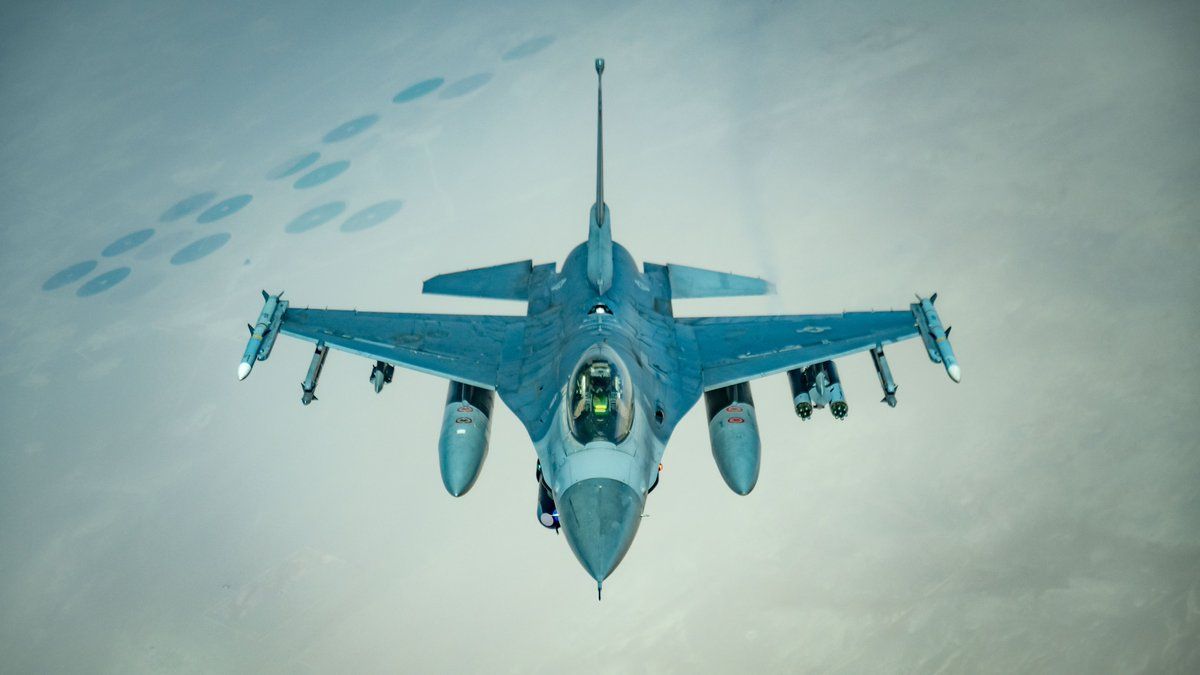
In the December 2025 imagery, a Ukrainian Air Force F-16 – likely preparing to land with its landing gear deployed and airbrakes extended – was carrying one LAU-131A/A missile pod under each wing. These seven-round pods were mounted on triple racks, allowing up to three pods per wing.
Within the U.S. Central Command area of responsibility, F-16 fighters have been flying with APKWS II missiles for over a year. At least two seven-round LAU-131A/A pods have been observed on these aircraft. Reports also indicate tests of a six-pod configuration, providing a total loadout of 42 missiles. However, that demonstration appears to have been conducted on the ground, primarily to practice procedures for ground crews in the event of deploying an increased APKWS II load under high-threat conditions.
The AGR-20 APKWS II is a modification of the unguided Hydra 70 rocket, enhanced with a laser guidance module. The system is configured with a 10-pound high-explosive warhead at the front and an Mk66 Mod 4 rocket motor at the rear, converting the Hydra 70 into a precision-guided munition. The guidance section contains optical laser receivers mounted on four foldable fins, providing a wide field of view and enabling engagement of both moving and stationary targets.
A second key upgrade is the software variant designed for counter-drone operations – AGR-20F FALCO (Fixed Wing, Air Launched, Counter-Unmanned Aircraft Systems Ordnance). This version is actively used against drones as a cost-effective alternative to much more expensive AIM-120 AMRAAM and AIM-9 Sidewinder missiles, which cost approximately $450,000 and over $1 million each, respectively. In comparison, a single APKWS II missile is estimated at around $30,000.
In April 2025, APKWS II developer BAE Systems introduced the Advanced Precision Kit (APK) for 70 mm Hydra rockets, adding an infrared seeker alongside the existing laser guidance to create a dual-mode system. This upgrade allows pilots to engage targets without maintaining continuous laser illumination, enabling faster transition to other tasks. The company described this as the next stage in the system’s evolution.
In December 2025, BAE Systems announced a contract with the U.S. Navy for APKWS II deliveries valued at $1.7 billion. Customers include the Special Defense Acquisition Fund (SDAF), as well as the U.S. Air Force, Army, Navy, and several international partners. Given that the SDAF has previously been used to supply weapons to Ukraine, it is expected that a portion of these future deliveries could be directed there.
Read also:
- U.S. Army Tests Drone Equipped with “Invisible Weapon” Capable of Disabling Swarms Without Explosives
- Ukrainian Defense Forces Conducted Drone and Missile Strikes on Infrastructure at the Kapustin Yar Test Range
Source: theaviationist