In the United Kingdom, the first flight of the autonomous Proteus helicopter, capable of carrying over one ton, has been completed. This development marks a new phase in aviation, demonstrating that autonomous flight is becoming a practical reality. Proteus operates under artificial intelligence, reducing risks to crew members by removing the need for onboard human control. The helicopter was developed by Leonardo Helicopters UK, the British division of the Italian aerospace company Leonardo, in close collaboration with the UK Ministry of Defence and the Royal Navy. This partnership between engineers and military authorities enabled the transition from a conceptual autonomous helicopter to a fully operational aircraft capable of independent flight.
Read also: MQM-172 Arrowhead: Overview of a Versatile Loitering Munition Drone
TABLE OF CONTENT:
Origins of the Project and Its Objective
The concept of Proteus emerged from the need for autonomous rotary-wing aircraft in maritime and defense operations. The project aimed to develop a helicopter capable of performing missions traditionally handled by manned aircraft, particularly in high-risk or extended-duration scenarios.

The project initially began as a research demonstrator, designed to test computer control algorithms, navigation sensors, and an AI-based decision-making system. Over time, Proteus evolved into a full-scale autonomous helicopter, illustrating that unmanned rotary-wing systems can perform tasks at the level of manned aircraft.
Read also: All About Project Suncatcher: Google’s Space Experiment
Flight History and Testing
In January 2026, UK aviation reached a notable milestone with the first flight of the fully autonomous, full-scale Proteus helicopter in Cornwall. The event attracted immediate attention within the aviation community, as the aircraft represents a standard-size helicopter capable of performing complex flight operations without an onboard pilot, rather than an experimental drone or scaled demonstrator platform.
For the first time in UK aviation history, a full-scale helicopter independently took off, completed a flight program, and safely concluded its mission relying entirely on onboard computational systems. During the test flight, Proteus performed takeoff, altitude gain, maneuvering, position holding, course correction, and speed control without any human intervention. All critical systems – including navigation, stabilization, environmental analysis, and obstacle avoidance – operated in real time and in coordination, demonstrating the platform’s readiness for practical deployment.
The Proteus project has deeper roots. It was officially introduced in 2022 by Leonardo’s UK division as a potential foundation for the next generation of autonomous helicopters. From the outset, the program was intended not as an experiment but as a functional flight platform suitable for integration into military and civilian operations. Between 2023 and 2025, the system underwent ground testing, autonomous algorithm development, and simulation exercises, ultimately leading to a fully autonomous flight in 2026.
The tests in Cornwall represented the culmination of several years of work by engineers, software developers, and flight specialists. They not only demonstrated the technical capabilities of Proteus but also provided practical evidence that autonomous helicopters can now perform tasks at the level of manned aircraft. Applications include reconnaissance, patrol, maritime operations, logistics, and missions in high-risk areas where crew presence is undesirable or unsafe.
The 2026 flight of Proteus therefore marked more than a routine test; it represented a turning point for UK aviation. It signaled the transition from the concept of a “unmanned future” to a reality in which full-scale autonomous helicopters function as operational tools in both defense and civilian contexts, opening a new phase in the development of vertical-lift aviation.
Read also: Weapons of Ukrainian Victory: Multi-Purpose Helicopter UH-60 / S-70A Black Hawk
Design and Technical Innovations
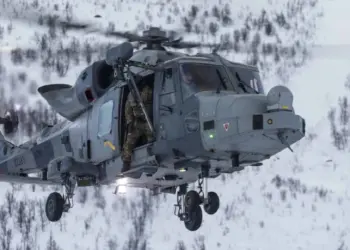
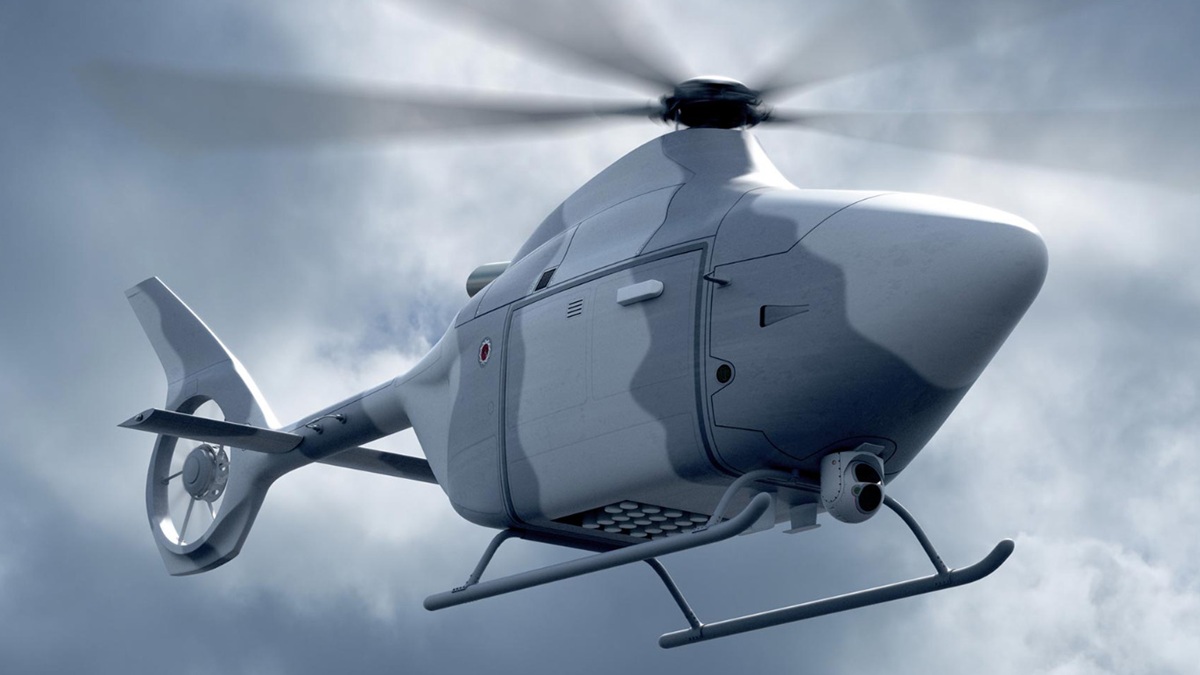
At first glance, the autonomous Proteus helicopter closely resembles a modern medium-sized rotorcraft, featuring a streamlined fuselage, a robust rotor system, and clean structural lines indicative of advanced engineering. However, it quickly becomes apparent that this is not a conventional aircraft. There is no pilot cabin; instead, the space is occupied by an integrated suite of computational modules, artificial intelligence processors, and multi-layered sensor systems. These systems function as the helicopter’s “eyes,” “ears,” and “brain,” enabling Proteus to navigate autonomously, analyze its surroundings, anticipate developments, and make real-time decisions without human intervention.
The sensor suite includes optical and infrared cameras, radar and LiDAR rangefinders, as well as navigation systems that provide precise positioning even in challenging conditions – such as low visibility, over open water, or in mountainous terrain. This allows Proteus not merely to follow a pre-programmed route but to continuously adapt to changing conditions: avoiding obstacles, adjusting altitude and speed, and responding to weather factors and unforeseen threats.
The helicopter’s airframe is constructed from advanced composite materials, combining low weight with high strength and damage resistance. This design enhances flight performance while reducing radar and thermal signatures, which is particularly important for specialized or military operations. The internal fuselage architecture is modular, allowing Proteus to be quickly reconfigured for different missions, ranging from reconnaissance and patrol to payload transport or installation of specialized equipment.
The rotor system, composed of multiple high-efficiency blades paired with a shrouded tail rotor, significantly enhances both aerodynamic performance and operational safety. The enclosed design reduces the risk of damage during low-altitude flights, operations near structures, or in confined spaces, while also lowering noise levels, making the helicopter less conspicuous. Together, these features provide Proteus with exceptional stability in challenging weather conditions, precise maneuvering capabilities in tight areas, and the ability to conduct long-duration or high-risk missions autonomously.
Proteus is therefore more than just an unmanned helicopter; it represents a full-scale, next-generation autonomous platform capable of operating in environments where human presence is unsafe, inefficient, or impractical. It embodies the transition from traditional aviation to intelligent aerial systems, where algorithms, adaptability, and fully autonomous operation are central to mission execution.
Autonomy and Digital Technologies
One of Proteus’s key innovations is the use of a digital twin – a virtual replica of the helicopter. This system allows for the simulation of various flight scenarios, testing of all onboard systems, and prediction of the aircraft’s response to complex conditions before conducting real-world trials.
The autonomous Proteus helicopter is capable of fully independent flight: it not only follows a planned route but also selects optimal trajectories in real time, avoids obstacles, and adapts to unexpected conditions. This capability makes it particularly suitable for operations in maritime and remote areas, where risks to crew members are especially high.
Read also: K-MAX Logistics Drone: An American Case Study
Functions and Capabilities
Proteus is designed to carry out complex and high-risk missions. The autonomous helicopter is engineered to perform tasks that have traditionally required manned aircraft and highly trained crews. Its design and intelligent systems enable fully autonomous operation, allowing it to complete missions with efficiency and safety. The helicopter’s capabilities span a wide range of applications, from defense operations to humanitarian support, positioning it as a versatile tool in modern aviation.
A key function of Proteus is maritime monitoring and ensuring safety at sea. The helicopter is equipped with advanced sensor systems capable of detecting underwater objects and tracking vessel movements over considerable distances. Proteus can autonomously patrol designated areas, collecting real-time data and transmitting it to operators for strategic analysis.
Its autonomy also allows for extended missions requiring continuous monitoring and precise execution, such as patrolling high-risk zones for naval vessels or detecting underwater threats. In addition, Proteus can be integrated with existing anti-submarine systems, facilitating coordination between autonomous platforms and conventional military assets, thereby enhancing the overall effectiveness of defense operations.
Proteus serves as a critical tool for reconnaissance and surveillance over both land and sea. Its comprehensive sensor suite – including high-resolution cameras, radar, and LiDAR – enables detailed monitoring of areas even under challenging weather conditions or at night.
The helicopter can autonomously identify objects, track their movement, and analyze collected data to build a complete situational picture. This capability supports strategic planning, timely responses to potential threats, and the monitoring of key infrastructure. Proteus allows for reconnaissance over greater distances and with lower risk to personnel compared to traditional manned aircraft.
Another important function of Proteus is cargo delivery to hard-to-reach areas. Its modular payload compartment can transport equipment, materials, and humanitarian supplies to regions where using manned helicopters would be hazardous or impractical.
Proteus is capable of autonomously following routes, delivering cargo to specified coordinates, and returning to base without human intervention. This capability is particularly valuable for crisis response, humanitarian aid, or operational support of military units in remote areas. The helicopter’s autonomy enables missions to be conducted quickly, efficiently, and without risk to crew, making logistics safer and more reliable.
As a result, Proteus functions as a versatile platform capable of performing tasks that previously required human crews and significant resources. Its autonomous systems reduce risks to personnel, enhance operational efficiency, and provide continuous monitoring in challenging conditions.
Proteus demonstrates how modern technologies can integrate autonomy, safety, and operational functionality, establishing a new standard for executing complex aviation tasks. Its capabilities span defense operations to humanitarian support, making it a valuable asset for future missions in both peacetime and crisis scenarios.
Read also: Weapons of Ukraine’s Victory: Tempest Air Defense System with AGM-114L Longbow Hellfire Missiles
Strategic Significance
Proteus is more than a technological experiment; it represents a new era in aviation, where autonomous systems operate alongside humans and manned aircraft to enhance efficiency and safety.
The helicopter is capable of conducting extended missions, performing reconnaissance, providing logistical support, and participating in military operations without placing a crew at risk. This paves the way for a new generation of rotary-wing platforms that integrate artificial intelligence, digital modeling, and advanced engineering solutions.
Proteus, developed by Leonardo Helicopters UK, represents a significant advancement in autonomous aviation, demonstrating the potential of combining innovative technologies with human engineering expertise. It redefines the concept of helicopters, transforming them from manned aircraft into intelligent autonomous systems capable of operating in some of the most demanding conditions of the modern world.
Proteus stands as a symbol of the emerging future of aviation, where humans and machines work in tandem, and traditional risks and routine tasks are increasingly managed by autonomous systems.
Read also: